• IP addresses are NOT logged in this forum so there's no point asking. Please note that this forum is full of homophobes, racists, lunatics, schizophrenics & absolute nut jobs with a smattering of geniuses, Chinese chauvinists, Moderate Muslims and last but not least a couple of "know-it-alls" constantly sprouting their dubious wisdom. If you believe that content generated by unsavory characters might cause you offense PLEASE LEAVE NOW! Sammyboy Admin and Staff are not responsible for your hurt feelings should you choose to read any of the content here.

    The OTHER forum is HERE so please stop asking.

CNA YOUTUBE- A degree used to mean job security.

joemartini

Alfrescian
Loyal
Joined
May 31, 2024
Messages
753
Points
63


Read the comments in youtube.

just wait.
all the jobs cannot sustain...FT, CECA, and now AI..
end up all the debts cannot sustain.
condo loans, million dollar HDB loans, car loans, credit card debts
things will start to domino and collapse.
even CECA losing their jobs in US, and hopefully kena here also.

AI should replaced all the JLB, deadwood in the civil service also.
if CECA here got no jobs, can deploy all the CECA into the civil service, and retrenched all the fucking useless PAP-voting civil servants.

5Cs - car, condo, credit card, country club, career
5Bs - mercedes Benz, own a Bank, BMW, Bungalow, own Business

those who voted for PAP, where are your 5Cs and 5Bs????? and your so-called Singapore dream?
where is the Swiss standard of living where???

I looking forward to 5Ds.
5Ds - Debts, Depression, Divorce, Destitution, Death.


Read the comments in youtube.

just wait.
all the jobs cannot sustain...FT, CECA, and now AI..
end up all the debts cannot sustain.
condo loans, million dollar HDB loans, car loans, credit card debts
things will start to domino and collapse.
even CECA losing their jobs in US, and hopefully kena here also.

AI should replaced all the JLB, deadwood in the civil service also.
if CECA here got no jobs, can deploy all the CECA into the civil service, and retrenched all the fucking useless PAP-voting civil servants.

5Cs - car, condo, credit card, country club, career
5Bs - mercedes Benz, own a Bank, BMW, Bungalow, own Business

those who voted for PAP, where are your 5Cs and 5Bs????? and your so-called Singapore dream?
where is the Swiss standard of living where???

I looking forward to 5Ds.
5Ds - Debts, Depression, Divorce, Destitution, Death.

When u see a fishball noodle coat rocketed from $2 in 2000 to $6 in 2026…I know we are really really in Good Hands - No Horse Run :)
 
Generative artificial intelligence could reshape the jobs of nearly 80 million workers across ASEAN, but there is little evidence so far that it has caused widespread job losses, according to a new report by the International Labour Organisation (ILO).

Singapore has the region's highest share of AI-exposed jobs, with 42.2 per cent of its workforce employed in occupations that could be affected by generative AI, while also ranking first in AI preparedness because of its strong digital infrastructure, skilled workforce and coordinated national strategy.

Across ASEAN, 22.9 per cent of workers are employed in occupations with some level of AI exposure, although only 3.3 per cent, or 11.7 million workers, fall into the highest-risk category.


The ILO said employment in AI-exposed occupations has continued to grow since 2017, suggesting the technology is reshaping work rather than replacing workers on a large scale, despite AI-related job cuts announced by companies such as Shopee and Meta.

Analysts identified financial analysts, multimedia developers and financial brokers among the occupations most exposed to AI, while noting that productivity gains will depend on investments in skills, human capital and supportive public policies.

The organisation urged governments to strengthen AI governance, expand upskilling and reskilling programmes, and help businesses and workers adapt, arguing that future labour market outcomes will be determined more by policy choices than by AI exposure alone.
https://sg.news.yahoo.com/live/sing...million-asean-jobs-face-change-011226189.html
 

Singapore best prepared as AI transforms jobs across ASEAN, says ILO​

Singapore has the region's highest AI job exposure and preparedness as the ILO says generative AI is changing work rather than eliminating jobs. (Photo: Getty Images)

Singapore has the region's highest AI job exposure and preparedness as the ILO says generative AI is changing work rather than eliminating jobs. (Photo: Getty Images)
M


Generative artificial intelligence could reshape the jobs of nearly 80 million workers across ASEAN, but there is little evidence that it has triggered large-scale job losses, according to a new report by the International Labour Organisation (ILO). Singapore stands at the centre of the transition, recording the region's highest share of AI-exposed jobs at 42.2 per cent of total employment while also ranking first in AI preparedness because of its advanced digital infrastructure, skilled workforce and whole-of-government strategy.

According to the ILO, 22.9 per cent of ASEAN's workforce – equivalent to nearly 80 million workers – is employed in occupations where generative AI could automate or augment at least some tasks. However, only 3.3 per cent, or 11.7 million workers, are in occupations with the highest AI exposure, while about 67 per cent of jobs across the region show no identifiable AI exposure. Employment in highly exposed occupations has continued to grow since 2017, indicating AI is transforming work more than replacing workers, according to reports citing the ILO study,

The ILO report identifies financial analysts, multimedia developers and financial brokers among the occupations most exposed to AI-driven change. Although companies including Sea's Shopee and Meta have announced AI-related workforce reductions, the ILO found no evidence that these isolated cases have resulted in widespread labour market disruption across Southeast Asia.

The ILO said generative AI can improve productivity in individual tasks, but those gains have yet to translate into measurable increases in employment or economy-wide productivity. Lead author Christian Viegelahn said productivity gains will depend on investments in human capital and social protection, adding that future labour market outcomes will be shaped more by policy choices than by AI exposure alone.

The report also highlights uneven AI readiness across ASEAN. While Singapore leads the region, the Philippines, Indonesia, Vietnam and Thailand follow in workforce exposure, and women remain more than twice as likely as men to work in occupations with high AI exposure because of their concentration in clerical, administrative and professional roles.

The ILO called on governments to strengthen human-centred AI governance, expand upskilling and reskilling programmes, support small businesses adopting AI and deepen regional cooperation. As AI adoption accelerates, the organisation says the key question is no longer whether work will change, but how effectively governments, businesses and workers prepare for the transition.
 
Indonesia is experiencing significant capital flight, driven by investor concerns over President Prabowo Subianto's assertive state policies, a widening fiscal deficit, and controversial cabinet changes. This “sell Indonesia” sentiment has triggered massive equity sell-offs, pushing the rupiah to record lows and prompting the country's wealthiest individuals to move billions offshore. [1, 2, 3, 4, 5]
Key dimensions of the crisis include:
  • Market Outflows: Foreign net outflows from the Indonesia Stock Exchange (IDX) reached Rp 61.3 trillion ($3.36 billion) in recent months, dragging the benchmark index down over 30% from its record highs. [1]
  • Wealth Flight: High-net-worth individuals and major tycoons are rapidly shifting cash to offshore financial hubs like Singapore, Switzerland, and Hong Kong. For example, one tycoon moved $300 million and another transferred at least $1 billion overseas. [1]
  • Index Risk: Index provider MSCI's scrutiny of transparency and liquidity has sparked fears of a downgrade to "frontier market" status, which analysts at Goldman Sachs warn could trigger an additional passive capital flight ranging from $2.3 billion to $13 billion. [1, 2]
  • Policy Pressures: Investor confidence has been hit by the firing of former Finance Minister Sri Mulyani Indrawati, the appointment of the President's nephew to the central bank, and pressure on banks to fund the state's populist programs. [1, 2]
  • Currency Impact: The relentless outflows have weakened the rupiah beyond Rp 17,700 per US dollar. Bank Indonesia has responded by delivering aggressive rate hikes and boosting sovereign bond yields to lure foreign capital back. [1, 2]
 

Indonesia’s $80 Billion Wake-Up Call​

The country’s recent stock crash was a clear warning that the world will no longer invest in a market dominated by a handful of powerful families.
By Larry Luckey
February 06, 2026

Indonesia’s $80 Billion Wake-Up Call

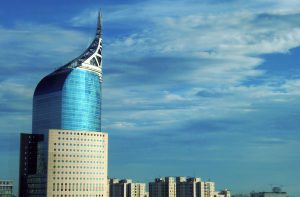
A skyscraper in Jakarta, Indonesia.

Credit: ID 96707010 © Rex Wholster | Dreamstime.com

Subscribe for ads-free reading
The Indonesia Stock Exchange (IDX) suffered a historic two-day wipeout on January 28 and 29, as the Jakarta Composite Index (IHSG) plummeted by over 11.5 percent, evaporating approximately $80 billion in market value and triggering the recent resignation of IDX President Director Iman Rachman and Mahendra Siregar, the head of the Indonesian Financial Services Authority (OJK). This collapse, fueled by sudden global concerns over market transparency, sent shockwaves through the region. Stakeholders are now grappling with why the crash occurred, what it signaled for the country’s economic future, and how such a systemic failure could be rectified and prevented.
 

Prabowo’s clampdown on Indonesian tycoons fuels capital flight​

Bloomberg News


Jul 10, 2026

3 days ago
Reprints
Share
Indonesia

Credit: Bloomberg
For roughly six decades, Indonesia’s political leaders and business elites enjoyed a near-symbiotic relationship, one that survived a transition from dictatorship to democracy. That’s now collapsing under President Prabowo Subianto, spurring a race among tycoons to move cash out of the Southeast Asian archipelago.

Driven by concern over growing inequality and a belief in a more assertive role for the state in managing the economy, the former special forces commander is targeting the country’s leading industrialists who built immense fortunes off the nation’s booming resources sector. Disparaging them in public remarks as greedy “thieves” and “robber barons,” Prabowo has wielded mostly sticks and a few carrots to get more of their cash into state coffers.

Yet despite grievances that have won support in some circles, Prabowo’s policies are backfiring among investors: The rupiah is near record lows against the dollar, Indonesia’s stocks are the world’s worst performers and bond yields are surging. Global investors have offloaded $4.3 billion of equities this year so far on a net basis, four times the whole of 2025, according to data tracked by Bloomberg.

Tycoons are losing patience with Prabowo’s rhetoric and his increasingly tough tactics to extract their money, according to more than a dozen people familiar with Indonesia’s wealthy elites, who requested anonymity to speak freely. While some see the president’s moves as well-intentioned but poorly executed, many high-net-worth individuals are moving hundreds of millions of dollars offshore out of fear that Prabowo may turn to more forceful measures.

One of Indonesia’s richest tycoons sold $300 million of stocks and bonds in April and transferred the proceeds to Singapore, the people familiar said. Another wealthy clan moved at least $1 billion of their money overseas, splitting it between accounts in Switzerland, Hong Kong and Singapore, other people said.

“Prabowo wants to recover as much wealth as possible from the tycoons who have benefited from the country,” said Derwin Pereira, the Singapore-based chief executive of strategic advisory business firm Pereira International, who predicts his actions will continue for as long as he’s president. “If businesses aren’t confident the wealth they create will be protected from arbitrary actions, then they’ll hesitate to invest and expand.”

Other world leaders have periodically squeezed the mega-rich, including Russia’s Vladimir Putin, Chinese leader Xi Jinping and Saudi Arabian Crown Prince Mohammed bin Salman, who famously ordered some top billionaires and princes to be held at the Ritz-Carlton hotel for months back in 2017. Unlike them, however, Prabowo presides over a democracy highly exposed to global markets with freer flows of capital and protections for investors.

Indonesia’s free-floating currency and reliance on external financing to fund its budget deficit increase the economic stakes for any policy moves that either prompt tycoons to withdraw funds or deter foreign investors from buying its stocks or bonds. Moody’s Ratings and Fitch Ratings Inc. this year revised their credit outlooks for Indonesia to negative due to increasing fiscal strain, putting at risk the investment-grade rating the nation has enjoyed for more than a decade.

In the 20 months since Prabowo took office, he has tested the limits of what’s possible under the law. Indonesia’s government has seized large swathes of land that it says were used illegally, launched tax probes into several high-net-worth individuals and pressured the moneyed class to cough up close to $4 billion for low-interest “patriot bonds” issued by Danantara, a newly created sovereign wealth fund that’s now playing a key role in managing the economy.

Prabowo’s government is also weighing the nation’s first wealth tax, and parliament is discussing a forfeiture bill that would enable the seizure of assets from individuals suspected of corruption — in some cases without criminal convictions.

To date, the moves don’t seem to have hurt Prabowo’s standing with the masses in what is the world’s fourth-most populous nation. Only a small percentage of Indonesia’s roughly 280 million citizens own stocks. Still, riots in Jakarta and across the nation last year show that anger over inequality can also easily turn onto Prabowo himself if the economy slows or prices surge.

A study released in April by the Center of Economic and Law Studies, a local think tank, found that Indonesia’s 50 wealthiest people had a median net worth of $3 billion, compared with just $4,845 for the general population. Those mega-fortunes are now starting to wane under Prabowo.

Since January, the combined net worth of the country’s 10 richest families has plunged by $56.7 billion, according to the Bloomberg Billionaires Index. The top five tycoons — Prajogo Pangestu, Anthoni Salim, Budi Hartono, Low Tuck Kwong and Tahir, who like many Indonesians only goes by one name — control listed companies that make up around 20% of the stock exchange’s market value. Pangestu, who owns Indonesia’s largest petrochemical company, has lost the most: As of June 30, his wealth had declined by 66% this year to $15.6 billion.

For many tycoons, dealing with Prabowo has been a turbulent experience marked by mixed messages and conflicting signals.

Back in January at the World Economic Forum in Davos, the president said his government uncovered illegal practices “in all sectors of the economy.” He boasted that his administration confiscated four million hectares of plantations and mines in its first year — roughly the size of Switzerland — and revoked the licenses of 28 corporations for one million hectares of land after finding they violated laws.

“I don’t call this free enterprise or the free market,” he said. “I called it greednomics.”

Yet shortly afterward, he invited a group of five billionaires to his hillside residence on the outside of Jakarta. At the gathering, Prabowo urged the wealthy businessmen — Pangestu, Salim, property magnate Sugianto Kusuma, coal baron Garibaldi Thohir and Franky Widjaja, senior executive of the Sinar Mas conglomerate — to support his social agenda, according to people familiar with the matter.

Briefing them on Indonesia’s negotiations to lower US tariffs, the president said his main concern was employment and asked the tycoons to assist him in creating more jobs, the people said. Everyone present pledged to do that, and upon returning to Jakarta they issued memos to their companies about the need to boost employment. But soon after the president continued his attacks on the wealthy, the people said, leaving the tycoons feeling baffled and confused.

Then in another meeting with the same group of tycoons at the president's house in south Jakarta in the first week of May, he asked them to help shore up the weakening rupiah. Prabowo told them they could convert their US dollars, be it for personal or business use, to local currency, framing it more as a request than an order, the people familiar said.

But later that month, as the currency spiraled, Prabowo announced a shock plan to centralize commodity exports, a move that risks cutting into tycoons’ margins and pricing power. The whiplash continued several weeks later when his government made another play for their loyalty, saying it would exempt any purchases of Danantara-issued bonds from legal and tax scrutiny in a bid to draw funds back to the country.

A spokesperson for Prabowo’s office noted that the president’s relationship with the business community is “founded on a strategic partnership aimed at advancing the nation’s long-term development.”

“The president’s economic agenda remains firmly focused on fostering inclusive growth, creating quality employment opportunities, and ensuring the fair and consistent application of the rule of law,” the government communication agency spokesperson said. “President Prabowo has consistently encouraged the private sector to play an active role in strengthening Indonesia’s economic fundamentals through investment, job creation and sustainable economic development.”

Prabowo’s office added that with regard to “law enforcement measures involving land governance, export administration, anti-corruption efforts and practices such as under-invoicing, the government emphasizes that these actions are not directed at any particular individual or business group. Rather, they form part of a broader structural reform agenda to strengthen governance, enhance transparency and ensure a level playing field for all market participants, including domestic and international investors.”

Representatives for Thohir and Widjaja didn’t respond to requests for comment. Pangestu declined to comment.

In many ways, Prabowo has long been part of the system he now rails against. The close ties between Indonesia’s politicians and business executives date back to the era of Suharto, a dictator who governed the country with an iron fist for more than three decades from 1967 until his downfall in 1998. His relationship with ethnic Chinese tycoons, a minority in Indonesia who control many top companies, involved both sides giving each other favors.

“It was a mutual back-scratching,” said Nancy Chng, co-author of a book titled Liem Sioe Liong’s Salim Group: The Business Pillar of Suharto’s Indonesia, an account of one of Indonesia’s foremost tycoons.

During his presidency, the last to see 8% growth in Indonesia, Suharto regarded business owners as associates who could help boost the country’s economy. The practice continued after the nation embraced democracy, with subsequent leaders granting tax breaks and other perks to large companies. In recent years, for example, tycoons supported former leader Joko Widodo’s vision to create a new capital city in Borneo that is in limbo.

Prabowo himself grew up as a member of Indonesia’s elite, with his father serving in Suharto’s cabinet. Hailing from an educated and cosmopolitan family, Prabowo eventually joined the military and married Suharto’s daughter, although they separated soon after his 1998 ouster. Prabowo has officially declared more than $110 million in assets and his younger brother, Hashim Djojohadikusumo, helms a conglomerate whose interests span palm oil to coal mining and forestry.

Yet far from being a friend to tycoons, Prabowo views them with suspicion and contempt. In his book Indonesia Paradox published in 2022, he described how company executives have enriched themselves at home while parking their money overseas, and called for an improved welfare system to help poorer Indonesians.

“This greedy oligarchy wants to control all of Indonesia’s economic resources and is cruelly allowing the majority of Indonesians to live in poverty,” Prabowo wrote.

In early 2025, shortly after Prabowo took office, his government began taking control of plantations, mining sites and other resource-rich land that it said legally belonged to the state. Among the tycoons affected was Purwanti Lee, known locally as the “Sugar Queen” because of her family’s dominant position in that industry.

Authorities seized more than 80,000 hectares of her company’s land planted with sugar cane, an area slightly larger than New York City, while also raiding her home and barring her from leaving the country as they investigated allegations of money laundering. She hasn’t been charged with any wrongdoing.

Representatives for Lee didn’t respond to a request for comment.

In October last year, a coastal real estate development in northern Jakarta spearheaded by Kusuma was taken off a list of the government’s national strategic projects. That followed a Supreme Court ruling that decreed parts of the development sit on protected forest land and violated spatial planning rules.

The project was a joint venture between Kusuma and Salim Group, a conglomerate helmed by fellow billionaire Salim. It was granted the special status by Prabowo’s predecessor as part of efforts to boost tourism.

Representatives for Kusama and Salim didn’t respond to requests for comment.

Then in November, Victor Hartono, the scion of one of the country’s richest families, was detained briefly at Jakarta’s airport by immigration officials as he returned home from a family holiday in Japan. Officials barred the 54-year-old president of conglomerate Djarum Group, which is involved in everything from cigarettes to financial services, from leaving the country for six months due to what they said was a tax-related corruption probe.

The news quickly reached his father, octogenarian billionaire Budi Hartono, and triggered panic among family members, according to people familiar with the matter. Victor Hartono’s travel ban was lifted in a matter of days, with authorities citing his cooperation. Budi and his older brother, the late Michael Bambang Hartono, still jointly control the family fortune.

Victor Hartono declined to comment.

People close to the president say the moves against the tycoons are part of his push to curb corruption and make elites who grew rich from the country’s natural resources contribute more to nation-building.

Even so, bankers, lawyers and wealth advisers told Bloomberg the nation’s wealthiest people are increasingly moving money offshore by investing in gold, cryptocurrency and real estate. Many Indonesian moneyed clans have family members living in Singapore and the US who have become citizens of those countries, making it easier for them to buy and own landed properties while incurring minimal taxes. Other common destinations for their funds include Dubai, Hong Kong and Liechtenstein.

Tax strategies to ringfence family wealth are also gaining traction. UBS Group AG estimates Indonesia’s billionaires could pass down some $114.6 billion in wealth to the next generation over the next 15 years, the second-most for any country in South and Southeast Asia after India.

In Indonesia, individuals can transfer ownership of property or other valuable assets to their children or immediate family members via what’s known as hibah — an Islamic gift — that may be exempt from income tax if the transaction meets certain criteria.

Some tycoons are looking to put money or company shares into trusts, which Indonesian law doesn’t recognize in the same way as common law jurisdictions like Singapore and the UK. While Indonesian tax authorities can access ownership details of assets placed in a Singapore holding company, the paper trail goes cold if that asset is owned by a trust, according to Justin Halim, a Jakarta-based lawyer with Swandy Halim & Partners.

“The fact Indonesian law doesn’t explicitly recognize trusts is an added advantage because it further complicates authorities’ efforts to trace, identify and execute Indonesian assets held by trust structures,” Halim said. “This allows wealthy Indonesians to obtain enhanced wealth preservation and asset protection.”

Some tycoons move their money overseas in smaller batches by opening multiple investment accounts in local branches of foreign-affiliated banks. After a few weeks or months, they shift the money to overseas accounts held by the same banks, people familiar said.

Although money transfers of $10,000 a month or more now have to be backed by underlying transactions — a tenth of what was allowed before April — bankers to the ultra wealthy only need to provide justification for large transfers such as investments abroad, and central bank officials rarely scrutinize those, the people familiar said.

It’s a similar case when tycoons sell large amounts of shares in their listed companies, transactions that generally don’t raise red flags among regulators unless the amount is big enough for them to risk losing a controlling stake. After transferring the shares to an overseas account, the tycoons can use them as collateral for credit lines, for example, the people said.

Another loophole is around working capital. A parent company remits working capital overseas in the form of loans to subsidiaries located in other countries, which aren’t subject to any cap so long as the reasons for the transfer are justifiable. After the loan has been made, tycoons can direct their bankers to withdraw the money and manage it elsewhere, the people familiar said.

Some tycoons acknowledge there are bad apples within their fraternity who are involved in corruption and under-invoicing, and understand why Prabowo is moving to end such practices. Others are grateful the pressure isn’t as extreme as in places like Saudi Arabia or China: Danantara’s so-called patriot bonds, which Prabowo views as a test of loyalty among tycoons, still at least pay a 2% coupon.

The government is penalizing certain business actors “to consolidate a more aligned coalition of capital,” said Faris Al-Fadhat, a professor of international political economy at Muhammadiyah University of Yogyakarta who writes frequently about Indonesia’s conglomerates. “What we’re seeing under Prabowo is not an attempt to dismantle oligarchy, but to reorder it.”
AUTHOR Bloomberg News

footer-master-logo

Footer Quick Links​

©2026 Crain Currency. All Rights Reserved.


×

 

Handsum Korean Oppa suddenly prioritised Foreign exchange authorities prioritize market imbalances over exchange rate level​

A staff member sorts U.S. dollar bills at Hana Bank’s currency counterfeiting response center in Seoul, July 3. Yonhap

A staff member sorts U.S. dollar bills at Hana Bank’s currency counterfeiting response center in Seoul, July 3. Yonhap
By Jun Ji-hye
  • Published Jul 13, 2026 3:15 PM KST
  • Updated Jul 13, 2026 6:31 PM KST

BOK governor says dollar liquidity sufficient, US swap line not urgent​

Editor’s note​

This is the second in a three-part series analyzing the reasons behind the won’s recent weakness against the dollar and responses from the Korean government and businesses. — ED.
As the won-dollar exchange rate remains at unusually elevated levels despite record-high exports fueled by strong semiconductor demand, market attention has increasingly turned to the question of how much ammunition foreign exchange authorities have.

Typically, stronger exports lead to increased dollar inflows, which support the won and push down the exchange rate. This time, however, the exchange rate has remained in the psychologically significant 1,500-won range for about two months. The won has fallen about 8 percent against the dollar this year, while the dollar index has risen about 3 percent during the first half. On Monday, the won also traded in the 1,500-won-per-dollar range before closing at 1,503.4 won in onshore trading, down 2.0 won.

A prolonged period of won depreciation could fuel higher import costs, squeeze corporate margins and erode households' real purchasing power.

Following the 1997 Asian financial crisis, Korea adopted a free-floating exchange rate system in which the won's value is driven by market demand and supply rather than government-set levels. More buyers of the won push the currency higher, while more sellers put downward pressure on it.

According to multiple government and financial sector sources, authorities are more concerned with market volatility and one-way market moves than with the exchange rate level itself when deciding whether to intervene, in line with their long-standing policy of avoiding interventions based on specific exchange-rate thresholds.

The approach reflects their view that a sharp, short-term surge in the exchange rate can be driven not only by supply and demand factors but also by shifting market expectations and sentiment, which can amplify volatility.

"We are not entering the market to defend any particular exchange-rate level," a senior foreign exchange official said. "While traders are attaching significance to the 1,500 or 1,600 mark, what matters to authorities is whether market functions are operating properly, rather than the level itself."

The emphasis on volatility rather than the exchange rate reflects concerns that treating a particular level as a policy target could distort market expectations.

Officials worry that any perception of defending a specific level would give traders a focal point for speculative bets, ultimately fueling rather than containing volatility.

Authorities' recent messaging has reflected that stance. When the won weakened beyond 1,550 per dollar in intraday trading on June 8, the Bank of Korea (BOK) and the Ministry of Finance and Economy stepped in with a joint verbal intervention, warning they would "never tolerate excessive volatility and one-way market moves" that diverge from economic fundamentals.

At the time, officials believed the volatility was being exacerbated not only by underlying market flows but also by speculative trading, particularly in the offshore nondeliverable forward market.

https://www.koreatimes.co.kr/amp/ec...ze-market-imbalances-over-exchange-rate-level
 
Last edited:

Dai Nippon Kikkoku Chiobu finance chief Sama floats JGBs in tax-free accounts and GPIF portfolio review…Samsters buying?​

Finance Minister Satsuki Katayama has cited proposals to promote investment in Japanese government bonds, including possibly making them eligible for the nation’s tax-free Nippon Individual Savings Account program and easing inheritance tax rules.
Finance Minister Satsuki Katayama has cited proposals to promote investment in Japanese government bonds, including possibly making them eligible for the nation’s tax-free Nippon Individual Savings Account program and easing inheritance tax rules. | JIJI
BY ERICA YOKOYAMA
BLOOMBERG
SHARE/SAVE
Jul 14, 2026


Listen to this article
5 min

Japan’s finance minister floated the idea of adding government bonds to a tax-free investment program for individuals and said the nation’s massive pension fund will adjust its holdings if needed, stepping up efforts to attract cash to domestic markets as the yen trades near 40-year lows.

“If we successfully advance our growth strategy, yen-denominated assets will become more attractive,” Finance Minister Satsuki Katayama told reporters Tuesday. “Since that’s the policy this administration is pursuing, it’s possible the portfolio could be reviewed and, if necessary, revised, as the chief cabinet secretary said.”


Chief Cabinet Secretary Minoru Kihara noted on Monday that the Government Pension Investment Fund (GPIF) conducts routine reviews of its portfolio.

Katayama said that within the Liberal Democratic Party and beyond, there have been various opinions — such as making JGBs eligible for a system such as the Nippon Individual Savings Account program that carries tax benefits for retail investors. Relaxing inheritance tax rules is another idea, though it might be criticized as favoring the wealthy, she said.

“While I have received petitions regarding these matters and cannot yet make a definitive decision, I feel that the time has come to move forward with these initiatives,” Katayama said

Health minister Kenichiro Ueno echoed Katayama’s remarks on the GPIF Tuesday, saying the fund’s basic portfolio will be reviewed if necessary. The health and welfare ministry oversees the GPIF.

“They’ve taken it a step further,” said Hiroyuki Machida, director of Japan FX and commodities sales at Australia & New Zealand Banking Group, referring to the comments by Katayama and Ueno. “It may not be something they can do quickly, but the message is: ’We’re going to do it at some point.”

He added that including JGBs in NISA may get more savings, including those of older people, moving into bonds. That would be a catalyst for yen buying while helping to stabilize the bond market, he said.

The return of inflation after decades of weak prices combined with an expansion of the NISA program allowance has fueled sharp growth in the number of accounts. Initial figures released for the end of 2025 showed ¥71 trillion ($437 billion) worth of assets in over 28 million accounts. Those holdings were more than triple the amount at the end of 2020.

Markets have been focused on Japan’s massive public pension fund after Katayama said on Friday that she wanted to encourage it to invest more in domestic assets. She said that with Japan entering a new phase of economic growth and rising interest rates, such a move would help households benefit more directly from the nation’s expansion.

The GPIF, one of the world’s largest pension funds, with ¥293.6 trillion in assets, sets asset allocation parameters every five years. In March 2025, the fund decided to keep splitting a quarter of its funds equally between domestic stocks and bonds, foreign equities and debt.

The fund also narrowed the allowable deviation from the target to 5-6 percentage points depending on movements by the various asset classes, from 6-8 percentage points.

As of March, the allocation to domestic bonds was 26.91%, meaning there would still be room to add investment in that category without formally changing the targeted allocations, according to Societe Generale.

After a brief move higher, the yen largely pared gains after the finance minister’s remarks. It was trading around ¥162.33 per dollar Tuesday morning in Tokyo, not far from its weakest level in 40 years touched earlier this month at ¥162.84.

Adjusting the GPIF portfolio may not be straightforward given the fund’s constraints.

By law, the fund’s investment decisions must be guided by the objective of generating sustainable long-term returns for pension beneficiaries, meaning any increase in domestic holdings would need to be justified on investment grounds rather than broader economic or policy objectives. Overseas stocks and bonds outperformed their Japanese counterparts for much of the past decade.

Katayama’s reference to the possible inclusion of bonds in NISA accounts follows the submission of a bill recommending that on Friday by the Democratic Party for the People (DPP). The party proposes allowing bonds to be included in NISA accounts and also excluding them from inheritance tax to provide another option for individual investors.

The DPP says the U.S., U.K., Canada and South Korea already allow bond holdings in tax-free accounts, while Italy has seen a sharp rise in individual bond ownership after those securities were excluded from inheritance tax.
 
Yes it was supposed to be until many foreigners leeches in then mnc accept boleh land degree and now many private degree biz open such as Kaplan and psb....
 

SK Hynix shares plunge 15.4%, most on record, in deepening South Korea sell-off​

Get ST's newsletters delivered to your inbox
The retail frenzy surrounding the stock and surge in leverage has made it susceptible to wild swings.

Shares of SK Hynix and key rival Samsung Electronics have become increasingly volatile as a retail-led investor frenzy chases AI profits.

PHOTO: BLOOMBERG


Published Jul 13, 2026, 10:59 AM
Updated Jul 13, 2026, 05:53 PM


Set as preferred source

Listen
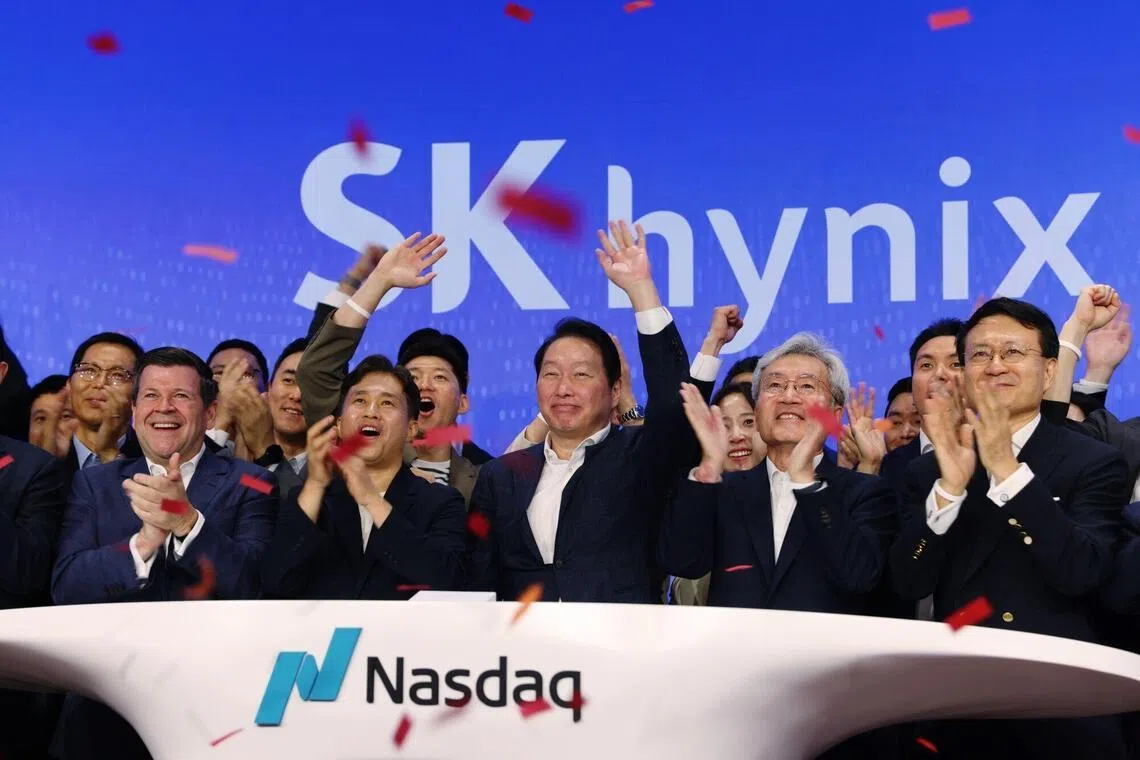
SEOUL – SK Hynix shares tumbled by the most on record in Seoul on July 13 after the memory chip giant’s highly anticipated US trading debut.

It was the latest sign of how volatile the South Korean market has become after the artificial intelligence boom drove massive outperformance versus global peers.

Shares of SK Hynix sank 15.4 per cent on the Korea Exchange to the lowest level in over two months, while peer Samsung Electronics slid 10.7 per cent. The pair drove a 9 per cent plunge in the benchmark Kospi index that triggered a brief circuit-breaker suspension for the seventh time in 2026.
 
Back
Top