
-
IP addresses are NOT logged in this forum so there's no point asking. Please note that this forum is full of homophobes, racists, lunatics, schizophrenics & absolute nut jobs with a smattering of geniuses, Chinese chauvinists, Moderate Muslims and last but not least a couple of "know-it-alls" constantly sprouting their dubious wisdom. If you believe that content generated by unsavory characters might cause you offense PLEASE LEAVE NOW! Sammyboy Admin and Staff are not responsible for your hurt feelings should you choose to read any of the content here. The OTHER forum is HERE so please stop asking.
You are using an out of date browser. It may not display this or other websites correctly.
You should upgrade or use an alternative browser.
You should upgrade or use an alternative browser.
Will Toyota Survive?
- Thread starter Leongsam
- Start date


- Joined
- Sep 13, 2023
- Messages
- 3,152
- Points
- 113
ICE is dead. So whether China will 'still be economically relevant' is moot as Toyota's long-term survival is doomed regardless of which trajectory China takes.Will China still be economically relevant in future, after natural disasters or wars?
Once the CCP subsidy for Tiong brand EV compnies fully dries up, expect to see lots of empty shop lots at Leng Kee.
So let's answer boss's question instead of peppering every thread with your tiresome shilling.

- Joined
- Aug 20, 2022
- Messages
- 31,559
- Points
- 113
I also think ICE days are numbered and those ICE manufacturers are like Nokia and will die soonICE is dead. So whether China will 'still be economically relevant' is moot as Toyota's long-term survival is doomed regardless of which trajectory China takes.
So let's answer boss's question instead of peppering every thread with your tiresome shilling.

- Joined
- Sep 22, 2008
- Messages
- 97,915
- Points
- 113
ICE is not dead. Batteries are still too heavy. Having smaller batteries and using ICE as generator seems like a logical. Choice currently unless power density 8n batterirs increase by double or more.ICE is dead. So whether China will 'still be economically relevant' is moot as Toyota's long-term survival is doomed regardless of which trajectory China takes.
So let's answer boss's question instead of peppering every thread with your tiresome shilling.

- Joined
- May 16, 2023
- Messages
- 48,071
- Points
- 113
When Toyota says the industry is in trouble… you start paying very close attention.
At a recent supplier summit, outgoing CEO Koji Sato didn’t sugarcoat it: “Unless things change, we will not survive.” That’s not cautious language. That’s not corporate nuance. That’s a red alert. And coming from the world’s largest car manufacturer by volume, it tells you one thing very clearly, the ground is shifting faster than even the strongest players can adapt.
This isn’t about Toyota. This is about everything.
It would be easy to interpret this as Toyota losing ground. It’s not. It’s the entire industry being pulled in multiple directions at once:- Chinese manufacturers redefining cost structures and speed
- Software becoming as important as hardware
- Electrification forcing massive capital shifts
- Supply chains under constant pressure
- Margins getting squeezed from every angle
Killing perfection to survive
Here’s where it gets really interesting. Toyota built its empire on precision. The famous Toyota Production System rejected anything less than perfection, even microscopic cosmetic flaws. Now? It’s actively rolling that back. Under a new initiative called “Smart Standard Activity”, Toyota is doing something almost unthinkable: accepting imperfections.Parts that were previously scrapped for invisible defects (a tiny wrinkle, a slight discoloration) will now be approved if they don’t impact functionality. At first glance, that sounds like lowering standards. In reality, it’s something else entirely.
It’s cutting unnecessary perfection to regain competitiveness. And that says a lot about how brutal the current market has become.
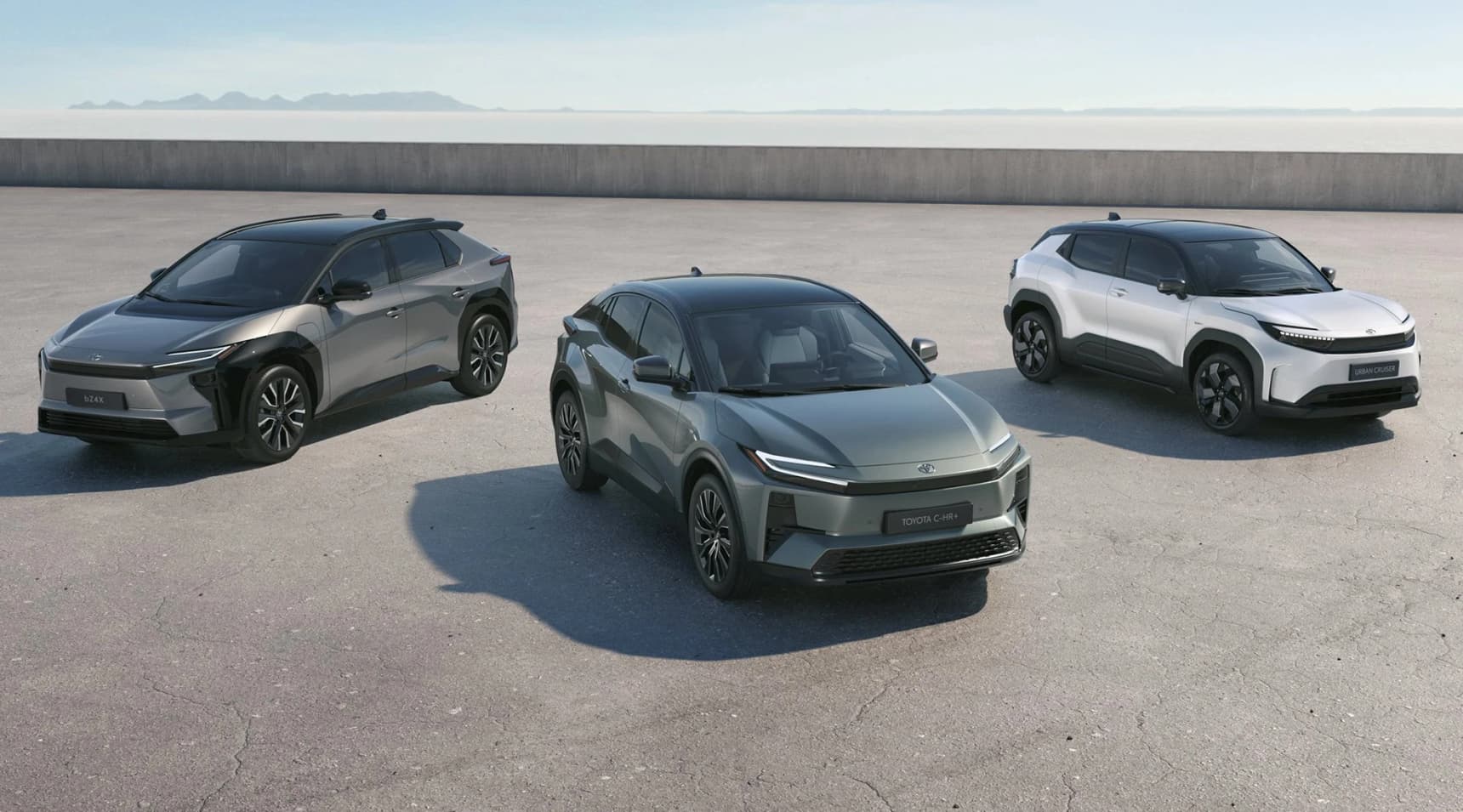
The real pressure: China and software
Let’s be blunt. The biggest threat isn’t legacy brands. It’s speed. Chinese manufacturers are building cars faster, cheaper and increasingly better, while Western and Japanese brands are still optimizing processes designed for a different era.At the same time, software is becoming the new battlefield. Not engines. Not chassis tuning. But user experience, updates, ecosystems. And this is exactly where brands like Toyota have historically been… conservative. That conservatism built reliability. But today, it risks slowing down evolution.
- Joined
- May 16, 2023
- Messages
- 48,071
- Points
- 113
Honda indefinitely suspends $15B EV plant in Ontario
Move comes as the automaker posts a $3.68 billion loss — its first full-year loss ever

Abby Hughes · CBC News · Posted: May 14, 2026 8:50 AM EDT | Last Updated: May 15

Listen to this article
Estimated 4 minutes

Honda confirms indefinite suspension of $15B Ontario EV plant project
May 14|
Duration4:02
Honda says it's indefinitely pausing plans for a $15-billion electric vehicle production chain that was supposed to come to Ontario by 2028. As CBC’s Lane Harrison explains, the complex could have created about 1,000 manufacturing jobs.
Social Sharing
- X
Honda has indefinitely suspended its plans for a $15-billion electric vehicle complex in Ontario due to changing business conditions.
The Japanese automaker said last May it was pausing development at the plant, with plans to review where the EV market was at in two years.
The decision to more definitively suspend the plant was first reported last week by Japanese media, but at the time Honda did not confirm the news.
- Joined
- May 16, 2023
- Messages
- 48,071
- Points
- 113
Why Japanese-owned auto plant becomes contract manufacturer for Chinese brand?: Global Times editorial
By Global Times Published: Jun 16, 2026 11:50 PM

Illustration: Liu Xiangya/GT
Recently, Nissan announced that it had signed a non-binding Memorandum of Understanding (MoU) with Chery International UK, under which it will study manufacturing Chery passenger vehicles at its Sunderland plant's production Line One in the UK from April of financial year 2027. Why is this worth paying attention to? Because it underscores a simple yet profound truth: Industrial and supply chains are cooperative networks shaped jointly by efficiency, markets, technology, employment, and rules under economic globalization. The global automotive industry is, through the most practical business logic, putting this basic economic principle into practice. The signing of the MoU once again underscored that point.
The foundation of cross-border industrial cooperation lies in the economic logic of pragmatism and mutual benefit. The Sunderland plant is an important automotive manufacturing base in the UK, owned by Nissan with established production capacity and workforce. The cooperation between Chinese and Japanese companies on a UK production line for contract manufacturing is based on complementary needs. One side brings a mature factory, workforce, quality system, and localization foundation in Europe, while the other offers a rapidly expanding lineup of different vehicle models, intelligent electric vehicle (EV) technologies, and strong global market expansion capabilities. When traditional automakers face underutilized production lines, while demand for new-energy vehicles surges and requirements for localized production in Europe grow, such cooperation becomes a natural adjustment of the global industrial division of labor under new conditions.
The market's real-world choices have rendered the so-called "threat theory" self-defeating. Currently, some Western media outlets and politicians have been framing China's automotive exports as a "threat" and portraying normal industrial competition as a "shock." Yet the partnership between Chery and Nissan dismantles the false narrative of a so-called "zero-sum game" between Chinese and Western enterprises.
Protectionism may raise costs, but it cannot stop consumers from making their choices; political rhetoric may create noise, but it cannot alter the laws of industry. Today, not only are cost-effective Chinese products selling well across the globe, but China's industrial and supply chains are also accelerating their global expansion, reaching countries including traditional manufacturing powerhouses - proving that China can not only cooperate with other nations for mutual benefit but also offers vast space for industrial complementarity.
The shift from "Western technology, Eastern market" to "Eastern technology, Western production capacity" reflects the transformation of the global automotive industry. Western-centric observers tend to be fixated on the "shifts" in positions along the supply chain, while overlooking the "enabling" role that China's manufacturing system plays for the world.
Foreign automakers once produced, sold, and profited in the Chinese market for years, while simultaneously helping Chinese suppliers learn, grow, and upgrade. Today, Chinese companies are bringing their strengths in new-energy technologies, cost management, software innovation, and supply chain coordination to global markets. In doing so, they can also bring orders, jobs, tax revenue, and industrial vitality to local economies.
The Sunderland contract-manufacturing cooperation combines China's efficient manufacturing capabilities with Europe's localized market needs, reducing transportation-related carbon emissions while accelerating the supply of green products. Such cooperation clearly represents the broadest "common denominator" for the interests of all parties and is well aligned with the needs of the global energy transition and industrial upgrading.
This development also offers Europe an opportunity for reflection. China's automotive industry has reached its current position not through protectionism, but through open competition. In the face of Chinese automobiles, Europe does not need to keep closing its door ever narrower, still less does it need to waver in the contradiction of "wanting the Chinese market while fearing Chinese competition."
The real risk to Europe's automotive industry lies in treating every competitor as a threat and every opportunity for cooperation as a risk. Europe should understand that openness is not a sign of weakness, and cooperation is not surrender. Those who can effectively integrate the world's best resources are more likely to prevail in the next wave of technological and industrial transformation.
In fact, Nissan's cooperation with Chery is far from an isolated case. Nikkei Asia reported last month that Chinese EV makers awaken Western rivals' zombie production lines. Similar examples include Stellantis' plans to share production facilities in Spain and France with its Chinese partners, Leapmotor and Dongfeng.
In recent years, Chinese automakers have utilized acquisitions, contract manufacturing, and strategic partnerships to revitalize underused overseas production capacity and build globalized manufacturing networks. This is a microcosm of Chinese manufacturing continuously contributing to global development as it steadily advances toward the higher end of the global value chain.
By Global Times Published: Jun 16, 2026 11:50 PM

Illustration: Liu Xiangya/GT
Recently, Nissan announced that it had signed a non-binding Memorandum of Understanding (MoU) with Chery International UK, under which it will study manufacturing Chery passenger vehicles at its Sunderland plant's production Line One in the UK from April of financial year 2027. Why is this worth paying attention to? Because it underscores a simple yet profound truth: Industrial and supply chains are cooperative networks shaped jointly by efficiency, markets, technology, employment, and rules under economic globalization. The global automotive industry is, through the most practical business logic, putting this basic economic principle into practice. The signing of the MoU once again underscored that point.
The foundation of cross-border industrial cooperation lies in the economic logic of pragmatism and mutual benefit. The Sunderland plant is an important automotive manufacturing base in the UK, owned by Nissan with established production capacity and workforce. The cooperation between Chinese and Japanese companies on a UK production line for contract manufacturing is based on complementary needs. One side brings a mature factory, workforce, quality system, and localization foundation in Europe, while the other offers a rapidly expanding lineup of different vehicle models, intelligent electric vehicle (EV) technologies, and strong global market expansion capabilities. When traditional automakers face underutilized production lines, while demand for new-energy vehicles surges and requirements for localized production in Europe grow, such cooperation becomes a natural adjustment of the global industrial division of labor under new conditions.
The market's real-world choices have rendered the so-called "threat theory" self-defeating. Currently, some Western media outlets and politicians have been framing China's automotive exports as a "threat" and portraying normal industrial competition as a "shock." Yet the partnership between Chery and Nissan dismantles the false narrative of a so-called "zero-sum game" between Chinese and Western enterprises.
Protectionism may raise costs, but it cannot stop consumers from making their choices; political rhetoric may create noise, but it cannot alter the laws of industry. Today, not only are cost-effective Chinese products selling well across the globe, but China's industrial and supply chains are also accelerating their global expansion, reaching countries including traditional manufacturing powerhouses - proving that China can not only cooperate with other nations for mutual benefit but also offers vast space for industrial complementarity.
The shift from "Western technology, Eastern market" to "Eastern technology, Western production capacity" reflects the transformation of the global automotive industry. Western-centric observers tend to be fixated on the "shifts" in positions along the supply chain, while overlooking the "enabling" role that China's manufacturing system plays for the world.
Foreign automakers once produced, sold, and profited in the Chinese market for years, while simultaneously helping Chinese suppliers learn, grow, and upgrade. Today, Chinese companies are bringing their strengths in new-energy technologies, cost management, software innovation, and supply chain coordination to global markets. In doing so, they can also bring orders, jobs, tax revenue, and industrial vitality to local economies.
The Sunderland contract-manufacturing cooperation combines China's efficient manufacturing capabilities with Europe's localized market needs, reducing transportation-related carbon emissions while accelerating the supply of green products. Such cooperation clearly represents the broadest "common denominator" for the interests of all parties and is well aligned with the needs of the global energy transition and industrial upgrading.
This development also offers Europe an opportunity for reflection. China's automotive industry has reached its current position not through protectionism, but through open competition. In the face of Chinese automobiles, Europe does not need to keep closing its door ever narrower, still less does it need to waver in the contradiction of "wanting the Chinese market while fearing Chinese competition."
The real risk to Europe's automotive industry lies in treating every competitor as a threat and every opportunity for cooperation as a risk. Europe should understand that openness is not a sign of weakness, and cooperation is not surrender. Those who can effectively integrate the world's best resources are more likely to prevail in the next wave of technological and industrial transformation.
In fact, Nissan's cooperation with Chery is far from an isolated case. Nikkei Asia reported last month that Chinese EV makers awaken Western rivals' zombie production lines. Similar examples include Stellantis' plans to share production facilities in Spain and France with its Chinese partners, Leapmotor and Dongfeng.
In recent years, Chinese automakers have utilized acquisitions, contract manufacturing, and strategic partnerships to revitalize underused overseas production capacity and build globalized manufacturing networks. This is a microcosm of Chinese manufacturing continuously contributing to global development as it steadily advances toward the higher end of the global value chain.
- Joined
- May 16, 2023
- Messages
- 48,071
- Points
- 113
Traders Plot Worst-Case Scenario for Yen If Crisis Hits
By Ruth Carson and John Cheng
July 2, 2026 at 7:00 AM GMT+8
Updated on
July 2, 2026 at 9:44 AM GMT+8
Save
Translate
Takeaways by Bloomberg AI
Sign up for the Next Japan newsletter, for an inside view of the forces reshaping Japan, and what’s next for its businesses, markets and consumers.The yen sliding to a once-unthinkable 200 per dollar level is now a medium-term risk — albeit an extreme one — for some investors.
- Joined
- May 16, 2023
- Messages
- 48,071
- Points
- 113
The Quiet Implosion of Japan
If it weren't for the constant threat of intervention, $/JPY would already be at 170
ROBIN J BROOKSJUN 30, 2026
67
7
8
Thank you for subscribing to my posts. If you’re not yet a paying subscriber, please consider becoming one. That’ll allow you to DM me with questions and comments. I plan to move my posts behind a paywall in coming months. Subscribing now locks you in at a low rate. Thank you so much for your support and feedback!
There’s a group of insects that - if you approach them slowly enough - don’t see you coming. That’s sort of how markets are about the global debt crisis that’s brewing and Japan - with its public debt of 240 percent of GDP - is at the leading edge of this.
I’ve done many posts explaining the key issue in Japan. To avoid a debt crisis, the Bank of Japan (BoJ) caps bond yields, which keeps the government’s interest burden manageable. But this means that risk premia aren’t reflected in bond yields, i.e. interest rates are too low versus the risk of crisis in the eyes of markets. That puts depreciation pressure on the Yen, since investors have little inventive to stay in Japan. The government periodically intervenes in foreign exchange (FX) markets to stop the Yen from falling too rapidly, but this approach is doomed to fail because it treats the symptom (Yen depreciation) and not the disease (too much debt). In fact, it’s my view that FX intervention is deeply counterproductive because it creates the illusion that nothing’s wrong when - actually - there’s a very serious crisis brewing.
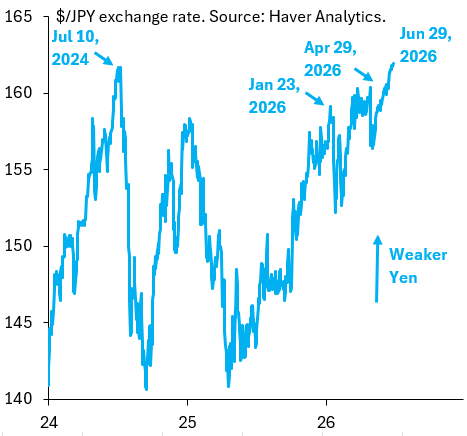
In today’s post, I push back on the dominant narrative that nothing’s wrong in Japan. That narrative stems from the fact that the Yen is weakening only slowly. This creates the illusion that nothing’s wrong and the chart above illustrates this. It plots the $/JPY exchange rate, which - when it goes up - means that the Yen is weakening against the Dollar. The Yen is certainly falling, but i
Similar threads

- Replies
- 2
- Views
- 208


- Replies
- 26
- Views
- 1K