
-
IP addresses are NOT logged in this forum so there's no point asking. Please note that this forum is full of homophobes, racists, lunatics, schizophrenics & absolute nut jobs with a smattering of geniuses, Chinese chauvinists, Moderate Muslims and last but not least a couple of "know-it-alls" constantly sprouting their dubious wisdom. If you believe that content generated by unsavory characters might cause you offense PLEASE LEAVE NOW! Sammyboy Admin and Staff are not responsible for your hurt feelings should you choose to read any of the content here. The OTHER forum is HERE so please stop asking.
You are using an out of date browser. It may not display this or other websites correctly.
You should upgrade or use an alternative browser.
You should upgrade or use an alternative browser.
My resting heartbeat shot go from 58 to 67 yesterday
- Thread starter Boonsiong
- Start date

- Joined
- Aug 20, 2022
- Messages
- 31,833
- Points
- 113
Common Causes for RHR FluctuationsAll because I didn’t sleep well
So yesterday I forced myself to sleep early and it works
My resting heart beat is 60 today and hopefully it will drop further this afternoon
According to data on RHR, your jump from 58 to 67 BPM yesterday could be caused by:
- Illness Onset: Your RHR often increases 24-48 hours before you feel actual symptoms of a virus or infection.
- Late Night Eating: Eating within 2-3 hours of sleeping forces your body to divert blood to digestion rather than recovery.
- Alcohol Consumption: Even moderate intake elevates RHR due to dehydration and metabolic processing.
- Dehydration: Forgetting to drink enough water forces your heart to work harder.
- Stress: High mental or emotional stress directly elevates RHR.
- Caffeine Timing: A late afternoon coffee or tea can linger in your system and increase your overnight or morning RHR.
Inclusive of sleeping time ?
- Joined
- Aug 20, 2022
- Messages
- 31,833
- Points
- 113
YepInclusive of sleeping time ?
That is good .
I try to sleep more and sexercise more and aim to achieve lower 50s HR
- Joined
- Aug 20, 2022
- Messages
- 31,833
- Points
- 113
For longevity, the best indicator is Vo2max. Dont bother about heart rate.That is good .
I try to sleep more and sexercise more and aim to achieve lower 50s HR
- Joined
- Aug 20, 2022
- Messages
- 31,833
- Points
- 113
Check your vo2max data ... the better your vo2max, the longer you will live even if you have elevated cholesterol or elevated high blood or elevated Hb1ac blood test readings.I only seriously sexercise in Feb and I bought Apple ultra watch to monitor my progress
- Joined
- Aug 20, 2022
- Messages
- 31,833
- Points
- 113
Survival of the fittest: VO2 max as a primary marker for longevity
By: Peter October 8, 2021
Blog by Dave
“If you have the aspiration of kicking ass when you’re 85, you can’t afford to be average when you’re 50” (or insert any other age). I love this quote from Peter Attia, New York based physician and podcaster who focuses on the applied science of longevity.
But what is average? And how do we know if we are above average? For that we need some valid and reliable indicators for longevity that we can focus on to ensure the best odds of success in this “game”.
About a year ago Pete wrote a great blog called the single research backed variable that will make you live longer.
It’s a fantastic summary of research that demonstrates for each incremental improvement in cardiovascular fitness your 10 year risk of dying decreases. Spoiler alert, today’s message has the same take home point: improve your cardiovascular fitness and reduce your risk of dying. However I know for many of you out there you want a more concrete objective measure to strive for, a number to chase after: enter VO2 max.
Traditionally V02 max is tested in the lab by hooking up a subject to a device that occludes around your mouth and nose and measures oxygen and carbon dioxide being expelled. Essentially this can tell you the maximum rate at which you can take oxygen from the air and deliver it through your lungs and into the bloodstream to be available for your muscles to use. The protocol for testing VO2 max generally requires an increasing level of exertion (often done on a bike or treadmill) to a maximum level before “failure”.
But VO2 max can also be estimated, using sub-maximal protocols. The estimate calculation is based on the relationship between heart rate and a known exertion level. This is what GPS watches like the newer series of Garmin Forerunner do by having you run for at least 10 minutes while measuring your heart rate and pace. VO2 max on your wrist!! This could be a game changer for those who want to kick ass at 85…IF the estimates are accurate.
Just this week Alex Huchinson, acclaimed exercise science journalist and Author of one of our favourite sports science books, Endure, summarized some of the research that has been done to test the accuracy of the VO2 max estimates from widely available wearable devices
https://www.runnersworld.com/gear/a20856601/can-your-watch-estimate-your-vo2-max/
In short the heart rate based estimates of VO2 max from wearable tech when compared with traditional lab tested VO2 max has on average less than 5% discrepancy. Some of the studies showed the watches and wearables overestimated and some showed they underestimated, so it is not clear that they consistently give you more or less favourable results. But 5%…that seems acceptable considering the convenience of this estimate from a widely available wearable (ie watch) versus the traditional lab based protocols. And if you are looking for more accuracy in the heart rate estimate of VO2 max, adding a chest strap improves the discrepancy between lab and wearable to less than 2%. So if you want to rely on this objective marker heavily the chest strap is advisable.
Ok so this is looking good. The wearables have a reasonable level of error that should still be able to capture increases or decreases in VO2 max over time.
What do we know about V02 max and longevity? And what VO2 max number should we be targeting.
A study done in 2018 of 122,007 patients with baseline cardiovascular fitness values followed the group for between 4.3-13.4 years, with a median of just over 8 years. 13,637 patients died during the study period after over a million years of patient observation. This is not your average hypothesis testing study, this was a serious piece of data collection.
People were grouped into one of 5 cardiovascular fitness categories: low, below average, above average, high and elite. Low were the people who scored in the bottom 25th percentile, below average 25th to 50th percentile, above average 50th to 75th percentile, high was 75th to 95th percentile and elite was the top 5%. The low, below average, above average and high each had about 30,000 participants and the elite group had just over 3500.
See the table below for how grouping was done in each age and gender bracket based on VO2 max (adapted from the original study).
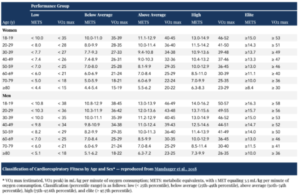
Just to put these VO2 max numbers in context the highest ever recorded VO2 max was a cyclist named Oskar Svendsen who measured about 96. Elite endurance athletes (ie rowers, runners, cyclist’s) will often have a VO2 max greater than 50, however as you can see from the chart as we age it is normal for our VO2 max to drop.
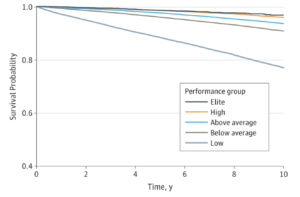
So how did these groups fair out? Looking at all cause mortality in the survival probability chart below there’s a pretty clear trend between fitness and mortality. The biggest gap is between the low cardiovascular fitness group and the below average. The smallest gap is between the high and elite groups.
This means if you are in the low cardiovascular fitness category, you have the most to gain from making an incremental improvement. And if you are already in the high category, increasing it further to the elite category isn’t going to make as much of a difference. Another example of the law of diminishing returns.
To put this further in perspective going from low to below average is a 50% reduction in mortality over a decade. And if you climb up one more category to the above average group it’s about a 60-70% reduction in mortality over a 10 year span! Huge.
Someone of low fitness has a five fold greater risk of mortality versus someone of elite fitness. This is not a small risk factor, and it’s the reason I believe VO2 max might be the best objective data you can get from wearable tech, especially if you are just getting started measuring your cardiovascular fitness progress.
So what number should you be striving for? Peter Attia’s aspiration to optimize longevity is for his patients to be in the “elite” category for someone a decade younger. So for me, I’m still hanging on to that 30-39 age bracket (barely) and thus am aspiring for the elite 20-29 group which is a VO2 max of greater than 56. That’s a big ask, but I love having a number to chase.
VO2 max for the win…let’s go!
My vo2max increased from 32.9 to 37.2Check your vo2max data ... the better your vo2max, the longer you will live even if you have elevated cholesterol or elevated high blood or elevated Hb1ac blood test readings.
I intend to push my vo2 max to 50
- Joined
- Aug 20, 2022
- Messages
- 31,833
- Points
- 113
Vo2max is very important. Low vo2max means likely shorten life. So work on vo2max during your workout runs, swims or whatever. Its even more important than cholesterol, high blood pressure or HBa1c numbers.
Last edited:
For vo2 max, you need to train your zone 2, occasionally you train your zone 4 and 5Vo2max is very important. Low vo2max means likely shorten life. So work on vo2max during your workout runs, swims or whatever. Its even more important than cholesterol, high blood pressure or Hb1ac numbers.
80/20 rule
80% at zone 2
20% at zone 4 and 5
I want to swim and can swim well but my skin cannot contact chlorine
Dear @Dongyi do you sexercise regularly ?
Dear @eatshitndie do you sexercise regularly with your Bedok landlady ?
Dear @eatshitndie do you sexercise regularly with your Bedok landlady ?
Similar threads

- Replies
- 26
- Views
- 3K
- Replies
- 8
- Views
- 650

- Replies
- 11
- Views
- 602

- Replies
- 4
- Views
- 322

- Replies
- 0
- Views
- 106