• IP addresses are NOT logged in this forum so there's no point asking. Please note that this forum is full of homophobes, racists, lunatics, schizophrenics & absolute nut jobs with a smattering of geniuses, Chinese chauvinists, Moderate Muslims and last but not least a couple of "know-it-alls" constantly sprouting their dubious wisdom. If you believe that content generated by unsavory characters might cause you offense PLEASE LEAVE NOW! Sammyboy Admin and Staff are not responsible for your hurt feelings should you choose to read any of the content here.

    The OTHER forum is HERE so please stop asking.

Do you have trust in the Singapore legal system?

Editorial

How did The Straits Times rewrite the Law Society story with a new narrative, not an update?​


The Straits Times replaced its original report on the Law Society EGM with a reframed narrative suggesting resolution, without disclosing the change. This raises questions about media independence, especially as SPH Media Trust stands to receive up to S$900 million in public funding.

11 December 2025
By The Online Citizen
ST-change-title.jpg

On 10 December 2025, The Straits Times published an article headlined “Former Law Society leaders call for EGM to protest election of new president.

It was clear, direct, and grounded in public interest: veteran lawyers and former Law Society presidents Peter Cuthbert Low and Chandra Mohan Nair had called an Extraordinary General Meeting (EGM) to challenge the appointment of Dinesh Singh Dhillon as President for the 2026 term.

The report explained that Dhillon had not been elected by the wider legal profession, but had instead been appointed to the Council under ministerial powers, and subsequently voted into the presidency by the Council.

The concern was not personal — but procedural, and principled. The requisitionists sought to affirm that the Law Society’s leadership should reflect democratic legitimacy, and protect the independence of the Bar.

But by the next day — 11 December — the original article, which had likely been widely circulated, was no longer accessible. Its link now redirected to a new report, bearing a different headline and framing: “Law Society members strike compromise over election of new president.

Rather than updating the original piece, the publication replaced it with an entirely new narrative — one that downplayed dissent and centred on reconciliation.

The new piece introduced a meeting brokered by Senior Counsel Jimmy Yim, presented the issue as largely resolved, and quoted another senior lawyer criticising the EGM as divisive.

The EGM was reframed as largely symbolic. The voices of dissent — which had been the centre of the original report — were now background noise to a story of resolution.

What changed — and why?​

Nothing about the EGM itself had changed:

  • It remains scheduled for 22 December 2025.
  • The resolution will be debated and voted on.
  • The original motion — to affirm that the President should be elected from among elected Council members — stands.
What changed was how the story was told. And that change, without any disclosure, editorial note, or public explanation, reflects a concerning practice in public-facing journalism: rewriting the narrative, rather than updating the facts.

When factual reporting on institutional dissent is overwritten with a polished message of unity and legitimacy — with no transparency — the line between journalism and public relations becomes dangerously blurred.

This is not how public trust is earned​

Media has a responsibility to report on institutional governance, especially when it involves professional bodies like the Law Society. When lawyers themselves are calling for greater transparency and democratic legitimacy within their own Council, it is not merely a “professional dispute” — it is a matter of public interest.

To recast that story, quietly and entirely, as a compromise — just because consensus messaging emerged — betrays the reader’s trust, and undermines the credibility of journalism itself.

Does S$900 million in funding cloud editorial independence?​

This editorial rewrite would be troubling in any context. But in Singapore, it cannot be viewed in isolation from the broader media environment — specifically, the Government’s commitment to fund SPH Media Trust (SMT) with up to S$900 million over five years.

This is the same SMT that owns The Straits Times, Business Times, and other mainstream publications — and the same entity that admitted to inflated circulation figures between 2020 and 2022, including counting destroyed and fictitious copies.

Despite this scandal, Minister for Communications and Information Josephine Teo reaffirmed the Government’s funding commitment in Parliament.

She said the focus would be on reach and engagement, not past circulation, and argued that local news outlets like SMT are essential for Singapore’s identity and trusted information landscape.

But the rewriting of the Law Society article reflects the exact opposite of what the Minister claimed public funding is meant to support.

If anything erodes public trust in mainstream media, it is not a lack of financial resources. It is the editorial decisions that prioritise institutional harmony over transparency. It is the erasure of dissent in favour of state-aligned messaging. And it is the absence of accountability when narratives are reframed without admission or explanation.

Readers are not blind. When headlines change, angles soften, and stories are rewritten to align with institutional preferences, the public takes notice — and reconsiders whom to trust.

Media independence is not a technical KPI​

Josephine Teo says funding is needed to help SMT transform and reach more Singaporeans. But media credibility is not a matter of digital outreach or vernacular engagement metrics. It rests on one principle: the freedom to tell the truth, even when it makes powerful institutions uncomfortable.

And in this case, the truth was that senior lawyers raised a serious concern about legal governance. That concern deserves to be reported — not rewritten.
 
Not reported in the government-controlled media:
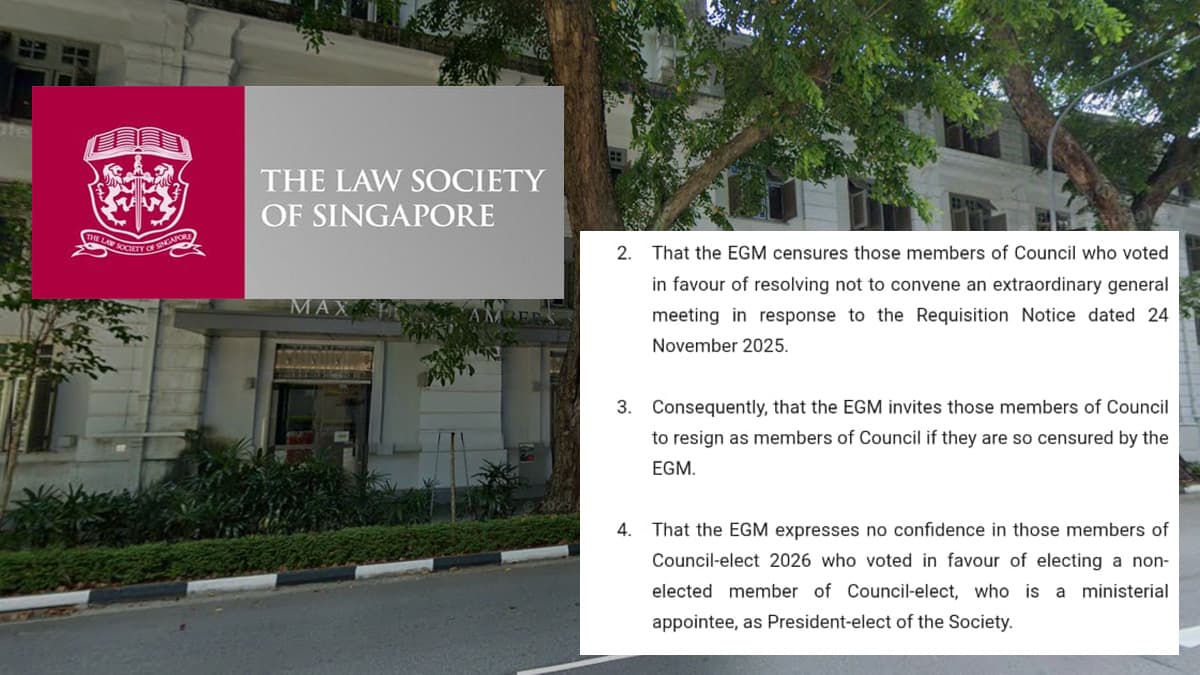
A second motion has been tabled for the 22 December EGM of the Law Society, calling for the censure and resignation of Council members who supported the election of an unelected President and refused to convene the meeting when first requisitioned.

Heidoh12 Dec 2025


LawSoc motion.jpg


AI-Generated Summary
  • Second motion filed for LawSoc EGM: Calls to censure and invite resignation of Council members who backed an unelected President.
  • EGM expanded: Meeting now covers both elected leadership and Council accountability.
  • Members to decide: Lawyers will vote at the 22 December EGM.

A new motion calling for the censure and resignation of the Law Society of Singapore's (LawSoc) Council members who voted to elect an unelected, ministerial appointee as President has been formally tabled for debate at the Extraordinary General Meeting (EGM) on 22 December 2025.

The motion, submitted by lawyer Sunil Sudheesan, was circulated to all practitioner members via a Law Society eBlast at around 3:00pm on 11 December 2025.

It significantly escalates the scope of the upcoming EGM by seeking formal accountability from both current and incoming Council members over their handling of the presidency and the earlier requisition for a general meeting.

At the core of the motion is a proposal that the EGM express no confidence in members of Council‑elect 2026 who voted in favour of electing a non‑elected Council member — a ministerial appointee — as President‑elect of the Society. It further proposes that members of the current Council who voted against convening the EGM in response to the requisition be formally censured, and invited to resign if so censured.

The motion also calls for:

  • Voting at the EGM to be conducted by secret ballot;
  • A requirement for Council‑elect 2026 to report to members by 23 January 2026 on whether EGM resolutions have been complied with; and
  • The reimbursement of all costs incurred in convening and holding the EGM.
The EGM itself was triggered after a group of 42 lawyers submitted a valid requisition on 24 November 2025, as allowed under Section 68 of the Legal Profession Act 1966. The requisition raised concerns over the appointment of Dinesh Singh Dhillon as President for the 2026 term.

Dhillon entered the Council as a statutory member appointed by the Minister for Law under Section 48(1)(b) of the Act, and was not elected by the Law Society’s general membership.

He was subsequently elected President through an internal vote by the 21-member Council, reportedly winning by a single vote over incumbent Vice President Samuel Chacko, according to media reports.

The first motion, formally issued on 9 December 2025 by former Law Society President Peter Cuthbert Low and seconded by Chandra Mohan Nair, seeks to place on record the principle that the President of the Law Society should be elected from among Council members who themselves were elected by members, in order to uphold good governance and confidence in the independence of the Bar.

The Council did not convene an EGM within the 14‑day statutory period following the 24 November requisition. As a result, the requisitionists exercised their legal right to proceed independently and issued formal notice of the EGM on 9 December.

LawSoc circulated its official EGM notice to members on 10 December, after the requisitionists had already acted.

With the addition of the second motion, the 22 December EGM will now address not only the principle of elected leadership, but also accountability for Council decisions, including whether Council members should face censure for supporting the election of an unelected President and for declining to convene the EGM when first requested.

The EGM will take place at 5:00pm on 22 December 2025 at the Wyndham Singapore Hotel Ballroom. All practising certificate holders, who are automatically members of the Law Society, are entitled to attend and vote.
 

Independent probe under way at Law Society following allegations of workplace bullying​

The investigation, which is being conducted by TSMP Law Corporation, was commissioned by the Law Society’s audit committee in September.

The investigation, which is being conducted by TSMP Law Corporation, was commissioned by the Law Society’s audit committee in September.

Summary
  • The Law Society of Singapore commissioned an independent investigation into claims of workplace bullying following an online post.
  • The investigation includes allegations of excessive spending on overseas trips.
  • Discontent arose after a ministerial appointee became president, leading to a proposed EGM and motions of no confidence.
AI generated

Dec 16, 2025

SINGAPORE – An online post in September 2025, which made allegations of workplace bullying at the Law Society of Singapore, has sparked an ongoing probe at the organisation.

The Straits Times understands the allegations come in the wake of a spate of resignations at the Law Society in 2025, with about a third of more than 70 full-time employees leaving their jobs.

A chief executive had quit less than four months into the job. Separately, the departure of a long-time senior executive spurred further resignations.

At one point in time, the human resources department was unstaffed.

The investigation, which is being conducted by TSMP Law Corporation, was commissioned by the Law Society’s audit committee in September.

When asked about the probe, TSMP’s joint managing partner, Senior Counsel Thio Shen Yi, said a progress report has been submitted to the audit committee.

He declined to give further details.

ST understands a number of former and current employees were interviewed between October and December.

A number of other issues were highlighted during the probe.

They include allegations of excessive spending during overseas trips, which had prompted several council members of the Law Society to raise concerns about the financial claims.

Under the organisation’s protocol, expenses below $50,000 do not have to be authorised by the council, which has 21 members.

Such claims need to be approved only by the executive committee, or Exco, a subgroup of the council comprising eight members.

The writer of the online post had also complained about how an allegation of sexual harassment was handled.

ST spoke to a number of former and current employees who said they were familiar with the issues raised in the online post.

One of them even prepared a statutory declaration before a Commissioner for Oaths to confirm the information that was provided to the TSMP team.

Several employees who spoke to ST asked to remain anonymous because they feared reprisal.

They described a work culture where they were expected to be available 24/7.

They said they were inundated with incessant text messages at all times of the day, including weekends and while they were on leave.

One showed ST a stack of printed-out WhatsApp chat messages.

Staff were also told to perform tasks outside their job scope, such as parking cars and dealing with flight bookings.

They said they were spoken to in condescending tones in front of other staff.

They said employees feared being sacked for not carrying out tasks swiftly or satisfactorily.

ST has contacted the Law Society for comment.

Ongoing conflict​

The professional body for lawyers was in the news recently following the appointment of Mr Dinesh Singh Dhillon, a ministerial appointee, as its new president.

Mr Dhillon was announced in November as president of the organisation for 2026.

2068fc6da1c6d2ea183d2aedc09357208cee810edd5a3b1dff1565aac41e0296

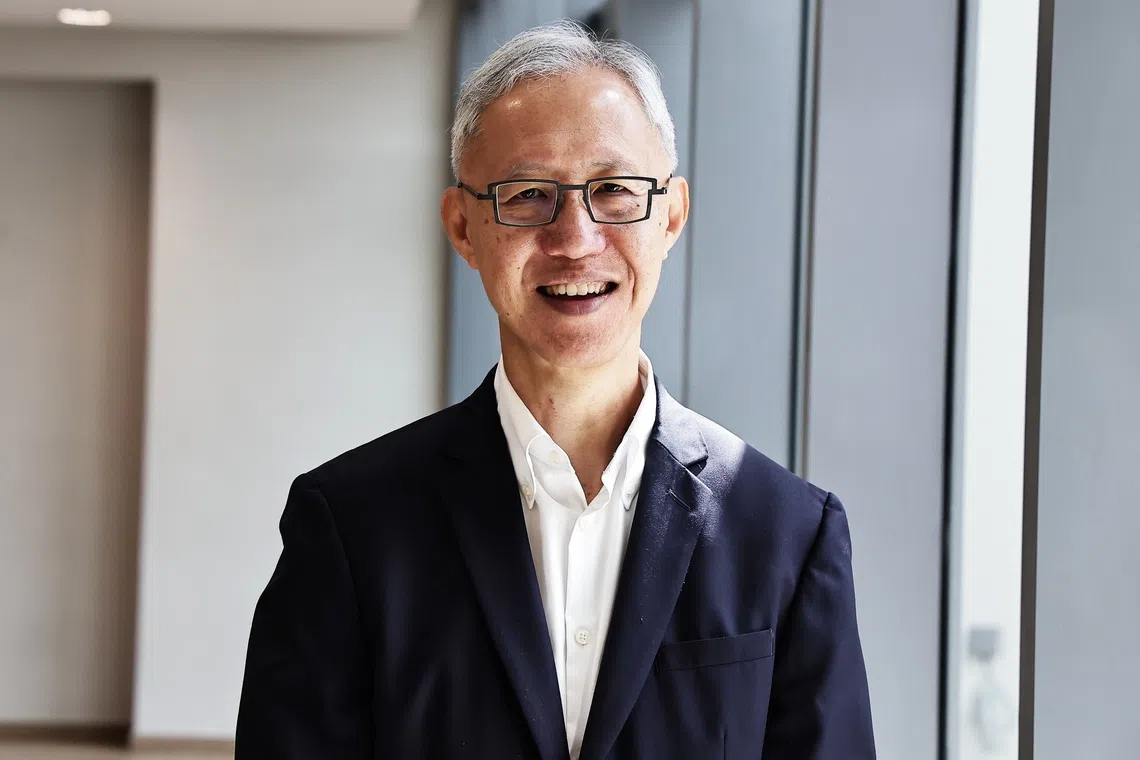
Mr Dinesh Singh Dhillon was announced in November as president of the organisation for 2026.

PHOTO: ST FILE

The current president, Ms Lisa Sam, will remain on the council.

Mr Samuel Chacko, who had lost the internal election to Mr Dhillon, will also be a council member.

The council typically comprises 15 elected members, three members appointed by the law minister, and another three co-opted by the council.

All council members serve a two-year term.

Internal voting for the four office bearers – the president, two vice-presidents and treasurer – is held every year among the council members.

When Mr Dhillon put himself up for the post of president and eventually won the internal vote, it caused disquiet among some members of the society.

On Nov 24, a group of members, led by Mr Peter Cuthbert Low and Mr Chandra Mohan Nair, submitted a request to the Law Society to hold an extraordinary general meeting (EGM).

They proposed to pass a resolution that the president of the body must be an elected member of the council.

On Dec 3, a meeting involving Law Minister Edwin Tong was held with three factions to resolve the unhappiness, Senior Counsel Jimmy Yim had earlier told ST.

The groups comprised two members of the current council including Ms Sam; the office-bearers of the incoming council including Mr Dhillon; and Mr Low and Mr Nair.

On Dec 5, Law Society members were invited to a tea session held on Dec 10 for both councils to address their queries and concerns.

No mention was made of the EGM request.

On Dec 9, Mr Low and Mr Nair told the Law Society that they would be holding the EGM because the council decided not to hold one.

The proposed resolution – worded differently from the original – seeks to place on record the view that only an elected council member should become president.

On Dec 10, criminal lawyer Sunil Sudheesan entered the fray.

He intends to seek a vote of no confidence at the EGM against members of the incoming council who had voted for a ministerial appointee to be president.

His intended motion also seeks the resignation of members of the current council who had decided not to call for an EGM.

On Dec 12, a third motion was added. Another lawyer, Mr Manimaran Arumugam, proposed a slight amendment to Mr Low and Mr Nair’s motion.
 
Back
Top