
Cleaners cut waste by eating leftovers
China Daily, December 4, 2013
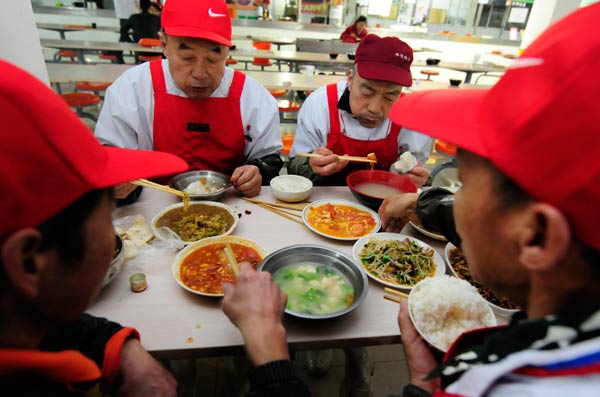
Cleaners in a canteen at Yantai University in Shandong province have taken to eating the students' leftover food, a policy they say has reduced wastefulness. Yu Peng / For China Daily
Canteen workers at a college in East China have won applause for giving students a lesson in the value of food — by eating their leftovers.
Seven cleaners have been credited with cutting the amount of wasted food at Yantai University's No 7 canteen by as much as 50 percent.
Piao Longhuan came up with his "clean plate" campaign in May after noticing a lot of food, particularly staples such as rice and steamed buns, were being thrown away untouched.
He persuaded his six colleagues, all in their 50s and 60s, to collect uneaten leftovers and use them for lunch or dinner.
"I know the feeling of hunger, and I think it's a shame to waste food," cleaner Zhou Lisheng said.
The 61-year-old, who arrived at the college after moving to Shandong province from his native Heilongjiang province more than a decade ago, said he had experienced famine when he was young.
"Also, I used to be a farmer, and I know how much effort goes into growing and harvesting grain and vegetables," he said, adding that cherishing food is a traditional virtue of Chinese culture.
Although not everyone supports the endeavor — Luo Guosheng, whose father works at the canteen, said the practice is "unhealthy" — it has made an impact on many students.
"We used to fill containers that had a capacity of 600 liters with leftovers every day," canteen manager Zhang Chengping said. "After students learned about the cleaners' efforts, the volume has decreased to 300 liters a day."
Xu Chunran, an accounting major at Yantai University, said she always cleared her plate but classmates often used to leave food.
"Now, learning from the cleaners, many have picked up the habit of clearing their plates," she said.
Yu Zengzhong, another student, said he had learned a lot from the cleaners, and he decided to buy the appropriate amount of food and try to finish it all to avoid waste.
Since November, Yantai University has held a series of activities to promote thrift and fight against waste, and some of the seven cleaners were invited to share their stories on thrift with students.
"No leftovers means students don't waste food anymore, and I will be glad to hear that," said Wu Minghua, 62, who was a primary school teacher before starting work as a canteen cleaner.
The United Nations Food and Agriculture Organization launched a campaign in Geneva in January, calling on people to save food and reduce waste.
The Ministry of Education also released a notice in February, asking all schools to nurture a sense of thrift among students and to promote the "clear your plate" campaign among them.


