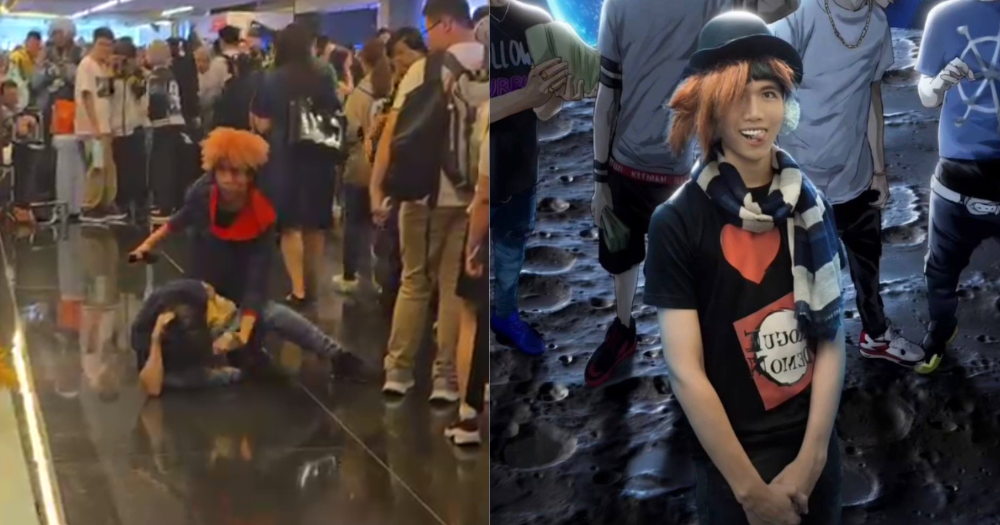
what? a foreigner wacked one of our own. time for vigilante action!Bosco Chun Ho Wang, an 18-year-old Chinese national and Singapore permanent resident, was given one charge each of public nuisance and voluntarily causing hurt.
https://www.channelnewsasia.com/sin...ck-amos-yee-suntec-city-doujin-market-6112726

-
IP addresses are NOT logged in this forum so there's no point asking. Please note that this forum is full of homophobes, racists, lunatics, schizophrenics & absolute nut jobs with a smattering of geniuses, Chinese chauvinists, Moderate Muslims and last but not least a couple of "know-it-alls" constantly sprouting their dubious wisdom. If you believe that content generated by unsavory characters might cause you offense PLEASE LEAVE NOW! Sammyboy Admin and Staff are not responsible for your hurt feelings should you choose to read any of the content here. The OTHER forum is HERE so please stop asking.
You are using an out of date browser. It may not display this or other websites correctly.
You should upgrade or use an alternative browser.
You should upgrade or use an alternative browser.
Amos Yee kena whacked by chow ah beng at Cosplay event
- Thread starter Balls2U
- Start date

- Joined
- Nov 25, 2011
- Messages
- 30,568
- Points
- 113
If he was intelligent, how did he end up getting caught?Amos is intelligent but not wise.
Come on la, he thinks he is intelligent but so far the facts have indicated otherwise.
Kena caught red handed. End up being jailed. Ended up being deported back. Got beaten up in Singapore. All these indicate intelligence?!
- Joined
- Nov 25, 2011
- Messages
- 30,568
- Points
- 113
https://www.cmpb.gov.sg/before-ns/offences/18 yr old pr don't need to serve ns? I thought around age 20 plus don't need....
Failure to serve NS
All NS defaulters shall be liable on conviction to a fine not exceeding $10,000 or to imprisonment for a term not exceeding three years or to both. NS defaulters below age 40 will still have to serve NS, and will be recommended for a lighter sentence as compared to those who have evaded NS entirely.- Joined
- May 31, 2024
- Messages
- 741
- Points
- 63
from whatapp.
PR Is a Privilege, Not a Punching Pass: The Bosco Chun Ho Wang Case Raises a Bigger Immigration Question
Singaporeans watched the viral Suntec City video with disbelief.
In a crowded public space, outside an anime convention, an 18-year-old identified in media reports as Bosco Chun Ho Wang, a Chinese national and Singapore permanent resident, was allegedly caught on camera attacking Amos Yee.
He has since been charged with public nuisance and voluntarily causing hurt. The case is now before the courts, and he must be treated as innocent unless proven guilty.
The public anger is not only about Amos Yee.
It is about something much bigger:
What does Singapore Permanent Residency mean if a PR can allegedly commit public violence and still expect to enjoy the privilege of living here?
This is not just a criminal case. It is an immigration test.
Let's be clear. Nobody is above the law. Not Singapore citizens. Not foreigners. Not PRs. Not work pass holders. Not students. Not anyone.
There is one major difference.
A Singapore citizen has an unconditional right to remain in Singapore. A foreign national does not. A PR enjoys a very significant privilege granted by the Singapore state. PR status gives long-term residence, access to many public systems, a pathway to deeper roots here, and in some cases a path toward citizenship.
That privilege must come with responsibility.
The Ministry of Home Affairs has already made the principle clear: foreigners, including Singapore PRs and work pass holders, who break Singapore’s laws or engage in undesirable conduct may have their passes or permits cancelled and may be barred from re-entering Singapore. MHA also said such cases are assessed based on the facts, the nature and severity of the incident, family roots in Singapore, and contributions to Singapore.
That means this is not some extreme or imaginary argument. It is already part of Singapore’s immigration framework.
If convicted, ICA should review his PR status
The key phrase is if convicted.
This article is not calling for mob justice. It is not saying immigration consequences should be imposed before the court has made findings. It is not saying a viral video alone should decide a person’s future.
If the court eventually finds that Bosco Chun Ho Wang did commit a deliberate public assault, then the question becomes unavoidable:
Should a foreign national who enjoys Singapore PR status continue to enjoy that privilege after being convicted of public violence?
ICA’s own public position is that Singapore PRs convicted of offences will have their PR status reviewed. In one past case, ICA stated that a PR convicted and jailed for breaching COVID-19 regulations had his PR status revoked.
ICA’s public FAQ also states that if a Singapore PR is sentenced to prison, the PR status will be reviewed accordingly.
So the demand is simple and reasonable:
If convicted, Bosco Chun Ho Wang’s PR status should be formally reviewed by ICA.
If the facts show a deliberate assault in a public venue, revocation should be seriously considered.
Singapore cannot normalise vigilante violence
Some people may dislike Amos Yee. Some may find him offensive. Some may think he should not have been there. Some may support the organisers’ decision to refuse him entry.
None of that gives any private individual the right to physically attack him.
A lawful society cannot operate on the principle that unpopular people can be assaulted by whoever feels morally justified. That is not justice. That is vigilantism.
Today, the target is Amos Yee.
Tomorrow, it could be a political opponent, a controversial speaker, an activist, a journalist, a religious critic, or anyone whom an angry crowd decides is “undeserving” of protection.
Once public violence becomes socially excused because the victim is disliked, the rule of law is weakened for everyone.
Immigration policies matters because PR is a national trust
Singapore is already one of the most densely populated countries in the world. We are constantly told that immigration is necessary, that foreign talent is necessary, that PRs contribute to the country, and that Singapore must remain open.
Fine.
Openness cannot mean softness.
A country that grants long-term residence must also protect the integrity of that privilege. PR status should not be treated as a one-way benefit with no behavioural expectations attached.
Singaporeans serve National Service. Singaporeans compete for jobs. Singaporeans pay the price of congestion, housing pressure, transport crowding, and social tension. When PR status is granted, citizens are entitled to expect that recipients respect Singapore’s laws, public order, and social compact.
If a PR contributes, integrates, obeys the law, and builds roots here, good.
If a PR is convicted of serious misconduct, especially public violence, the state must be willing to ask: why should this privilege continue?
The standard should be consistent
This is also about fairness.
If an ordinary foreign worker, student pass holder, or work permit holder were convicted of public violence, many Singaporeans would expect immigration consequences. The same standard should apply consistently to PRs.
PR status should not become a shield.
It should not mean: “I am foreign enough to avoid citizen obligations, but rooted enough to avoid immigration consequences.”
That middle ground is precisely why the public gets angry.
The public wants consistency. If the law says foreigners and PRs who break the law may have their status reviewed, then apply that principle clearly and transparently.
A firm but fair position
The fair position is not “deport him now”.
The fair position is:
Let the court process run. If Bosco Chun Ho Wang is acquitted, that is the end of the matter. If he is convicted, ICA should review his PR status. If the court finds that this was deliberate public violence, then revocation of PR should be seriously considered.
That is not xenophobia.
That is not anti-foreigner.
That is basic national accountability.
Singapore can be open to people who respect our laws. Singapore can welcome those who contribute, integrate, and behave responsibly. But Singapore must never send the message that PR status is immune from consequences.
Because PR is not a birthright.
PR is not an entitlement.
PR is not a free pass.
It should never become a punching pass.
A Chinese national and Singapore PR has been charged after the alleged Suntec City attack on Amos Yee.
This is bigger than one viral video.
The real question is: what does Singapore PR mean?
If a PR is convicted of public violence in Singapore, should ICA review his PR status? Absolutely.
PR is a privilege. It comes with responsibility. Singaporeans have every right to expect foreign nationals granted long-term residence here to respect our laws, our public order, and our social compact.
Dislike Amos Yee all you want. Nobody has the right to assault anyone in public. Once we allow vigilante violence against unpopular people, the rule of law becomes selective.
Let the court decide guilt. But if convicted, ICA should review his PR status, and revocation should be seriously considered.
PR is not a birthright. PR is not an entitlement. PR byis not a punching pass.
PR Is a Privilege, Not a Punching Pass: The Bosco Chun Ho Wang Case Raises a Bigger Immigration Question
Singaporeans watched the viral Suntec City video with disbelief.
In a crowded public space, outside an anime convention, an 18-year-old identified in media reports as Bosco Chun Ho Wang, a Chinese national and Singapore permanent resident, was allegedly caught on camera attacking Amos Yee.
He has since been charged with public nuisance and voluntarily causing hurt. The case is now before the courts, and he must be treated as innocent unless proven guilty.
The public anger is not only about Amos Yee.
It is about something much bigger:
What does Singapore Permanent Residency mean if a PR can allegedly commit public violence and still expect to enjoy the privilege of living here?
This is not just a criminal case. It is an immigration test.
Let's be clear. Nobody is above the law. Not Singapore citizens. Not foreigners. Not PRs. Not work pass holders. Not students. Not anyone.
There is one major difference.
A Singapore citizen has an unconditional right to remain in Singapore. A foreign national does not. A PR enjoys a very significant privilege granted by the Singapore state. PR status gives long-term residence, access to many public systems, a pathway to deeper roots here, and in some cases a path toward citizenship.
That privilege must come with responsibility.
The Ministry of Home Affairs has already made the principle clear: foreigners, including Singapore PRs and work pass holders, who break Singapore’s laws or engage in undesirable conduct may have their passes or permits cancelled and may be barred from re-entering Singapore. MHA also said such cases are assessed based on the facts, the nature and severity of the incident, family roots in Singapore, and contributions to Singapore.
That means this is not some extreme or imaginary argument. It is already part of Singapore’s immigration framework.
If convicted, ICA should review his PR status
The key phrase is if convicted.
This article is not calling for mob justice. It is not saying immigration consequences should be imposed before the court has made findings. It is not saying a viral video alone should decide a person’s future.
If the court eventually finds that Bosco Chun Ho Wang did commit a deliberate public assault, then the question becomes unavoidable:
Should a foreign national who enjoys Singapore PR status continue to enjoy that privilege after being convicted of public violence?
ICA’s own public position is that Singapore PRs convicted of offences will have their PR status reviewed. In one past case, ICA stated that a PR convicted and jailed for breaching COVID-19 regulations had his PR status revoked.
ICA’s public FAQ also states that if a Singapore PR is sentenced to prison, the PR status will be reviewed accordingly.
So the demand is simple and reasonable:
If convicted, Bosco Chun Ho Wang’s PR status should be formally reviewed by ICA.
If the facts show a deliberate assault in a public venue, revocation should be seriously considered.
Singapore cannot normalise vigilante violence
Some people may dislike Amos Yee. Some may find him offensive. Some may think he should not have been there. Some may support the organisers’ decision to refuse him entry.
None of that gives any private individual the right to physically attack him.
A lawful society cannot operate on the principle that unpopular people can be assaulted by whoever feels morally justified. That is not justice. That is vigilantism.
Today, the target is Amos Yee.
Tomorrow, it could be a political opponent, a controversial speaker, an activist, a journalist, a religious critic, or anyone whom an angry crowd decides is “undeserving” of protection.
Once public violence becomes socially excused because the victim is disliked, the rule of law is weakened for everyone.
Immigration policies matters because PR is a national trust
Singapore is already one of the most densely populated countries in the world. We are constantly told that immigration is necessary, that foreign talent is necessary, that PRs contribute to the country, and that Singapore must remain open.
Fine.
Openness cannot mean softness.
A country that grants long-term residence must also protect the integrity of that privilege. PR status should not be treated as a one-way benefit with no behavioural expectations attached.
Singaporeans serve National Service. Singaporeans compete for jobs. Singaporeans pay the price of congestion, housing pressure, transport crowding, and social tension. When PR status is granted, citizens are entitled to expect that recipients respect Singapore’s laws, public order, and social compact.
If a PR contributes, integrates, obeys the law, and builds roots here, good.
If a PR is convicted of serious misconduct, especially public violence, the state must be willing to ask: why should this privilege continue?
The standard should be consistent
This is also about fairness.
If an ordinary foreign worker, student pass holder, or work permit holder were convicted of public violence, many Singaporeans would expect immigration consequences. The same standard should apply consistently to PRs.
PR status should not become a shield.
It should not mean: “I am foreign enough to avoid citizen obligations, but rooted enough to avoid immigration consequences.”
That middle ground is precisely why the public gets angry.
The public wants consistency. If the law says foreigners and PRs who break the law may have their status reviewed, then apply that principle clearly and transparently.
A firm but fair position
The fair position is not “deport him now”.
The fair position is:
Let the court process run. If Bosco Chun Ho Wang is acquitted, that is the end of the matter. If he is convicted, ICA should review his PR status. If the court finds that this was deliberate public violence, then revocation of PR should be seriously considered.
That is not xenophobia.
That is not anti-foreigner.
That is basic national accountability.
Singapore can be open to people who respect our laws. Singapore can welcome those who contribute, integrate, and behave responsibly. But Singapore must never send the message that PR status is immune from consequences.
Because PR is not a birthright.
PR is not an entitlement.
PR is not a free pass.
It should never become a punching pass.
A Chinese national and Singapore PR has been charged after the alleged Suntec City attack on Amos Yee.
This is bigger than one viral video.
The real question is: what does Singapore PR mean?
If a PR is convicted of public violence in Singapore, should ICA review his PR status? Absolutely.
PR is a privilege. It comes with responsibility. Singaporeans have every right to expect foreign nationals granted long-term residence here to respect our laws, our public order, and our social compact.
Dislike Amos Yee all you want. Nobody has the right to assault anyone in public. Once we allow vigilante violence against unpopular people, the rule of law becomes selective.
Let the court decide guilt. But if convicted, ICA should review his PR status, and revocation should be seriously considered.
PR is not a birthright. PR is not an entitlement. PR byis not a punching pass.
lianbeng says pak hor yi si lah!


- Joined
- Apr 20, 2024
- Messages
- 1,429
- Points
- 83
https://www.cmpb.gov.sg/before-ns/offences/
Failure to serve NS
All NS defaulters shall be liable on conviction to a fine not exceeding $10,000 or to imprisonment for a term not exceeding three years or to both. NS defaulters below age 40 will still have to serve NS, and will be recommended for a lighter sentence as compared to those who have evaded NS entirely.
I know alot of foreign talent get pr around 20 plus don't need to serve ns liao. Got msian worker his dad retire and renounce his pr and getting back his cpf money, he still able to get pr. Got peo say once renounce pr will affect his children but it never.
So the 2nd gen can just take up PR again and while their children leech a second time in our education system depriving our sinkies children of a place in preferredI know alot of foreign talent get pr around 20 plus don't need to serve ns liao. Got msian worker his dad retire and renounce his pr and getting back his cpf money, he still able to get pr. Got peo say once renounce pr will affect his children but it never.
school, the 3rd gen can dont take up citizenship again, right?
- Joined
- Dec 18, 2023
- Messages
- 2,186
- Points
- 113
Many people owe LKY their lives.
Hence, amos is never safe in SG.
Hence, amos is never safe in SG.
- Joined
- Apr 20, 2024
- Messages
- 1,429
- Points
- 83
So the 2nd gen can just take up PR again and while their children leech a second time in our education system depriving our sinkies children of a place in preferred
school, the 3rd gen can dont take up citizenship again, right?
Yes he is my ex colleague. I hear many peo say if the msian father renounce sinkie pr his children will be affected. But the truth is not. My tat msian colleague got pr even his dad renounce it. Both also never serve ns!
So, really something wrong with giving PR to 1st gen and 2nd gen not sinkie to serve NS.Yes he is my ex colleague. I hear many peo say if the msian father renounce sinkie pr his children will be affected. But the truth is not. My tat msian colleague got pr even his dad renounce it. Both also never serve ns!
- Joined
- Apr 20, 2024
- Messages
- 1,429
- Points
- 83
So, really something wrong with giving PR to 1st gen and 2nd gen not sinkie to serve NS.
I dunno. I know this on my ex Malaysian colleague. He told all the people his dad renounce sinkie pr then aft that like one yr later, he get pr already. I think Malaysian just don't serve the msia NS or don't let sinkie gov know, as this will be harder or maybe cannot get sinkie pr. The chance they call into serving msia NS is also very low.

- Joined
- Jul 13, 2025
- Messages
- 211
- Points
- 28
The kid is a classic case of high functioning autism. The country can't accommodate folks like him. The system does not have an algorithm to deal with the likes of him.Amos is intelligent but not wise.
So it casts him out and vilifies him.
For all parents with autistic kids... This is the future that awaits your child when they grow up. Say or do one wrong thing, and they can kiss their future goodbye.
- Joined
- Nov 25, 2011
- Messages
- 30,568
- Points
- 113
You are mistaking being a pedo and an absolute asshole = high functioning autism.The kid is a classic case of high functioning autism. The country can't accommodate folks like him. The system does not have an algorithm to deal with the likes of him.
So it casts him out and vilifies him.
For all parents with autistic kids... This is the future that awaits your child when they grow up. Say or do one wrong thing, and they can kiss their future goodbye.
Please la, this fucker ain’t no Dustin Hoffman the Rainman.


- Joined
- Oct 15, 2023
- Messages
- 26,516
- Points
- 113
That 18-year-old probably has a chronic, enduring psychiatric condition with a pattern of attention-seeking behaviour and emotional displays. This condition usually emerges in late adolescence.the bail is not high will he run road?
- Joined
- Apr 19, 2015
- Messages
- 5,222
- Points
- 113
Resemble Donnie Yen...

- Joined
- Oct 5, 2018
- Messages
- 20,708
- Points
- 113
Children of PRs need to serve NSThat 18-year-old probably has a chronic, enduring psychiatric condition with a pattern of attention-seeking behaviour and emotional displays. This condition usually emerges in late adolescence.
I think he will geng a downgrade with this incident.
Similar threads

- Replies
- 2
- Views
- 223


- Replies
- 1
- Views
- 197


- Replies
- 37
- Views
- 1K