• IP addresses are NOT logged in this forum so there's no point asking. Please note that this forum is full of homophobes, racists, lunatics, schizophrenics & absolute nut jobs with a smattering of geniuses, Chinese chauvinists, Moderate Muslims and last but not least a couple of "know-it-alls" constantly sprouting their dubious wisdom. If you believe that content generated by unsavory characters might cause you offense PLEASE LEAVE NOW! Sammyboy Admin and Staff are not responsible for your hurt feelings should you choose to read any of the content here.

    The OTHER forum is HERE so please stop asking.

Australia’s suddenly emerging Greenland dilemma

glockman

Old Fart
Asset
Joined
Sep 11, 2010
Messages
40,618
Points
113
To summarise, Oz (and by extension NZ) better wise up, wake the fuck up. Trump's US is not a reliable ally, it's a dangerous friend not to be trusted.

Australia’s suddenly emerging Greenland dilemma​

Peter Layton
Denmark has been a steadfast US ally. That this appears to count for so little in Washington should give Australia pause.

Published 9 Jan 2026

GettyImages-2236663507.jpg


Listen to this article if you're illiterate


The first Trump administration aspired to acquire Greenland; the second is now seriously increasing the pressure. Greenland, a large island in Arctic, has been part of Denmark since 1814. Today, it is a Danish autonomous territory and the largest by land area of the country’s three parts, the others being Denmark and the Faroes.

A few days ago, President Trump suddenly spoke of a timeline of 20 days or maybe two months; a takeover within three years is being discussed. The administration has proposed various ways to acquire Greenland, including convincing its approximately 60,000 people to join the US, a buyout, and forming a compact of free association like those the US has with some Pacific islands.

In 2025 Denmark objected to the US undertaking covert influence operations in Greenland. The US has refused to discuss the future of Greenland with the Danish and Greenlandic governments. Now, in the wake of the Venezuela raid and with talk of US dominance of the Western Hemisphere, the US has firmly linked military options with Greenland.

Denmark has long been a strong US ally and was a founding member of NATO in 1949. Since the Cold War, Danish armed forces have fought with the US in Bosnia and Herzegovina, Iraq, and Afghanistan where 44 Danish soldiers were killed, the highest per-capita loss rate of any coalition force member except for the US. Like Australia, Denmark's armed forces use US-made equipment extensively. Also like Australia, Denmark is a Level 3 manufacturing partner in the F-35 fighter program, making mainly airframe components.

This deep relationship may soon end abruptly. Danish Prime Minister Mette Frederiksen has said that an American attack on Greenland would end the NATO military alliance. While it is unclear what other nations might do, Denmark would likely leave NATO and thus the US alliance in such a situation. The US relationship with Denmark would never be the same again.

In many respects, Denmark has been as good, or better, an ally to the US than has Australia. This raises three issues.

First, Australia’s confidence in the US alliance, based at least partly on reciprocity, may be misplaced. Australia participates in US-led wars expecting that the US would return the favour if Australia was at war. Australian ministers and officials often remind us that Australians have fought alongside the US since World War I. Australia’s loyalty, it is hoped, will mean the US is obliged to help Australia militarily in a future crisis. But Denmark’s Greenland experience suggests this belief is unfounded. Danish loyalty is clearly considered irrelevant by the Trump administration. Thus, Australia needs to revise its stance. In particular, Australia’s current military involvements in the Middle East need re-examining; these could be gaining Australia nothing.

Second, it seems that the alliance is increasingly one of interests, not values. Australia and the US appear to share an interest in balancing Chinese military power in the Indo-Pacific, but this is perhaps becoming the sole rationale for the alliance. The US appears willing to sacrifice Danish interests for even minor gains. This is also evident in America’s reluctance to commit clearly to defending NATO’s Baltic nations from Russian invasion. Such patterns suggest the US alliance may be narrowing to include only steadfast partners like Australia – and even then, only as long as they align with current US priorities. The concern is that these priorities are national interests decided by the US without consultation, so they may change quickly and perhaps radically.

Third is the question of whether Australia should push back against US declarations about Greenland.

Australia opposes Russia’s attempts at territorial expansion, rejects China’s claim to owning most of the South China Sea, and approves of the UN charter on self-determination. The Greenland case appears to fall into the category of hostile takeovers.

European nations are slowly combining to oppose the Trump administration, although they are cornered in also wanting US help with Ukraine. An element of US divide and conquer is emerging, where Europe will be pressured into accepting American territorial expansion. Some European nations released a joint statement: “Greenland belongs to its people, and only Denmark and Greenland can decide on matters concerning their relations.” Greenlanders are opposed to the American bid.

The Trump administration appears to be approaching a point of radically rethinking its global alliance network. The value of collective defence is being savagely downgraded. Success in Greenland might reinforce America’s – and perhaps other great powers’ – lurch towards unilateral nationalism.

It may soon be time for Australia to join European and NATO nations in expressing concern. If there is no pushback, the administration will assume that allies are content with its treatment of Denmark. This style of destructive alliance management might then spread to European nations and the Indo-Pacific. Better outcomes may come from middle powers standing together, rather than waiting to be assaulted individually.

If the Greenland situation worsens, the Australian government will eventually be forced to take a stand.

https://www.lowyinstitute.org/the-interpreter/australia-s-suddenly-emerging-greenland-dilemma
 
To summarise, Oz (and by extension NZ) better wise up, wake the fuck up. Trump's US is not a reliable ally, it's a dangerous friend not to be trusted.

U.S. Secretary of State Henry Kissinger:

"It may be dangerous to be America's enemy, but to be America's friend is fatal."
 
Australia is being a drama mama.

Greenland is in the Western hemisphere. Australia is too far for USA to project it's power. They are better off forming an alliance with NZ and become the food supplier for Asia
 
To summarise, Oz (and by extension NZ) better wise up, wake the fuck up. Trump's US is not a reliable ally, it's a dangerous friend not to be trusted.

Australia’s suddenly emerging Greenland dilemma​

Peter Layton
Denmark has been a steadfast US ally. That this appears to count for so little in Washington should give Australia pause.

Published 9 Jan 2026

GettyImages-2236663507.jpg


Listen to this article if you're illiterate


The first Trump administration aspired to acquire Greenland; the second is now seriously increasing the pressure. Greenland, a large island in Arctic, has been part of Denmark since 1814. Today, it is a Danish autonomous territory and the largest by land area of the country’s three parts, the others being Denmark and the Faroes.

A few days ago, President Trump suddenly spoke of a timeline of 20 days or maybe two months; a takeover within three years is being discussed. The administration has proposed various ways to acquire Greenland, including convincing its approximately 60,000 people to join the US, a buyout, and forming a compact of free association like those the US has with some Pacific islands.

In 2025 Denmark objected to the US undertaking covert influence operations in Greenland. The US has refused to discuss the future of Greenland with the Danish and Greenlandic governments. Now, in the wake of the Venezuela raid and with talk of US dominance of the Western Hemisphere, the US has firmly linked military options with Greenland.

Denmark has long been a strong US ally and was a founding member of NATO in 1949. Since the Cold War, Danish armed forces have fought with the US in Bosnia and Herzegovina, Iraq, and Afghanistan where 44 Danish soldiers were killed, the highest per-capita loss rate of any coalition force member except for the US. Like Australia, Denmark's armed forces use US-made equipment extensively. Also like Australia, Denmark is a Level 3 manufacturing partner in the F-35 fighter program, making mainly airframe components.

This deep relationship may soon end abruptly. Danish Prime Minister Mette Frederiksen has said that an American attack on Greenland would end the NATO military alliance. While it is unclear what other nations might do, Denmark would likely leave NATO and thus the US alliance in such a situation. The US relationship with Denmark would never be the same again.

In many respects, Denmark has been as good, or better, an ally to the US than has Australia. This raises three issues.

First, Australia’s confidence in the US alliance, based at least partly on reciprocity, may be misplaced. Australia participates in US-led wars expecting that the US would return the favour if Australia was at war. Australian ministers and officials often remind us that Australians have fought alongside the US since World War I. Australia’s loyalty, it is hoped, will mean the US is obliged to help Australia militarily in a future crisis. But Denmark’s Greenland experience suggests this belief is unfounded. Danish loyalty is clearly considered irrelevant by the Trump administration. Thus, Australia needs to revise its stance. In particular, Australia’s current military involvements in the Middle East need re-examining; these could be gaining Australia nothing.

Second, it seems that the alliance is increasingly one of interests, not values. Australia and the US appear to share an interest in balancing Chinese military power in the Indo-Pacific, but this is perhaps becoming the sole rationale for the alliance. The US appears willing to sacrifice Danish interests for even minor gains. This is also evident in America’s reluctance to commit clearly to defending NATO’s Baltic nations from Russian invasion. Such patterns suggest the US alliance may be narrowing to include only steadfast partners like Australia – and even then, only as long as they align with current US priorities. The concern is that these priorities are national interests decided by the US without consultation, so they may change quickly and perhaps radically.

Third is the question of whether Australia should push back against US declarations about Greenland.

Australia opposes Russia’s attempts at territorial expansion, rejects China’s claim to owning most of the South China Sea, and approves of the UN charter on self-determination. The Greenland case appears to fall into the category of hostile takeovers.

European nations are slowly combining to oppose the Trump administration, although they are cornered in also wanting US help with Ukraine. An element of US divide and conquer is emerging, where Europe will be pressured into accepting American territorial expansion. Some European nations released a joint statement: “Greenland belongs to its people, and only Denmark and Greenland can decide on matters concerning their relations.” Greenlanders are opposed to the American bid.

The Trump administration appears to be approaching a point of radically rethinking its global alliance network. The value of collective defence is being savagely downgraded. Success in Greenland might reinforce America’s – and perhaps other great powers’ – lurch towards unilateral nationalism.

It may soon be time for Australia to join European and NATO nations in expressing concern. If there is no pushback, the administration will assume that allies are content with its treatment of Denmark. This style of destructive alliance management might then spread to European nations and the Indo-Pacific. Better outcomes may come from middle powers standing together, rather than waiting to be assaulted individually.

If the Greenland situation worsens, the Australian government will eventually be forced to take a stand.

https://www.lowyinstitute.org/the-interpreter/australia-s-suddenly-emerging-greenland-dilemma

It's an excellent idea and I have to say a brilliant masterstroke on Trump's part. It counters the obvious threat from China and we all know just how bad Chinese influence can be.
 
It's an excellent idea and I have to say a brilliant masterstroke on Trump's part. It counters the obvious threat from China and we all know just how bad Chinese influence can be.
On the contrary. Just having western or US influence only will be boring.
 
Australia is being a drama mama.

Greenland is in the Western hemisphere. Australia is too far for USA to project it's power. They are better off forming an alliance with NZ and become the food supplier for Asia
Like egypt was to rome.
 
Only ignoramus don't realize China prefers dealing with Trump over Europe.

Don't be a dumb fuck.
 
It's an excellent idea and I have to say a brilliant masterstroke on Trump's part. It counters the obvious threat from China and we all know just how bad Chinese influence can be.
Yeah, and if Trump also takes NZ, you'll be the first to celebrate with your balls hanging loose and having multiple orgasms, that is if at your age you are still capable of.
 
Yeah, and if Trump also takes NZ, you'll be the first to celebrate with your balls hanging loose and having multiple orgasms, that is if at your age you are still capable of.

If Trump took over it would be great for NZ. It would finally reverse the rot that has set in as a result of the woke policies of successive governments over the last decade.

As for my sexual prowess there are loads of videos of me in action on my other forum as irrefutable proof that I still have what it takes. :)
 
If Trump took over it would be great for NZ. It would finally reverse the rot that has set in as a result of the woke policies of successive governments over the last decade.

As for my sexual prowess there are loads of videos of me in action on my other forum as irrefutable proof that I still have what it takes. :)
You are sick, very truly sick.
 
Secret weapon that makes Trump so powerful!


Imagery from Venezuela Shows a Surgical Strike, Not Shock and Awe​


Photo © Airbus DS 2026


Photo © Airbus DS 2026


Published January 9, 2026


In the early morning hours of January 3, 2026, more than 200 U.S. special operations forces (SOF) surged through Caracas to capture Venezuelan dictator Nicolas Maduro and his wife, Cilia Flores, in Operation Absolute Resolve. Extensive intelligence collection—overhead and on the ground—built a “pattern of life” on Maduro and provided the foundation for a successful mission: Maduro and his wife were captured, and no U.S. personnel were killed. It was an extraordinary military and intelligence achievement.

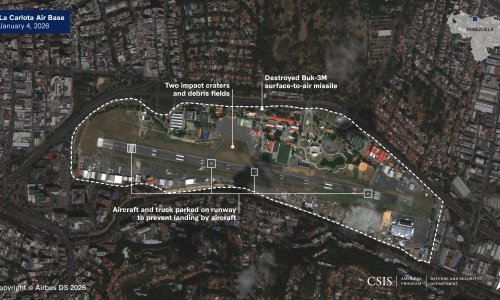
Using satellite imagery, combined with details that have emerged since the operation, CSIS was able to estimate the military activity and battle damage at four sites: the Fort Tiuna Military Complex, La Carlota Air Base, La Guaira Port, and El Higuerote Airport.

The picture that emerges from these images is that of a military operation in furtherance of a law enforcement mission—an operation laser-focused on the capture of Maduro with minimal collateral damage. This was not a “shock and awe” campaign intended to bring the entire Venezuelan security apparatus to heel with overwhelming force, although that too would be within U.S. capabilities given the force posture in the southern Caribbean. It was thus unlike the U.S. air attacks against Iraq in 1991 and 2003, where the objective was to shut the country down via a broad set of attacks on electrical, communications, and transportation infrastructure, thus forcing capitulation. No such targets were struck here.

In addition to these four sites, open-source reporting has confirmed that, at a minimum, additional strikes were carried out against communications infrastructure in El Volcán as well as air defenses in Catia La Mar and Fort Guaicaipuro. These more minor sites are not covered in this analysis.

Remote Visualization


U.S. forces focused on a limited number of sites, primarily the Fort Tiuna Military Complex where Maduro was known to have several bunkers. Air defense batteries and radars were also attacked to create a corridor for helicopters to enter Venezuelan territory and reach the target without interference. Many air defense sites remained untouched, however. U.S. military doctrine prescribes corridors: It was not necessary to take out the entire air defense system.

Venezuela’s regular military forces and their headquarters were also not struck. While an air defense unit was hit in the Port of La Guaira, for example, nearby Venezuelan navy ships were not. None of the buildings at La Carlota Air Base, reported to be part of the Venezuelan air force headquarters, were struck. This narrow target set may reflect a sincere desire to reduce casualties—both military and civilian. Even striking buildings at night, when many are virtually deserted, produces some casualties. It may also reflect a deliberate signal to the Venezuelan armed forces and the remainder of Maduro’s inner circle of the limited U.S. objectives. The Trump administration could have already decided to work through the existing Venezuelan structure and, therefore, did not want to destabilize or decapitate the military because it would be needed to keep order.

The inept force posture of the National Bolivarian Armed Forces of Venezuela (FANB) prior to January 3, 2026, facilitated the U.S. strikes. Air defenses were caught undisguised and out in the open, making them easy targets for U.S. attacks. It seems obvious in retrospect that these units should have been well camouflaged, possibly with decoys. However, units often fight as they train. If the training is undemanding—for example, taking place in the open, where it is easier to set up and conduct operations—units will do the same in wartime.

Venezuelan command and control, heavily degraded by electronic warfare and possibly cyber, failed to react until it was too late, allowing the force to enter Caracas. In the words of General Dan Caine, they “maintained totally the element of surprise.” Even in the face of imminent U.S. attack, the FANB failed to prepare adequately for the task at hand. It seems likely that, had the United States opted for a larger-scale campaign as its opening maneuver, the FANB would have suffered much greater losses than those reported. Years of neglect, combined with endemic corruption, low morale, and cronyism, have eroded the FANB’s operational capabilities significantly.

While U.S. strikes were limited, they still produced casualties. Current estimates report that approximately 75 people were killed, including 32 Cuban special forces who served as bodyguards for Maduro. Two civilian deaths have been identified, while residential buildings throughout Caracas were damaged. An investigation by Bellingcat found that one woman was killed when an AGM-88 anti-radiation missile detonated near an apartment block in Catia La Mar. Another civilian was reportedly killed when U.S. forces struck a communications array near El Volcán.

Fort Tiuna Military Complex

The sprawling military complex at Fort Tiuna constitutes the nerve center of the FANB. It is also reportedly where Maduro and his wife had taken up residence as the United States stepped up its military pressure against the regime. Accordingly, this site sustained the heaviest damage of the four locations reviewed by CSIS. However, the damage at Fort Tiuna is tightly focused, with no evidence of widespread strikes against barracks, training facilities, and administrative headquarters. This suggests a deliberate effort to isolate and neutralize those specific capabilities tied directly to rapid response and regime protection.

A January 3, 2026, Vantor image of Fort Tiuna shows the damage concentrated in several discrete areas within the complex. The most heavily damaged site is a motor vehicle maintenance and storage facility that is likely supporting a mechanized unit. The damage shows widespread destruction without clearly defined impact craters, suggesting it was struck by rocket or missile systems rather than bombs. Several heavy equipment transporters (HETs) are visible within the compound, further indicating that the facility supported a high-readiness mechanized unit capable of rapid movement. Open-source reporting suggests the unit may have been the FANB’s 312th “Ayala” Armored Cavalry Battalion. U.S. operational planners did not want this mobile force, with its considerable firepower, to mount a counterattack against SOF operators on the ground. Although special operators are superbly trained, they are light infantry without heavy weapons. They could easily be overrun by determined mechanized forces.
 

Imagery from Venezuela Shows a Surgical Strike, Not Shock and Awe​


Photo © Airbus DS 2026


Photo © Airbus DS 2026


Published January 9, 2026


In the early morning hours of January 3, 2026, more than 200 U.S. special operations forces (SOF) surged through Caracas to capture Venezuelan dictator Nicolas Maduro and his wife, Cilia Flores, in Operation Absolute Resolve. Extensive intelligence collection—overhead and on the ground—built a “pattern of life” on Maduro and provided the foundation for a successful mission: Maduro and his wife were captured, and no U.S. personnel were killed. It was an extraordinary military and intelligence achievement.

Using satellite imagery, combined with details that have emerged since the operation, CSIS was able to estimate the military activity and battle damage at four sites: the Fort Tiuna Military Complex, La Carlota Air Base, La Guaira Port, and El Higuerote Airport.

The picture that emerges from these images is that of a military operation in furtherance of a law enforcement mission—an operation laser-focused on the capture of Maduro with minimal collateral damage. This was not a “shock and awe” campaign intended to bring the entire Venezuelan security apparatus to heel with overwhelming force, although that too would be within U.S. capabilities given the force posture in the southern Caribbean. It was thus unlike the U.S. air attacks against Iraq in 1991 and 2003, where the objective was to shut the country down via a broad set of attacks on electrical, communications, and transportation infrastructure, thus forcing capitulation. No such targets were struck here.

In addition to these four sites, open-source reporting has confirmed that, at a minimum, additional strikes were carried out against communications infrastructure in El Volcán as well as air defenses in Catia La Mar and Fort Guaicaipuro. These more minor sites are not covered in this analysis.

Remote Visualization


U.S. forces focused on a limited number of sites, primarily the Fort Tiuna Military Complex where Maduro was known to have several bunkers. Air defense batteries and radars were also attacked to create a corridor for helicopters to enter Venezuelan territory and reach the target without interference. Many air defense sites remained untouched, however. U.S. military doctrine prescribes corridors: It was not necessary to take out the entire air defense system.

Venezuela’s regular military forces and their headquarters were also not struck. While an air defense unit was hit in the Port of La Guaira, for example, nearby Venezuelan navy ships were not. None of the buildings at La Carlota Air Base, reported to be part of the Venezuelan air force headquarters, were struck. This narrow target set may reflect a sincere desire to reduce casualties—both military and civilian. Even striking buildings at night, when many are virtually deserted, produces some casualties. It may also reflect a deliberate signal to the Venezuelan armed forces and the remainder of Maduro’s inner circle of the limited U.S. objectives. The Trump administration could have already decided to work through the existing Venezuelan structure and, therefore, did not want to destabilize or decapitate the military because it would be needed to keep order.

The inept force posture of the National Bolivarian Armed Forces of Venezuela (FANB) prior to January 3, 2026, facilitated the U.S. strikes. Air defenses were caught undisguised and out in the open, making them easy targets for U.S. attacks. It seems obvious in retrospect that these units should have been well camouflaged, possibly with decoys. However, units often fight as they train. If the training is undemanding—for example, taking place in the open, where it is easier to set up and conduct operations—units will do the same in wartime.

Venezuelan command and control, heavily degraded by electronic warfare and possibly cyber, failed to react until it was too late, allowing the force to enter Caracas. In the words of General Dan Caine, they “maintained totally the element of surprise.” Even in the face of imminent U.S. attack, the FANB failed to prepare adequately for the task at hand. It seems likely that, had the United States opted for a larger-scale campaign as its opening maneuver, the FANB would have suffered much greater losses than those reported. Years of neglect, combined with endemic corruption, low morale, and cronyism, have eroded the FANB’s operational capabilities significantly.

While U.S. strikes were limited, they still produced casualties. Current estimates report that approximately 75 people were killed, including 32 Cuban special forces who served as bodyguards for Maduro. Two civilian deaths have been identified, while residential buildings throughout Caracas were damaged. An investigation by Bellingcat found that one woman was killed when an AGM-88 anti-radiation missile detonated near an apartment block in Catia La Mar. Another civilian was reportedly killed when U.S. forces struck a communications array near El Volcán.

Fort Tiuna Military Complex

The sprawling military complex at Fort Tiuna constitutes the nerve center of the FANB. It is also reportedly where Maduro and his wife had taken up residence as the United States stepped up its military pressure against the regime. Accordingly, this site sustained the heaviest damage of the four locations reviewed by CSIS. However, the damage at Fort Tiuna is tightly focused, with no evidence of widespread strikes against barracks, training facilities, and administrative headquarters. This suggests a deliberate effort to isolate and neutralize those specific capabilities tied directly to rapid response and regime protection.

A January 3, 2026, Vantor image of Fort Tiuna shows the damage concentrated in several discrete areas within the complex. The most heavily damaged site is a motor vehicle maintenance and storage facility that is likely supporting a mechanized unit. The damage shows widespread destruction without clearly defined impact craters, suggesting it was struck by rocket or missile systems rather than bombs. Several heavy equipment transporters (HETs) are visible within the compound, further indicating that the facility supported a high-readiness mechanized unit capable of rapid movement. Open-source reporting suggests the unit may have been the FANB’s 312th “Ayala” Armored Cavalry Battalion. U.S. operational planners did not want this mobile force, with its considerable firepower, to mount a counterattack against SOF operators on the ground. Although special operators are superbly trained, they are light infantry without heavy weapons. They could easily be overrun by determined mechanized forces.
Everyone had been betrayed, except for the Cuban bodyguard who remained loyal. Unfortunately, all the Cubans were tragically shot and killed.
 
It's an excellent idea and I have to say a brilliant masterstroke on Trump's part. It counters the obvious threat from China and we all know just how bad Chinese influence can be.
On the contrary. Just having western or US influence only will be boring.
Too bad (or should I say fortuitous!) for the aussies and kiwis they're located right smack in the part of the world where China is the dominate power. By right, their location should be named South China, not Oceania. Yes, a multipolar world is so exciting! And it does not matter whether China is a good or bad influence, because as long as a country is rich and powerful, they can do whatever they want and everyone is happy to accommodate them.
 
Time to send our well trained, sharpshooters, super fit army boys to claim Christmas island.

We need the crabs for our chilli crab industry.
 
Back
Top