Follow along with the video below to see how to install our site as a web app on your home screen.
Note: This feature may not be available in some browsers.
IP addresses are NOT logged in this forum so there's no point asking. Please note that this forum is full of homophobes, racists, lunatics, schizophrenics & absolute nut jobs with a smattering of geniuses, Chinese chauvinists, Moderate Muslims and last but not least a couple of "know-it-alls" constantly sprouting their dubious wisdom. If you believe that content generated by unsavory characters might cause you offense PLEASE LEAVE NOW! Sammyboy Admin and Staff are not responsible for your hurt feelings should you choose to read any of the content here. The OTHER forum is HERE so please stop asking.
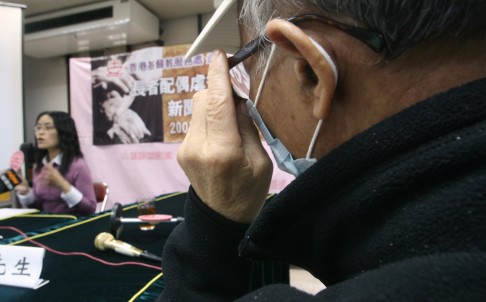
More and more elderly abuse casese have been reported involving cross-border marriages in recent years. A Mr Chan (pictured), 60, told a social group about his ordeal in 2007. Photo by David Wong
Uncle Law, 83, just wanted someone to share the rest of his life with and when he met his young mainland wife, he thought he’d found her.
They married after meeting in Hunan Province in 2010 and had a son the following year.
But last year, six months after his wife and son finally obtained one-way permits to live in Hong Kong, his world fell apart.
After months of abuse, including public humiliation, he was divorced, lost custody of his son, then aged three, and was evicted from his 150 sqft public flat.
Law’s story is not unusual, according to welfare agency Against Elderly Abuse, to which he was referred in December. But he was the oldest of 100 elderly men who sought help from the agency last year.
“In the beginning, the couple had disputes over trivial matters,” assistant executive director Roy Lam Man-chiu said. “She then complained about poor living conditions, argued over money and their relationship and shouted at him every day.”
She also accused him of impotence in front of his friends and neighbours.
“This made him feel ashamed and embarrassed,” Lam said. “He was afraid to go out and meet neighbours and friends.”
Social Welfare Department figures show the number of cases involving abuse of the elderly rose by 44 per cent to 589 last year from 408 in 2012. There were 368 reports in 2011 and 319 in 2010.
Psychological abuse, the category Uncle Law’s case falls under, almost doubled to 73 cases last year from 36 in 2012 – the highest level since 2009.
Lam said the 100 abuse cases handled by his agency last year compared to just dozens in previous years.
In response to a South China Morning Post enquiry, the department did not offer an explanation of the rise in elderly abuse cases. But it said that the government would not tolerate elderly abuse and would take such cases seriously.
Law was ordered to move out of his flat after his wife, then aged in her 30s, won custody of the child.
The Housing Authority said that in the case of a divorce, it usually would allow the custodial parent to keep the flat.
Lam said many elderly people who did not know how to seek help ended up homeless. But the agency has helped Law find another flat through the Housing Department’s compassionate rehousing scheme.
Lam said he believed the main reason mainland women married elderly men was to get residency in Hong Kong and seize their flats.
In similar cases handled by Against Elderly Abuse most of the women were from Hunan and Hubei provinces and in their 30s.
Their spouses are all public housing tenants over 60 years old living on welfare.
Social welfare sector lawmaker Peter Cheung Kwok-che said the rule awarding a flat to custodial parents also protected wives and children from hostile husbands.
He said the government at best was only able to take remedial action such as offering men evicted from their flats after divorce a rental allowance of around HK$1,500 to rent a bedsit apartment.
Men over 60 should think carefully if a young mainland woman agreed to tie the knot, Cheung said adding it could be “too good to be true”.
Echoing Cheung’s advice, Lam from Against Elderly Abuse said: “Lust? Use caution.”
A civilian US defence contractor accused of giving military secrets to a Chinese girlfriend half his age will be entering a guilty plea, according to his attorney.
Benjamin Bishop was expected to plead guilty in federal court today to one count of transmitting national defence information to a person not entitled to receive it and one count of unlawfully retaining national defence documents and plans.
Bishop, 60, was arrested in March last year at the headquarters of the US Pacific Command, where he worked.
A document for the plea agreement, filed on Tuesday, said Bishop e-mailed his girlfriend classified information on joint training and planning sessions between the US and South Korea.
It said Bishop had classified documents at his Hawaii home, including one titled "US Department of Defence China Strategy", another on US force posture in Asia and the Pacific and a US Pacific Command joint intelligence operations centre special report.
An FBI affidavit last year alleged the then-59-year-old gave his 27-year-old girlfriend classified information about war plans, nuclear weapons, missile defences and other topics.
His attorney, Birney Bervar, has said the two were in love and that the case was about love and not espionage.
Bishop has been in federal detention in Honolulu for the majority of time since his arrest in March last year.
US district court judge Leslie Kobayashi allowed him to move to a halfway house in June. A magistrate ordered him back to jail in December after he violated the terms of his release by e-mailing his girlfriend and writing a letter to her.
The FBI alleged Bishop and the woman, now 28, started an intimate, romantic relationship in June 2011. The prosecution said she was a graduate student and that she and Bishop were having an extramarital affair.
Utah state records show Bishop was married until 2012.
The FBI's affidavit alleged the woman might have attended an international defence conference in Hawaii, where she initially met Bishop, specifically to target people like Bishop who had access to classified information.
Authorities have not released her identity or whereabouts. They also have not said publicly whether they believed she was working for the Chinese government.
She was living in the US as a student on a J-1 visa, according to the FBI.
Defendants must normally be indicted within a month of their arrest. Bishop's defence team waived the deadline in exchange for an opportunity to view the prosecution's evidence, much of which is classified.
Bishop, who is a lieutenant colonel in the US army reserve, worked in the field of cyberdefence at Pacific Command from May 2011 until his arrest. Prior to that, he helped develop Pacific Command strategy and policy.