
This November is the Wikipedia Asian Month. Come join us.
 Open main menu

Search
Convair B-36 Peacemaker
The
Convair B-36 "Peacemaker"[N 1] is a
strategic bomber built by
Convair and operated solely by the
United States Air Force(USAF) from 1949 to 1959. The B-36 is the largest mass-produced
piston-enginedaircraft ever built. It had the longest
wingspanof any combat aircraft ever built, at 230 ft (70.1 m). The B-36 was the first bomber capable of delivering any of the
nuclear weapons in the U.S. arsenal from inside its four bomb bays without aircraft modifications. With a range of 10,000 mi (16,000 km) and a maximum payload of 87,200 lb (39,600 kg), the B-36 was capable of intercontinental flight without refuelling.
B-36 "Peacemaker" 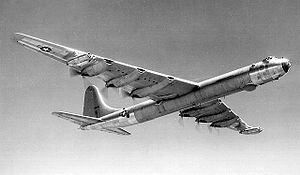
The B-36D used both piston and jet engines.
Role Strategic bomberNational origin United States
Manufacturer ConvairFirst flight 8 August 1946
Introduction 1949
Retired 12 February 1959
Primary user United States Air ForceProduced 1946–1954
Number built 384
Unit cost
US$4.1 million (B-36D)[
citation needed]
($33.2 million in 2016 dollars
[1])
Variants Convair XC-99
Convair NB-36H
Convair X-6Developed into Convair YB-60
Entering service in 1948, the B-36 was the primary
nuclear weapons delivery vehicle of
Strategic Air Command (SAC) until it was replaced by the jet-powered
Boeing B-52 Stratofortress beginning in 1955. All but five examples were scrapped.
DevelopmentEdit
The genesis of the B-36 can be traced to early 1941, prior to the entry of the United States into
World War II. At the time it appeared there was a very real chance that
Britain might fallto the
German "Blitz", making a strategic bombing effort by the
United States Army Air Corps (USAAC) against Germany impossible with the aircraft of the time.
[3]
The United States would need a new class of bomber which would reach
Europe and return to bases in North America,
[4] necessitating a combat range of at least 5,700 miles (9,200 km), the length of a
Gander, Newfoundland–
Berlin round trip. The USAAC therefore sought a bomber of truly intercontinental range,
[5][6] similar to the German
RLM's ultra-long-range
Amerika Bomber program, the subject of a 33-page proposal submitted to
ReichsmarschallHermann Goering on May 12, 1942.
The USAAC sent out the initial request on 11 April 1941, asking for a 450 mph (720 km/h) top speed, a 275 mph (443 km/h) cruising speed, a service ceiling of 45,000 ft (14,000 m), beyond the range of ground-based anti-aircraft fire, and a maximum range of 12,000 miles (19,000 km) at 25,000 ft (7,600 m).
[7] These requirements proved too demanding for any short-term design—far exceeding the technology of the day—
[5] so on 19 August 1941 they were reduced to a maximum range of 10,000 mi (16,000 km), an effective
combat radius of 4,000 mi (6,400 km) with a 10,000 lb (4,500 kg) bombload, a cruising speed between 240 and 300 mph (390 and 480 km/h), and a service ceiling of 40,000 ft (12,000 m),
[4] above the maximum effective altitude of all of
Nazi Germany's anti-aircraft
Flak guns, save for the rarely deployed
12.8 cm FlaK 40 heavy
Flakcannon.
World War II and afterEdit
As the Pacific war progressed, the air force increasingly needed a bomber capable of reaching Japan from its bases in
Hawaii, and the development of the B-36 resumed in earnest. Secretary of War
Henry L. Stimson, in discussions with high-ranking officers of the USAAF, decided to waive normal army procurement procedures, and on
23 July 1943– some fifteen months after the Germans'
Amerika Bomber proposal's submission made it to their
RLM authority; and ironically, the same day that, in Germany, the RLM had ordered the
Heinkel firm to design
a six-engined version of their own,
BMW 801E-powered
Amerika Bomber design proposal
[8] – the USAAF submitted a "letter of intent" to Convair, ordering an initial production run of 100 B-36s before the completion and testing of the two prototypes.
[9] The first delivery was due in August 1945, and the last in October 1946, but Consolidated (by this time renamed Convair after its 1943 merger with
Vultee Aircraft) delayed delivery. The aircraft was unveiled on 20 August 1945 (three months after
V-E Day), and flew for the first time on 8 August 1946.
[10]
After the establishment of an independent United States Air Force in 1947, the beginning in earnest of the
Cold War with the 1948
Berlin Airlift, and the 1949 atmospheric test of the
first Soviet atomic bomb, American military planners sought bombers capable of delivering the very large and heavy first-generation atomic bombs.
The B-36 was the only American aircraft with the range and
payload to carry such bombs from airfields on American soil to targets in the USSR. The modification to allow the use of larger atomic weapons on the B-36 was called the "Grand Slam Installation".
[11]
The B-36 was arguably obsolete from the outset, being piston-powered, coupled with the widespread introduction of
first generation jet fighters in potential enemy air forces.
[3][12] But its jet rival, the
Boeing B-47 Stratojet, which did not become fully operational until 1953, lacked the range to attack the Soviet homeland from North America without aerial refueling and could not carry the huge first-generation
Mark 16 hydrogen bomb.
The other American piston bombers of the day, the
B-29 and
B-50, were also too limited in range to be part of America's developing nuclear arsenal.
[13] Intercontinental ballistic missiles (ICBMs) did not become sufficiently reliable until the early 1960s. Until the Boeing B-52 Stratofortress became operational in 1955, the B-36, as the only truly intercontinental bomber, continued to be the primary nuclear weapons delivery vehicle of the
Strategic Air Command (SAC).
[3]
Convair touted the B-36 as the "aluminum overcast", a so-called "
long rifle" giving SAC truly global reach.
[3] During General
Curtis LeMay's tenure as head of SAC (1949–57), the B-36, through intense crew training and development, formed the heart of the Strategic Air Command. Its maximum payload was more than four times that of the B-29, and exceeded that of the B-52.
The B-36 was slow and could not refuel in midair, but could fly missions to targets 3,400 miles (5,500 km) away and stay aloft as long as 40 hours.
[3] Moreover, the B-36 was believed to have "an ace up its sleeve": a phenomenal cruising altitude for a piston-driven aircraft, made possible by its huge wing area and six 28-cylinder engines, putting it out of range of most of the interceptors of the day, as well as ground-based
anti aircraft guns.
[3]
Experimentals and prototypesEdit
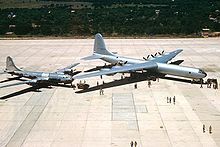
The huge new XB-36 alongside the first superbomber, the
Boeing B-29 Superfortress. The wings of the 'Peacemaker' were 7 feet (2.1 m) thick at the root.
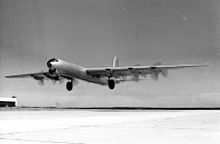
The XB-36 showing the giant single tires. Production aircraft had a four-wheel main gear instead.

Closeup of the XB-36's single-wheeled portside main gear unit
Consolidated Vultee Aircraft Corporation(later Convair) and
Boeing Aircraft Companytook part in the competition, with Consolidated winning a tender on 16 October 1941. Consolidated asked for a $15 million contract with $800,000 for research and development, mockup, and tooling. Two experimental bombers were proposed, the first to be delivered in 30 months, and the second within another six months. Originally designated Model B-35, the name was changed to B-36 to avoid confusion with the
Northrop YB-35 piston-engined flying wing bomber,
[5][14] against which the B-36 was meant to compete for a production contract.
Throughout its development, the B-36 encountered delays. When the United States entered World War II, Consolidated was ordered to slow B-36 development and greatly increase
Consolidated B-24 Liberatorproduction. The first mockup was inspected on 20 July 1942, following six months of refinements. A month after the inspection, the project was moved from San Diego, California, to Fort Worth, Texas, which set back development several months. Consolidated changed the tail from a twin-tail to a single, thereby saving 3,850 pounds (1,750 kg), but this change delayed delivery by 120 days.
The
tricycle landing gear system's initial main gear design, with huge single wheels found to cause significant ground pressure problems, limited the B-36 to operating from just three air bases in the United States:
Carswell Field(former
Carswell AFB, now
NAS JRB Fort Worth/Carswell Field), adjacent to the Consolidated factory in Fort Worth, Texas;
Eglin Field (now
Eglin AFB), Florida; and
Fairfield-Suisun Field (now
Travis AFB) in California.
[15]
As a result, the Air Force mandated that Consolidated design a four-wheeled
bogie-type wheel system for each main gear unit instead, which distributed the pressure more evenly and reduced weight by 1,500 pounds (680 kg).
[5][16][17] Changes in the
United States Army Air Forces (USAAF) requirements did add back any weight saved in redesigns, and cost more time. A new antenna system needed to be designed to accommodate an ordered radio and radar system. The Pratt & Whitney engines were redesigned, adding another 1,000 pounds (450 kg).
[18]
Design
Operational history
Variants
Operators
Aircraft on display
Notable incidents and accidents
Specifications (B-36J-III)
Lore
Notable appearances in media
See also
References
External links
Last edited 8 days ago by
Celect
RELATED ARTICLES
Content is available under
CC BY-SA 3.0 unless otherwise noted.




