
- Joined
- Apr 14, 2011
- Messages
- 21,743
- Points
- 113
Singapore faces shortage of organ donations; more than 500 patients waiting for transplant
As of end-2024, kidney patients on the transplant waiting list had to wait an average of nine years to get a new organ.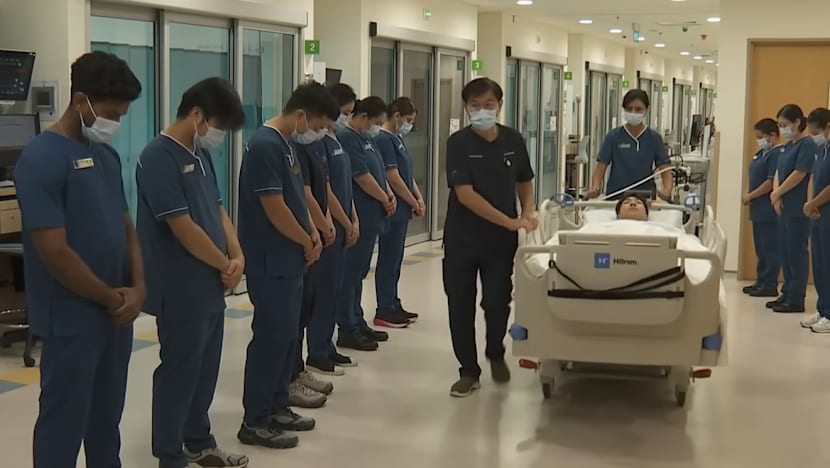
A re-enactment of an honour walk, where healthcare staff pay tribute to an organ donor being wheeled to the operating theatre. This re-enactment took place at Khoo Teck Puat Hospital
Listen
5 min


Sherlyn Seah & Louisa Tang
19 Dec 2025 03:24PM (Updated: 19 Dec 2025 04:23PM)
BookmarkShare
Read a summary of this article on FAST.
FAST
SINGAPORE: A silent line of healthcare staff forms along a hospital corridor as a patient who has been certified brain-dead is wheeled towards the operating theatre.
There, their organs will be retrieved to give others a new lease of life.
ADVERTISEMENT
This solemn procession, known as an honour walk, offers a final tribute to organ donors – and support for their grieving loved ones.
Such gestures highlight the deep respect afforded to donors, said Ms Sally Kong, deputy director of the National Organ Transplant Unit (NOTU).
“I think the families have reacted very positively to this, because they can see how much (the) donation is being valued and (they) are being cared for at the time when they are hurting the most,” she added.
Singapore faces a persistent shortage of organs for transplant.
More than 500 patients are currently on the waiting list for vital organs, with kidney patients facing the most acute shortage.
Only 10 per cent of those on the transplant waiting list received a transplant last year. As of end-2024, the average wait has stretched to nine years. This was due to the small pool of eventual deceased organ donors, said the Ministry of Health (MOH).
While a single donor can save up to seven lives, the annual number of deceased donors remains in the low double digits, according to data from the ministry.
ADVERTISEMENT
Each donation requires fast, tightly coordinated work across multiple hospital units – all while ensuring the donor’s and family’s wishes are respected.
HOW ORGAN DONATION WORKS
Organ donation in Singapore is governed by two legal frameworks.The Human Organ Transplant Act covers the kidneys, heart, liver and corneas. It applies to all Singapore citizens and permanent residents aged 21 and above who are not mentally disordered, unless they have opted out.
Those who opt out will have a lower priority on waiting lists if they need an organ transplant in the future. Opt-out rates have stayed stable at 3 per cent annually.
The second framework is the Medical (Therapy, Education and Research) Act. It allows all nationalities aged 18 and above to pledge additional organs, tissues or even their whole body for transplant, education or research.
On average, about 800 people have made such pledges every year for the past five years.
However, organ donation may not work out for various reasons, including unsuitable conditions or the absence of consent from a donor’s next-of-kin under the Medical Act, said MOH.
Last year, 16 patients with end-stage kidney failure did not receive a transplant because organ donation could not proceed.
ADVERTISEMENT
“This underscores the importance of having timely conversations and making one’s organ donation preferences known, so that our loved ones are able to make informed decisions with clarity and confidence,” added an MOH spokesperson.
Ms Kong said having such a conversation is “indeed very sensitive and very challenging”, both for family members and the healthcare team.
She recounted a situation where a donor’s son was doubtful about whether his mother truly understood the laws and willingly consented to donating her organs.
The team acknowledged that it was a very difficult time for the family and supported him along the process, she added.
For families suddenly confronted with loss, such support can make the difference between clarity and uncertainty.
“At the end of it, he found comfort that his mother's action could impact so many lives, because it was not just the recipients but also the family's lives that the mother had saved in a way,” Ms Kong added.
“After the donation, he expressed gratitude to the team for being there for him, caring for the family and also caring for their mother, and he invited the team to the wake (where) he proudly shared with the attendees how (his) mother's gift left a lasting legacy.”
Healthcare workers now undergo regular training on how to navigate such conversations as part of end-of-life care.
ADVERTISEMENT
MOH also runs the Live On campaign to foster broader discussions and awareness about organ donation in Singapore.
Those interested in making their wishes known can log in to the Organ Donor Registry with Singpass to update their donor status.
Related:

'Are you sure he is dead?': Doctors struggle with families’ lack of understanding of HOTA

Why does Malaysia grapple with low organ donation rate despite long transplant waitlist?
BRAIN DONATIONS
As for brain donations, they are are currently managed by both NOTU and Brain Bank Singapore – the first tissue bank in Southeast Asia dedicated to the repository of human brain tissue to study various neurological disorders.Some questions have been raised about the separate registries, but MOH said there are no plans for a single national registry consolidating organ, body and brain donations.
This came after Dr Choo Pei Ling, a neuroscientist and Member of Parliament for Chua Chu Kang GRC, filed a parliamentary question last month calling for such a registry.
MOH cited established processes and coordination between existing registries.
In response, Dr Choo told CNA she raised the question after residents told her the system feels complex, and that she appreciates MOH’s safeguards.
ADVERTISEMENT
She also acknowledged that the differing organs require distinct expertise and protocols.
“There is an information and knowledge asymmetry between the public and the Ministry. Addressing it can foster better understanding and encourage more Singaporeans to pledge the gift of life,” she added.


