
- Joined
- Apr 14, 2011
- Messages
- 20,141
- Points
- 113
Singapore’s young graduates feel the heat in ‘draining’ job hunt
A dearth of entry-level jobs has forced some young Singaporeans to pivot to stopgap roles and entrepreneurship
Reading Time:5 minuteshttps://www.scmp.com/policies-and-standards
Kolette Lim
Published: 1:00pm, 24 Dec 2025
After finishing his postgraduate studies in May, Tan Kwan Ann expected the job hunt to be difficult, but not so disheartening.
The 33-year-old, who specialised in structural biology at Singapore’s Nanyang Technological University (NTU), sent out more than 600 applications while waiting for the formal conferment of his doctorate, but heard back from almost none of them.
“It seemed like I was excluded from society and made me feel very lousy. It made me question if it was my fault that I chose to further my studies, and whether I had become less employable,” Tan said.
His experience reflects the growing unease among young Singaporeans entering a labour market where entry-level hiring has cooled noticeably – even as overall unemployment in Singapore remained low at about 2.0 per cent as of the third quarter of this year – amid global economic uncertainty and fears that artificial intelligence could outpace some jobs.
Against this backdrop, the government has rolled out subsidised traineeships as a stopgap for fresh graduates, while some young Singaporeans are choosing to sit out the search for traditional full-time roles altogether and carve out their own paths.
According to statistics from the manpower ministry, the unemployment rate of residents aged below 30 saw a first-time increase last quarter in the city state, to 5.7 per cent in June from 5.4 per cent in March. It has since dipped to 5.5 per cent in September.
Overall job vacancies in Singapore fell to 69,200 in September from 76,900 in June, according to labour market statistics released earlier this month.

Demetrius Tan decided to pursue his dream of being an entrepreneur by starting a 3D printing business after little luck in the job market in Singapore. Photo: Demetrius Tan
Tan said he started applying for almost every opening as rejections piled up. He recently began a three-month traineeship as a scientist.
On opting for a non-permanent role, Tan said: “I don’t think I have a choice. If companies won’t hire me, I have to find a way to get employed and earn a pay cheque.”
Demetrius Tan, 28, had applied for more than 200 jobs since the start of the year. The mechanical engineering graduate from the National University of Singapore (NUS) did not receive a single job offer.
“I was constantly rewriting cover letters and tweaking my resume for each role, but I only received 20 replies, which were all rejections,” he said. “It was quite draining, especially since I put in so much effort into each application yet received no response.”
Are traineeships effective?
To alleviate graduate unemployment and shore up confidence, Singapore in October launched the Graduate Industry Traineeships (Grit) scheme for fresh graduates, offering up to 800 positions in the private and public sectors.Salaries in the scheme range from S$1,800 (US$1,400) to S$2,400 a month, with the government funding 70 per cent of the monthly stipend, while the host organisation pays the remaining 30 per cent. Participating firms include banks such as DBS and OCBC, and technology firms like Micron and ST Engineering.
Economist Xia Xing said such traineeships were a “good starting point” to mitigate the dearth of entry-level jobs offered, and would provide graduates with on-the-job training.
“It’s very important for fresh graduates to enter the job market quickly and start accumulating experience and valuable knowledge, so that 10 years from now they will have experience that AI is unable to replicate,” said Xia, a senior lecturer with the Lee Kuan Yew School of Public Policy at NUS.
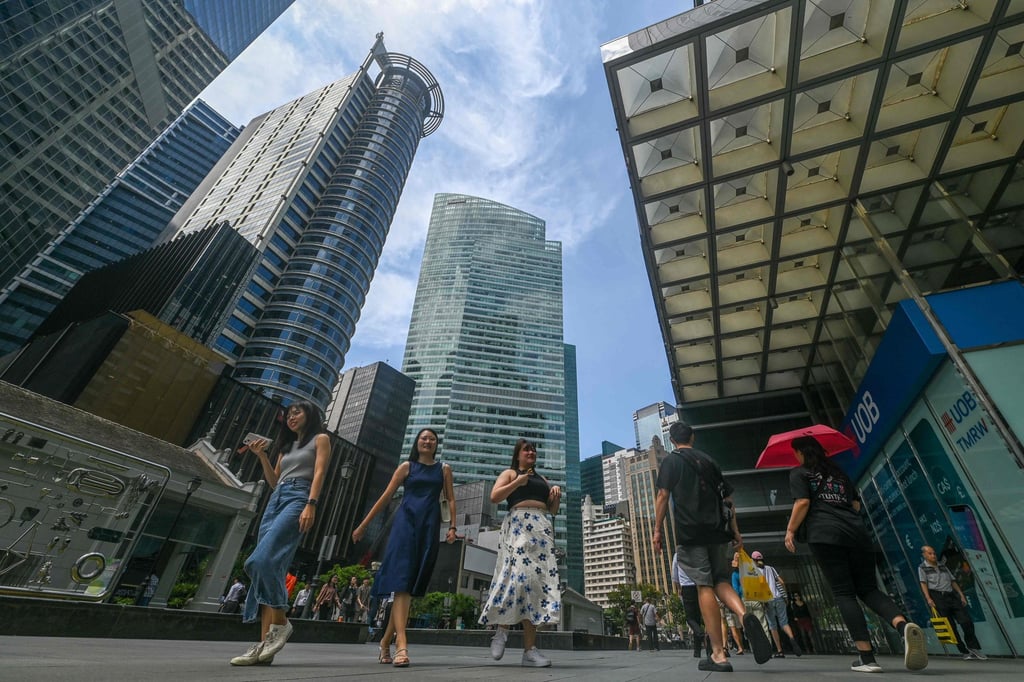
People walk out for a lunch break in the Raffles Place financial business district in Singapore. The city state in October launched the Graduate Industry Traineeships scheme for fresh graduates. Photo: AFP
Walter Edgar Theseira, an associate professor of business at the Singapore University of Social Sciences, said it was too early to tell how effective Grit would be in solving current labour market problems.
He cited concerns such as firms creating positions for marginal work and not paying full salaries, or converting full-time positions to subsidised ones such as traineeships.
“This might be good and bad; it might allow for an eventual better fit and some skills development, but might lead to subsidised underpayment of workers who would otherwise have been hired under regular terms.”
Recent graduates who spoke to This Week in Asia cited low remuneration and a lack of job stability as reasons for forgoing the traineeship.
The median gross monthly salary of fresh graduates in full-time work was S$3,500 in 2024. For graduates from autonomous universities such as NUS and NTU, the median monthly salary was S$4,500, according to a graduate survey conducted by the institutions.
Dave Ho, who graduated from NTU with a business degree last December, said he felt the scheme was not “worth it” as he was getting a higher salary during his internship at a tech company when he was an undergraduate.
The 27-year-old also voiced concern about having to return to the job market if the traineeship did not lead to an offer of a permanent role.
“I don’t think companies will be able to squeeze a headcount at the end of the traineeship, and trainees might not be able to land a job after the programme,” he said.
Getting a foot in the scheme, however, could prove difficult. Tan from NTU said an offer for a Grit role did not materialise despite applications to about 40 openings. According to the job portal, some Grit openings have received more than 100 applications.
Manpower Minister Tan See Leng had in September said the number of traineeships was meant to ensure programme quality and manage the risk of “crowding out” full-time roles. The government, however, was prepared to expand the initiative if the economy worsened, or if demand for traineeships grew, he added.

Dave Ho, who graduated from NTU in Singapore with a business degree in December 2024, ventured into live streaming earlier this year. Photo: Dave Ho
Carving their own path
In the face of labour market uncertainty, some graduates have opted to start their own businesses amid a desire to take charge of their careers.When Ho from NTU failed to land a job after about 200 applications, he decided to venture into live streaming in April, selling products for clients on social media platforms.
“Some people think I set out to be a live streamer, but it was more of desperation and I started dabbling in this, and now I’m really trying to make it work,” he said.
According to manpower ministry statistics on this year’s labour force released in advance last month, the number of residents who held a self-employed role as their main job increased to 179,200, up from 169,000 last year. The study showed that 95.5 per cent chose such work out of preference.
Xia lauded entrepreneurial ventures and said they would equip graduates with crucial critical thinking skills. She warned against viewing the pathway as one of less stability and insurance.
“If two to three years from now, the labour market improves and hiring opportunities are more abundant, they have a choice to switch to working for a company, or continue to grow their business if they are doing well,” she said.
Theseira also called for more attention to carving out non-graduate pathways for success, noting the tendency in Singapore and Asia to prioritise degree qualifications over skills when hiring.
“This encourages people to take up degree education even when they may not be suited for it, which significantly worsens graduate employment,” he said.

In her search for job fulfilment and ownership, Esther Low launched a business in Singapore selling vanity cases after turning down a job opportunity in a finance firm. Photo: Esther Low
With rejections piling up, Tan from NUS decided to take a leap of faith. In June, he launched Vincible3d, a 3D printing business, using his salary as a floorball coach as a start-up fund.
“I have always wanted to start my own business, and I chose this path because I genuinely enjoy designing and building new products,” he said.
“I get to learn very quickly because I’m forced to handle everything myself, from design to production, to marketing and sales.”
Esther Low started laying the groundwork for her business venture, Maison Ellure, half a year after graduating from NTU with a business degree in December 2024.
Low, 23, said she always knew she wanted to start a business, and her idea to build it around vanity cases for women was sparked by her love for travel.
After applying for about 50 job openings, she received an offer for a finance role but felt it wasn’t the right fit. She accepted an offer as a wealth management analyst in September and plans to use her salary to grow her business.
“I don’t want to do something that I would be unhappy with or dread doing,” she said. “Starting and doing something really excites me in a way I’ve never been, and I can feel my heart burning for it.”

Kolette Lim
Kolette Lim joined the Post’s Asia desk as a reporter in 2025, and writes about a wide range of topics concerning Singapore and the region. She graduated from Nanyang Technological University with a degree in Communication Studies and a second major in Business. She previously wrote for The Straits Times, where she covered breaking news.
Singapore
This Week in AsiaLifestyle & Culture
Singapore’s unforgiving food scene can go hot and cold on brands. What keeps them coming?
Over 3,000 eateries shut their doors last year, the highest since 2005, in one of the world’s most competitive dining markets
Reading Time:3 minutesWhy you can trust SCMP
5
Listen
Further Reading
As more department stores in Singapore struggle, can they adapt and survive?
‘It’s life’: ex-NBA star in Singapore for brain cancer treatment exudes hope
Why Southeast Asia’s move to protect children online may fuel state surveillance
Can Singapore’s cyber laws keep pace with speed of borderless online threats?
Discover MORE stories on
Singapore
now and stay updated with
Former Singapore lawyer and human rights activist M Ravi dies
Singapore’s young graduates feel the heat in ‘draining’ job hunt
Business class thief jailed after targeting Singapore Airlines passengers
related topics
Singapore
McDonald's | Food and Drinks | Asian Cuisine | Chinese cuisine | Starbucks | Consumers | United States | Singapore Management University (SMU) | Singapore University of Social Sciences
discover more stories from
Singapore
Explainer |
HKIC ends year on high note but Hong Kong cost of living a drawback for talent
Browse other locations
China
Asia
North America
Middle East
Europe
Russia and Central Asia
Oceania
Africa
Americas and Caribbean
Before you go
scmp poll

Jean Iau
Published: 1:30pm, 21 Dec 2025Updated: 1:41pm, 21 Dec 2025
Singapore has long been a proven test bed for international food and beverage chains as a wealthy, brand-savvy market where new entrants can generate instant buzz – and just as quickly disappear for those who fail to cook up a storm.
The first part of that pattern was on display this month, with long queues forming outside the first Asia outlet of US fast-food chain Chick-fil-A more than a week after it opened in the city state.
The crowds reflect the initial pull of a well-known American brand, but industry analysts say Singapore’s unforgiving dining landscape means early hype is rarely a reliable predictor of long-term success.
Chick-fil-A, the third-largest fast-food chain in the United States by sales, opened its doors at Bugis+ on December 11, serving its signature chicken sandwich and waffle potato fries, alongside a range of sauces – including a Singapore-exclusive spicy chilli.
Chris Wang chose to spend his day off in the dine-in queue while waiting for his wife to take her lunch break. The 31-year-old, who works in IT, eats fast food at McDonald’s two to three times a week because of its consistency, a trait that he believes matters deeply to Singaporeans.
“Singaporeans always say ‘the standard dropped’, that’s the main thing that causes places to fail. If I patronise a store regularly and one day I go down and the food is not nice, the ingredients are not fresh, or the portion is suddenly stingy, then I probably won’t go back,” Wang told This Week in Asia.
Industry experts agree, saying consistency is a key ingredient for franchises to survive in Singapore’s saturated market, where Western franchises like McDonald’s and Starbucks are facing stiffer competition from Chinese brands like Haidilao, Luckin Coffee and Mixue.

Chick-fil-A, which has opened its first outlet in Singapore, is known for its signature chicken sandwich and waffle potato fries. Photo: YouTube/Chick-fil-A
Chick-fil-A’s launch comes at a challenging time for the sector, with food and beverage businesses closing at the fastest pace in nearly two decades.
A total of 3,047 establishments shut their doors last year, the most since 3,352 closures in 2005, highlighting what industry observers describe as one of the world’s most competitive dining markets.
Local media outlets reported in October that local F&B veteran Chyn Koh was selected to own and operate the Chick-fil-A outlet in Singapore out of over 700 applicants. The 49-year-old has 17 years of experience running Subway outlets before he divested them to take up Chick-fil-A’s franchise.
In line with the franchise’s tradition of having one operator per outlet for most of its operations with minimal individual investment, Koh paid S$15,000 (US$11,540) in franchise fees.
Having local stewardship improves a foreign brand’s chances, but only up to a point, according to analysts.
Emil Fazira, Asia-Pacific food insight manager at data analytics firm Euromonitor International, said brands built around narrow or highly specific cuisines, such as Taco Bell and Eggslut, often struggled to connect with local taste buds over time.
Chains without a strong competitive edge or memorable market positioning, such as Wendy’s, had also failed to gain traction, she said.

Starbucks coffee cups in Christmas festive colours. Western franchises like Starbucks and McDonald’s have been able to thrive in Singapore’s challenging food scene. Photo: AP
Hungry for novelty
In Singapore, McDonald’s, Haidilao and KFC took the top three spots on Euromonitor International brand rankings last year.Established brands like McDonald’s and Starbucks have strong brand power globally that is not easily replicated, according to Fazira.
“In terms of menu offering, while these two global brands do innovate with frequent limited time offers and seasonal menus, they also have signature menu items and meals that consumers can rely on and have built a following of returning customers.”
Dianna Chang, an associate professor of marketing at the Singapore University of Social Sciences, said the threat of substitutes was substantial as hawker food – an integral part of Singapore’s culture – directly competed with fast food and the lower end of the dining market.
Consumers are also highly value-conscious and spoiled for choice, while Singapore’s supply constraints can pose a challenge for food businesses.
“The key lies in establishing a clear and compelling unique selling proposition – something Chick-fil-A has historically executed well. Consumers do not visit fast-food chains for variety; rather, they value convenience, consistency and distinctive, specialised flavours,” Chang said.
This means that success will depend on the brand focusing on quality while responding to local tastes. “Above all, product quality must remain high and consistent, with flavours that are authentic and appealing.”
Foreign chains may be able to leverage their success overseas to create the initial hype, but to sustain growth, they must adapt to the lifestyles of consumers in the heartland and central business districts, according to Fazira. Beyond localising the menu, they should also offer seasonal sets for the price-sensitive and novelty-seeking consumers.
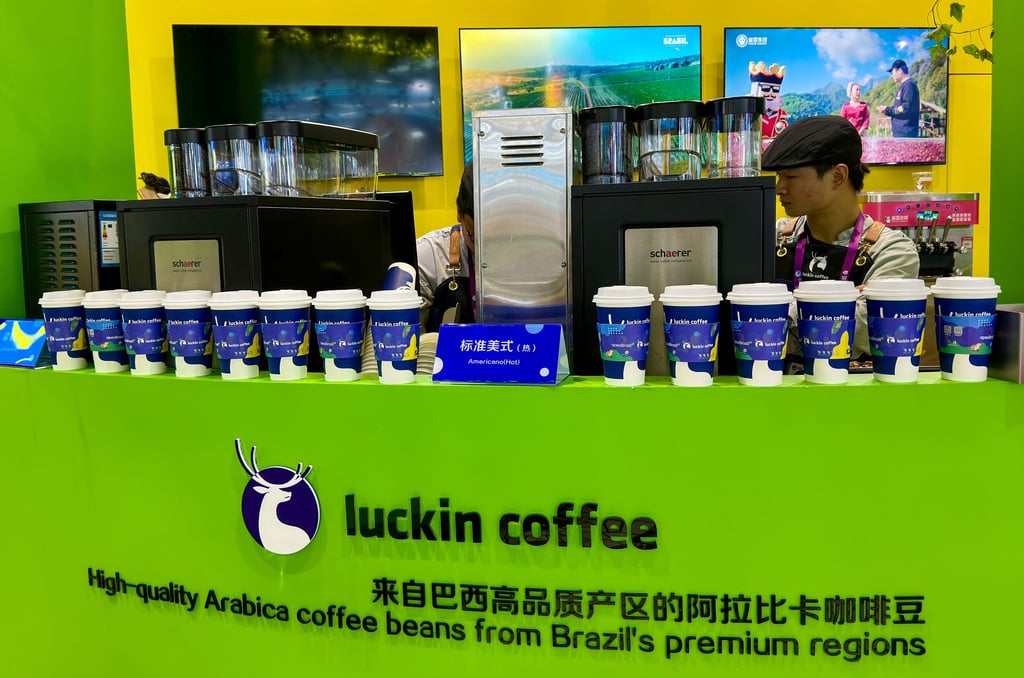
Chinese coffee shop chain Luckin Coffee at the China International Import Expo in Shanghai. Chinese brands like Luckin Coffee, Haidilao and Mixue have expanded their presence in Singapore in recent years. Photo: Frank Chen
The experts noted that aggressive marketing to establish a brand was also a key strategy. Luckin Coffee, for example, offers drinks for 99 Singapore cents (80 US cents) to first-time app users.
Seshan Ramaswami, an associate professor of marketing education at the Singapore Management University, said that in a market saturated with cafes and local coffee shops, Luckin’s app-based ordering system and takeaway model made it stand out, while allowing it to save on rent and automatically generate user data.
“Constant innovation in product assortment as well as operating model, and offering thematic specials especially relevant to Singapore, such as school holidays and National Day celebrations, are key to long-term survival in what is a saturated market, but yet eager for innovation,” he said.
“Singaporean consumers are going to be experiencing an eternally evolving set of international F&B brands, even as they always have the comfort of their hawker centre favourites.”


