

- Joined
- Aug 20, 2022
- Messages
- 32,110
- Points
- 113
Singapore studying separate car licence plates for EVs to warn SCDF, public in cases of fire: MHA
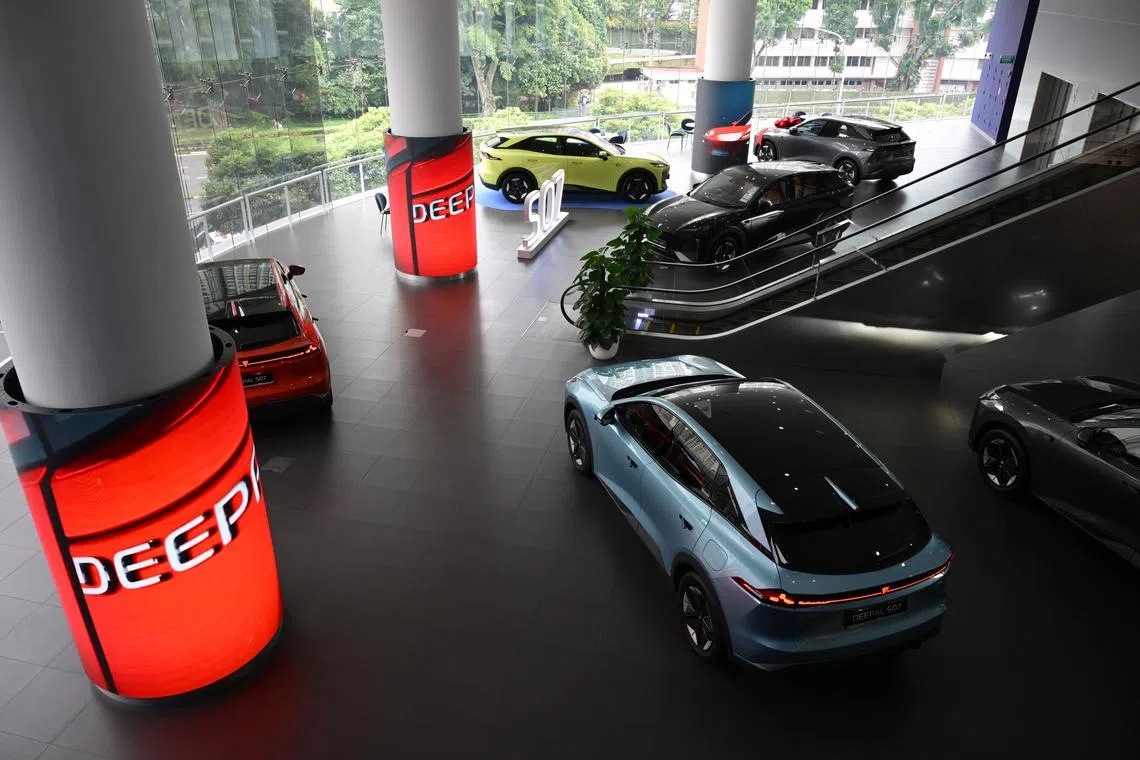
The visual cue will also help members of the public who see a burning EV to be aware and stay further away from the blaze.
ST PHOTO: NG SOR LUAN
Andrew Wong
SINGAPORE – The authorities will continue to study if electric vehicles (EVs) need a different car licence plate from traditional vehicles to help first responders identify if specialised procedures are needed during incidents.
The visual cue will also help members of the public who see a burning EV be aware and stay farther away from the blaze.
Law Minister Edwin Tong said this on Feb 27 during the debate on the Ministry of Home Affairs’ (MHA) budget.
The move to study the possibility of fitting all EVs in Singapore with specialised car plates was
first raised
by National Development Minister Chee Hong Tat in a written parliamentary reply in August 2024. Mr Chee was Transport Minister then.
Mr Tong, who is also Second Minister for Home Affairs, was addressing Parliament on the emerging risks MHA was monitoring, including the different risks EVs pose from traditional petrol- and diesel-powered vehicles when they catch fire.
Said Mr Tong: “While research has shown that fires in electric vehicles are less likely than in internal combustion engine vehicles, EVs pose different risks when they catch fire, and require a different management approach.”
He said MHA and the Ministry of Transport (MOT) will continue studying the use of differentiated licence plates for traditional vehicles and for EVs, to address the emerging fire safety risks.
The Land Transport Authority and the Singapore Civil Defence Force (SCDF) told The Straits Times they will engage the motor industry and EV owners for their views on the proposal.
The agencies said: “The proposed EV identifier (EVI) designs must ensure visibility and ease of identification. There will only be one common EVI design for EVs and plug-in hybrid vehicles. More details on the final design and implementation process will be provided in due course.”
Annual statistics from SCDF showed that
four EVs caught fire in 2025
, up from just one in 2024.
LTA data showed that there were 50,025 registered EVs in Singapore, including cars, taxis and motorcycles, as at Dec 31, 2025.
Singapore’s total vehicle population was 833,103.
Mr Tong also addressed the fire safety risks posed by
active mobility devices (AMDs)
, which include personal mobility devices (PMDs), power-assisted bicycles and personal mobility aids.
From June 1, keeping non-compliant AMDs, whether at home or elsewhere, that do not meet UL2272 standards will be an offence.
Mr Tong noted that all AMD fatalities recorded in Singapore involved devices which did not comply with the standards.
Motorised devices here are required by law to meet the UL2272 standard for motorised PMDs and the EN15194 standard for e-bikes. Only AMDs that meet these standards can be imported into and used in Singapore.
MOT will also tighten regulations in 2026 on the online sale and advertising of AMDs.
This is even though the number of AMD fires in Singapore dropped to 49 in 2025 from 67 in 2024. Of those in 2025, 34 cases occurred in residential premises.
Those convicted of using non-compliant AMDs can be fined up to $10,000, jailed for up to six months, or both. Repeat offenders face a fine of up to $20,000, up to a year’s jail, or both.
Those convicted of selling non-compliant AMDs can be fined up to $20,000, jailed for up to 24 months, or both. Companies can be fined up to $40,000.
On fire safety in buildings, Mr Tong highlighted the
Wang Fuk Court blaze in Hong Kong,
which killed 168 people in November 2025, after fire spread via the screening netting mounted on bamboo scaffolding surrounding several residential buildings.
He said Singapore has stringent controls to mitigate the spread of fires and bamboo scaffolds are not permitted at building and construction sites.
He added: “Nevertheless, the authorities are thoroughly reviewing our scaffolds and netting safety regimes.”
Mr Tong said Singapore’s overall rate of fire incidents has remained low by international standards – with about 2,000 incidents annually over the past five years.
He added: “Over the past three years, over 98 per cent of the buildings which require a fire certificate (FC) have ensured that their fire protection systems remain reliable.”
Owners or occupiers of public buildings must obtain an FC to ensure the proper maintenance and working condition of fire safety systems in the building.
Mr Tong said that to incentivise good fire safety management and lower the administrative and processing costs for compliant building owners and occupiers, SCDF will, from April 1, extend the validity of FCs from one year to three years.
On Singapore’s anti-drug efforts, Senior Minister of State for Home Affairs Faishal Ibrahim said that while Singapore’s tough laws and enforcement have kept the drug situation under control, the global drug situation was becoming more challenging.
Pointing to a
report by the United Nations Office on Drugs and Crime
, Associate Professor Faishal, who is also Acting Minister-in-charge of Muslim Affairs, said 236 tonnes of methamphetamine were seized in East and South-east Asia in 2024.
“Singapore is vulnerable to these developments. Methamphetamine remains the most commonly abused drug in Singapore, reflecting the worldwide trend,” said Prof Faishal.
In 2025, the Central Narcotics Bureau (CNB) dismantled 25 drug syndicates and seized over $21 million worth of drugs. To aid its work, the Government will amend the Misuse of Drugs Act.
Prof Faishal said: “We will introduce a presumption clause for hair test results. This means that if a controlled drug is found in a person’s hair, they will be presumed to have abused it. This gives CNB a stronger tool for enforcement, since hair tests can detect abuse over a longer period.”


