

- Joined
- Aug 20, 2022
- Messages
- 32,197
- Points
- 113
Singapore executes three men for drug offences over two days
4 hours agoKelly NgSingapore
Share
Save
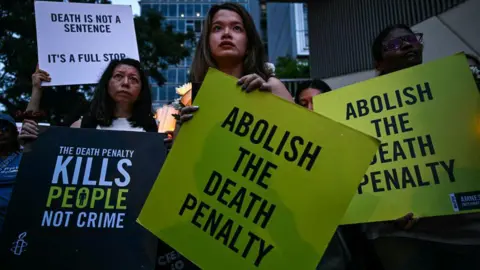
Singapore has some of the world's harshest anti-drug laws, which it says are a necessary deterrent to drug crime
Singapore hanged three people for drug offences last week, bringing the total number of executions to 17 this year - the highest since 2003.
These come a week before a constitutional challenge against the death penalty for drug offences is due to be heard.
Singapore has some of the world's harshest anti-drug laws, which it says are a necessary deterrent to drug crime, a major issue elsewhere in South East Asia.
Anyone convicted of trafficking - which includes selling, giving, transporting or administering - more than 15g of diamorphine, 30g of cocaine, 250g of methamphetamine and 500g of cannabis in Singapore will be handed the death sentence.
The seven activists who filed the constitutional challenge argue that Singapore's mandatory death penalty violates constitutional rights to life and to equal protection of the law.
The constitution states that "no person shall be deprived of his life or personal liberty save in accordance with law".
"Singapore's barbaric drug control regime is increasingly alone on the world stage," local activist group the Transformative Justice Collective said, noting that it is one of a few countries that continue to execute people for drugs offences.
The Singapore government maintains that removing the death penalty could lead to more dire consequences.
These include more serious crime, violence, drug-related deaths, including the deaths of innocent young children, its Home Affairs Minister K Shanmugam said earlier this year.
"As policy makers, we set aside our personal feelings, and do what is necessary to protect the majority of people.. we cannot be at peace with ourselves, if we take a step which leads to many more innocent people dying in Singapore," he wrote in a Facebook post in January.
Among those executed last Wednesday and Thursday was logistics driver Saminathan Selvaraju, who was found guilty of transporting 301.6g of diamorphine, also known as heroin, from Malaysia to Singapore on the night of 21 November 2013.
Saminathan argued that he had driven his company's trailer earlier in the day, but not when the drugs were brought into Singapore. Several drivers used the same vehicle, he said.
Investigators found pre-written immigration cards with his signature in the vehicle, one of which had the Singapore address of the place where the drugs were eventually discovered. But Saminathan, a Malaysian national, argued that he was not the one who wrote it.
The judge rejected his defence and he was hanged on Thursday.
Over the years Saminathan was involved in several civil actions against the death penalty, including a constitutional challenge he filed with three others on death row in 2022, against certain presumptions in Singapore's drug statutes.
For instance, the law presumes someone found with narcotics in quantities exceeding the stated thresholds is a trafficker, unless the person can prove otherwise.
As another example, someone who holds keys to a place where illicit drugs are found is presumed to have possessed them until proven otherwise.
Singapore's highest court dismissed the challenge in August, noting that the law is written as such "to address a problem that is thought to be a scourge on society".
In September, Saminathan and the other three prisoners submitted a clemency plea to the president, which was rejected - as most such appeals in Singapore are.
In Singapore, the death penalty is also imposed in offences such as murder and kidnapping, but its application in drug-related crimes has drawn the most criticism.
A key argument made by critics is that it predominantly punishes low-level smugglers and couriers recruited from marginalised communities, including lower-income groups, but does not weed out the kingpins.
Lawyer Mervyn Cheong, who has defended prisoners on death row, says he finds it challenging at times to "reconcile why mandatory death sentences must apply to murder or certain drug-related offences, when perpetrators of more egregious international crimes do not face the same penalty".
He noted that under the Rome Statute, which established the International Criminal Court and has been ratified by 125 countries, the maximum punishment for the gravest of crimes - such as genocide and war crimes - is life imprisonment.
The European Union's delegation to Singapore says the executions last week represented a "significant increase in the use of capital punishment" in the city state.
"Imposing the death penalty for drug offences is incompatible with international law, as these offences do not meet the threshold of 'most serious crimes'," it said in a statement, adding that the punishment makes rehabilitation impossible.
The Singapore government however argues that the death penalty has helped make it one of the safest places in the world, with its home ministry saying the sentence is applied only in offences "involving the most serious forms of harms to victims and to society".
A 2023 survey commissioned by the ministry showed that about 69% of the 2,000 citizens and permanent residents polled agreed that the death penalty is an appropriate punishment for those convicted of trafficking a significant amount of drugs.


