
- Joined
- Aug 20, 2022
- Messages
- 28,172
- Points
- 113
Fewer fresh S’pore uni graduates in 2025 found full-time work, but pay held steady: Survey
www.straitstimes.com
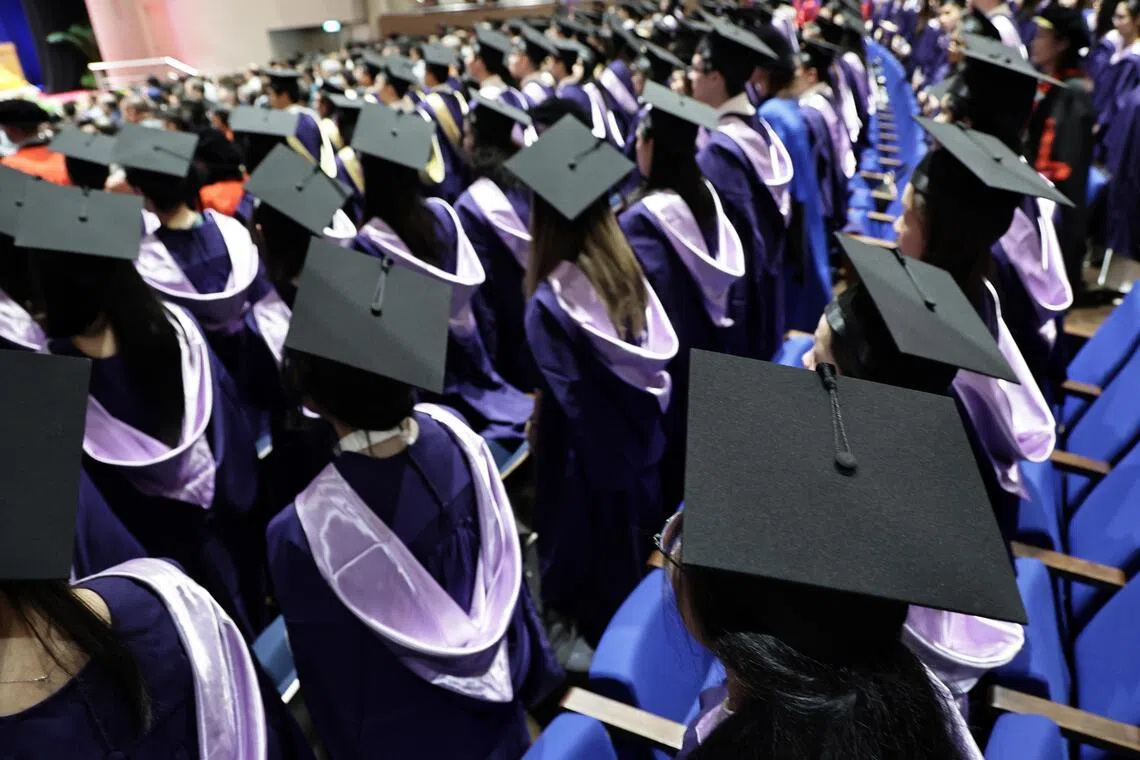
ST PHOTO: KELVIN CHNG

Shermaine Ang
Published Mar 05, 2026, 03:00 PM
Updated Mar 05, 2026, 06:31 PM
SINGAPORE - Graduates fresh out of local universities saw a further drop in employment, especially for full-time roles, though salaries held steady.
Results from the latest graduate employment survey, released on March 5, showed that 74.4 per cent of graduates secured full-time positions in 2025,
down from 79.4 per cent in 2024.
Overall, a higher proportion of graduates entered the labour force, from 90.7 per cent in 2024, to 92.2 per cent in 2025. This refers to those who are either working or unemployed but actively looking for a job.
Among those who did find full-time jobs, the median gross monthly salary stayed at $4,500 in 2025, the same as in 2024.
A higher proportion of graduates applied for jobs but did not get any offers in 2025, rising to 8.5 per cent from 5.7 per cent in 2024, and 4.1 per cent in 2023. At the same time, more graduates took on part-time or temporary employment, with 7.2 per cent doing so in 2025, from 6 per cent in 2024, and 4.1 per cent in 2023.
The joint statement from the six local universities said the number of job vacancies has moderated from the post-pandemic peak, driven by reduced churn and slower hiring.
“This reflects a more cautious hiring sentiment amid broader economic uncertainty and geopolitical developments.
“While there continues to be entry-level job opportunities, some outward-oriented sectors, such as information and communications, saw more subdued hiring compared with previous years,” said the statement.
It added that the survey reflects graduate employment outcomes six months after graduation, and these generally improve beyond the six-month mark, based on past cohorts.
Based on labour market data from the Ministry of Manpower, about four in 10 entry-level vacancies for fresh graduates are in growth sectors such as financial and insurance services and professional services, and in occupations such as financial compliance officers, risk analysts and auditors, the statement said.
Starting in 2026, the survey’s results reflect whether graduates have secured employment or not, instead of the previous employed-unemployed split.
This change started with the
latest graduate employment survey by the five polytechnics
released earlier on Jan 15.
Those who have secured employment include graduates who are already working – full-time, freelance or part-time – as well as those who have accepted a job offer and will start later, or are actively taking steps to start a business.
In past iterations, the “employed” category captured only those who were already in a job at the point of the survey, while those due to start jobs later or setting up businesses were counted as unemployed.
The latest results also, for the first time, gave more details about graduates who have not secured work. This group falls into three categories: those who received but rejected job offers, those who applied but did not receive any offers, and those who did not look for full-time work.
Some 14,400 graduates from full-time programmes at the National University of Singapore, Nanyang Technological University, Singapore Management University (SMU), Singapore University of Technology and Design, Singapore Institute of Technology and Singapore University of Social Sciences took part in this survey, representing a response rate of 73.7 per cent.
They were surveyed by the six universities on their employment status as at Nov 1, 2025, about six months after the completion of their final examinations.
Health sciences, built environment, and information and digital technologies were the three course clusters that continued to record the highest full-time permanent employment rates for graduates in 2025, ranging from about 78 per cent to 89 per cent.
Graduates of information and digital technologies courses continued to take home the highest monthly pay, at $5,500 in 2025 – the same as in 2024.
Graduates who need help in their job search can reach out to their universities for career coaching and attend career fairs. They may also tap resources from Workforce Singapore or NTUC’s Employment and Employability Institute, or explore Graduate Industry Traineeships and GRIT@Gov programmes launched in October 2025.
OCBC Bank chief economist Selena Ling said the 5 percentage point drop in graduates securing full-time employment in 2025 is “not insignificant”, suggesting that it is getting more challenging for fresh graduates to find permanent employment.
“That said, the outlook is uncertain but not necessarily bleak as almost three in four are still employed, but it may take longer to get the job,” she said.
Ms Ling said this is due to a combination of cyclical economic caution and structural changes in the labour market, such as how entry-level jobs may be increasingly automated by artificial intelligence.
She added that geopolitical and tariff uncertainties may have slowed down capital expenditure – investments a company makes to grow or maintain its business operations – and hiring needs in the short term.
“For the vacancies employers need to fill, they may prefer experienced staff or those with specialised skills, or they may choose to employ contract or temporary staff for the junior roles until there is greater clarity,” Ms Ling said.
Fresh university graduate Crystal Yong, a full-time management associate at Resorts World Sentosa, described the job hunt as tiring.
The 23-year-old who studied marketing analytics started applying for full-time jobs at the start of her final year in SMU, with her eye on management associate roles.
She applied to nearly 30 roles, around half of which she did not hear back from.
Ms Yong said she felt demoralised when she was turned down for a management associate position at a company she had interned at, after reaching the final round of interviews.
She discovered her interest in tourism and working with colleagues from around the world through marketing internships in Bangkok and Bali, under SMU’s ASEAN Internship Programme.
Ms Yong received two job offers in March 2025, a month before graduating, and chose the one that better aligned with her interest in tourism.
“I’m happy with where I am right now,” she said.

