

- Joined
- Aug 7, 2008
- Messages
- 5,782
- Points
- 113
Massage shops set for stricter rules; no rooms, partitions or cubicles in open-concept outlets
Get ST's newsletters delivered to your inbox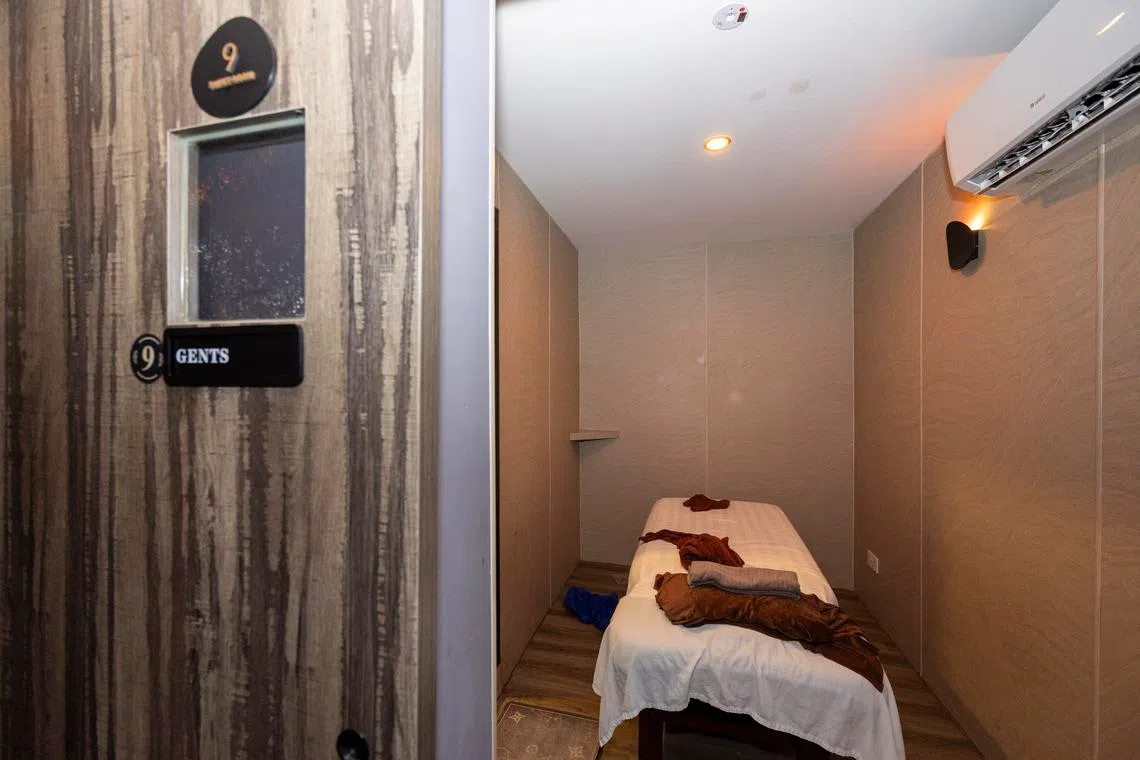
Under the new regime, slated to come into force by the second half of 2026, all massage establishments will be subjected to the same “fit and proper” requirements.
ST PHOTO: BRIAN TEO

Published Apr 21, 2026, 12:35 PM
Updated Apr 21, 2026, 12:50 PM
Listen
SINGAPORE - A mandatory licensing regime will be imposed on all massage establishments, with police bringing an end to rooms, partitions and cubicles for open-concept outlets which were supposed to operate in full view of the public.
The change comes in the wake of public unhappiness over the current system, with the Singapore Police Force (SPF) noting an increase in vice-related activities and infringement of conditions imposed on open-concept massage establishments.
Open-concept establishments were exempted from licensing since 2018, but are required to be registered with the police.
Under the new regime, slated to come into force by the second half of 2026, all massage establishments will be subjected to the same “fit and proper” requirements.
The new regime will also remove the licensing exemption for open-concept massage establishments.
They will be subjected to more stringent licensing criteria, and a requirement to obtain the relevant approvals from the Housing Board or Urban Redevelopment Authority before setting up shop.
These establishments must also comply with conditions including the requirement to not have rooms, partitions or cubicles within the shop.
"Since the exemption took effect in 2018, the police have observed a steady rise in public unhappiness, arising from the increase in number of open-concept massage establishments and the social disamenities they create.
Police have also observed an increase in vice-related activities and infringements of exemption conditions in open-concept massage establishments,” said SPF in a statement on April 21.
Massage establishments are grouped under three categories.
Category 1 licences are granted to those that operate in HDB shop houses, shopping centres and hotels, while Category 2 licences are given to those operating in spaces away from residential areas, schools and places of worship.
Open-concept massage establishments will require Category 3 licences.
SPF said they will also introduce three other changes to the Massage Establishments Act.
First, shops will have to display a poster on its shop front stating the licence number of the shop, as well as a URL for members of the public to report regulatory breaches.
Second, to reduce administration burden on compliant establishments, SPF will extend licence tenures for up to five years, compared to the three years currently.
New licensees under Category 1 and 2 will be issued with a one-year provisional licence, before they are assessed again depending on their compliance history.
New Category 3 establishments will be issued with licences of up to three or five years from the outset, subject to SPF’s approval.
Police said they will also introduce mandatory industry-wide standards on uniform decency that establishments must comply with, removing the current requirement for establishments to seek approval for employee uniforms.
Enforcement actions will be taken against errant shops that do not comply with the new uniform standards.
The changes to the industry will be implemented in the second half of the year, after SPF engages with massage establishment associations and operators.
Existing open-concept massage operators will be granted a grace period to apply for the new Category 3 licence after the changes come into force.
Calls for review
The changes to the licensing regime come after concerns were raised over the industry.
Ms Denise Phua (Jalan Besar GRC), had called for a review of the regulations surrounding massage businesses in Parliament on February 4.
In an adjournment motion, Ms Phua said the exemption of some massage establishments from licensing have affected residents, adding that residents in Crawford estate were uncomfortable with the “visible solicitation activities” outside some massage establishments.
Senior Minister of State for National Development Sun Xueling responded, saying that the authorities take a “three-strikes” approach.
Ms Sun added that HDB and the police had worked with private owners of the HDB shops to evict close to 40 massage establishment operators in 2025.
The number of massage establishment licences being given out has decreased over the past three years, from 907 in 2023 to 868 in 2025.
On April 18, the PAP’s Women’s Wing held its first listening session to discuss ways to achieve a more family-friendly neighbourhood.
A key talking point was the emergence of massage establishments that offer vice activities in neighbourhoods, which came in the wake of a report by The Straits Times that revealed a rise in the number of beauty and massage businesses in the heartland.
At the dialogue, PAP Women’s Wing’s central district adviser Ms Elysa Chen said the group would be pushing for policy advancements and will continue raising residents’ concerns over these establishments in Parliament.
As at January, there were some 15,600 HDB shops – 8,500 of them privately owned and 7,100 rented out by HDB.
The Housing Board told ST in March that around 13 per cent of the shops it rents out are beauty and wellness establishments, including hair and beauty salons, TCM facilities and massage establishments.
Last edited:


