

- Joined
- Sep 2, 2023
- Messages
- 6,316
- Points
- 113
LOL
https://www.straitstimes.com/busine...4m-once-rts-link-opens-study?ref=stories-card

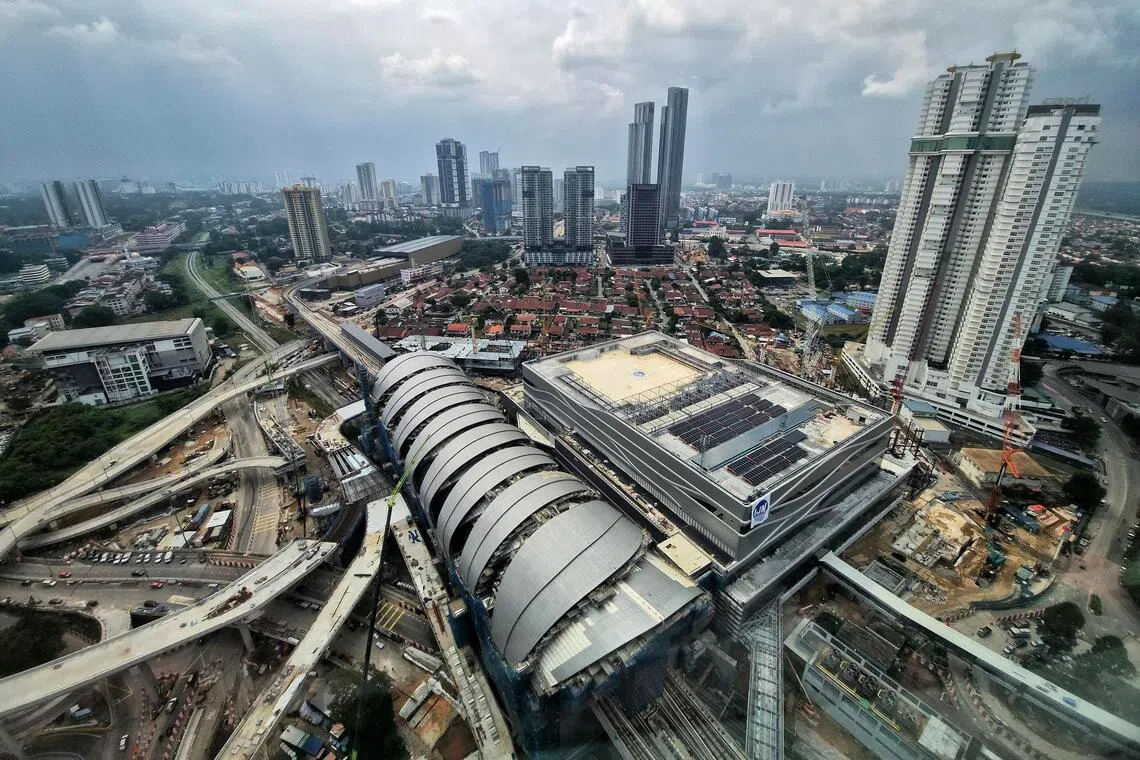
The Johor Bahru-Singapore RTS Link station and Johor Bahru Town on July 13. Singaporeans are projected to spend $1.05 billion more across the Causeway when the Johor Bahru-Singapore RTS Link begins passenger service in January 2027.
ST PHOTO: ARIFFIN JAMAR
Alyssa Woo
Published Jul 16, 2026, 10:00 AM
Updated Jul 16, 2026, 10:49 AM
Set as preferred source
Listen
SINGAPORE – When the Johor Bahru-Singapore RTS Link begins passenger service in January 2027, Singaporeans are projected to spend $1.05 billion more across the Causeway – nearly 40 per cent higher than the $756 million increase in spending by JB visitors in Singapore.
The projections come from a joint study released on July 16 by the Singapore Business Federation (SBF), the Restaurant Association of Singapore (RAS) and the Singapore Retailers Association (SRA), examining how the RTS Link could reshape consumer spending, tourism flows and business competitiveness in Singapore’s retail and food and beverage (F&B) sectors.
The study projects a 51 per cent annual increase in Singapore consumers crossing over to JB once the railway shuttle opens, with groceries, pharmacies, dining and beauty currently topping the list of categories Singaporeans spend on.
Among JB respondents, 34 per cent said they intend to visit Singapore once the RTS Link opens, with annual visits by public transport users projected to rise by 57 per cent on average, the study found.
Visitors who previously drove into Singapore said they would switch to the RTS Link, with a preference for overnight stays and spending on entertainment.
Currently, public transport options between both cities are the KTM Shuttle Tebrau train or cross-border buses and taxis. The RTS Link is intended to offer a faster, higher-frequency alternative to the KTM service.
Tech
World
Opinion
Asia
Singapore

Sport

Business
Small and medium-sized enterprises (SMEs) were particularly concerned about adapting as quickly as larger operators, and called for more support to strengthen competitiveness and capture new opportunities from increased cross-border flows.
Still, the billion dollars Singaporeans are projected to spend in JB is a small portion of Singapore’s retail and F&B sector, which contributed about $16.6 billion to the economy in 2025.
The study underscored the need for stronger collaboration among trade associations, landlords, tourism stakeholders and government agencies to help businesses respond to changing consumer trends and increased cross-border connectivity.
Kok Ping Soon, SBF’s chief executive, said the RTS Link will create opportunities for Singapore businesses to attract more visitors, but noted that it also raises competitive pressure, particularly for the retail and F&B sectors.
“This shift is structural, not incremental. Businesses must adapt beyond price competition by strengthening their offerings, experiences and productivity, while industry and the Government must work together to help them compete in a more connected cross-border market,” he said.
SRA’s president Ernie Koh said they anticipate a “measurable shift in consumer behaviour” with the opening of the RTS.
“While local retailers pivot heavily towards experiential concepts, and malls actively curate tenant remixes, we look forward to specific government mitigation measures such as increased manpower flexibility and support over the next three to five years,” he said.
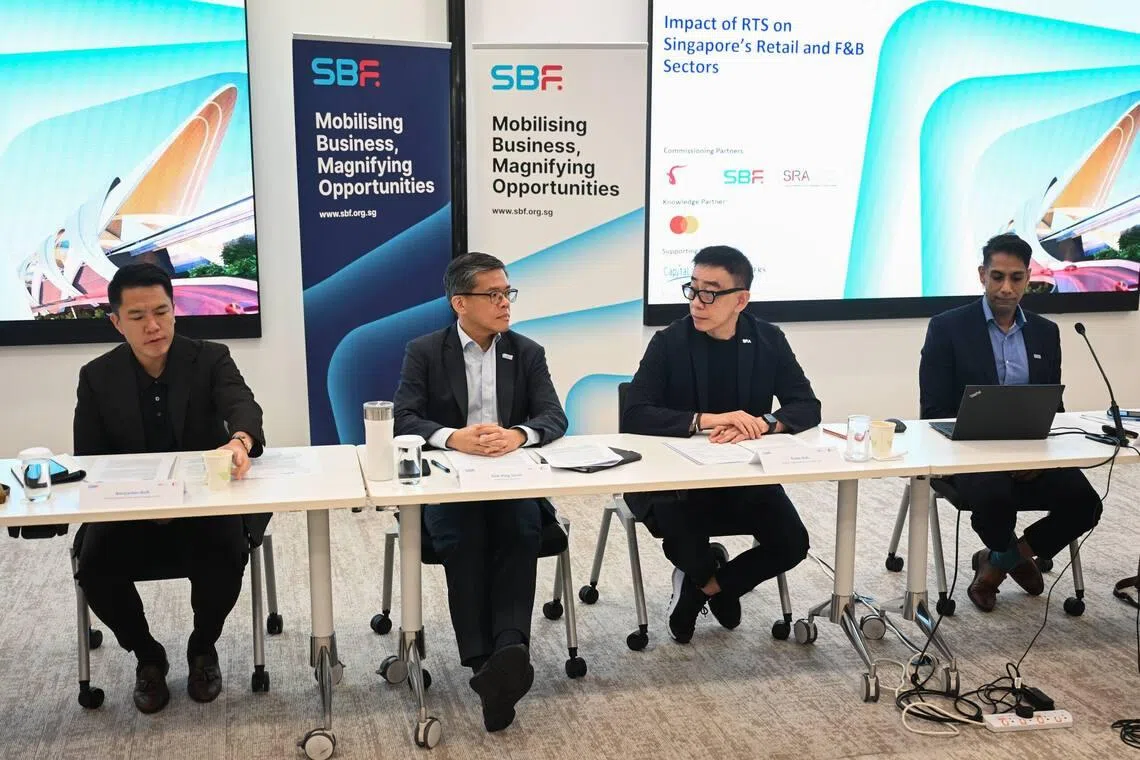
(From left) RAS president Benjamin Boh, SBF chief executive Kok Ping Soon, SRA president Ernie Koh and SBF chief policy and operating officer Musa Fazal at the SBF Center on July 16.
ST PHOTO: SHINTARO TAY
Benjamin Boh, president of RAS, said: “Singapore’s F&B sector currently operates in a dynamic and cost-sensitive climate. With increased cross-border travel, we can expect new pressures to be introduced on an already highly competitive F&B industry at large, and opportunities for selective players based on where inbound visitors typically spend their money.
“To capture both local and tourist spending, businesses must be empowered with manpower agility and operational flexibility to consistently deliver compelling dining experiences that give local consumers more reasons to spend in Singapore while attracting more visitors.”
More on this topic
RTS Link
Consumer culture
Food and beverage sector
Retail
Back to top
E-paper
Newsletters
Podcasts
RSS Feed
About Us
Terms & Conditions
Personal Data Protection Notice
Need help? Reach us here.
Advertise with us
Download the app
https://itunes.apple.com/sg/app/the-straits-times-for-iphone/id547465441?mt=8
https://play.google.com/store/apps/details?id=com.buuuk.st&hl=en
Get unlimited access to exclusive stories and incisive insights from the ST newsroom
Subscribe
MDDI (P) 046/10/2025. Published by SPH Media Limited, Co. Regn. No.202120748H. Copyright © 2026 SPH Media Limited. All rights reserved.
https://www.straitstimes.com/busine...4m-once-rts-link-opens-study?ref=stories-card
RTS Link to spur S’poreans to spend $1 billion more in JB a year: Study
Sign up now: Get ST's newsletters delivered to your inbox
The Johor Bahru-Singapore RTS Link station and Johor Bahru Town on July 13. Singaporeans are projected to spend $1.05 billion more across the Causeway when the Johor Bahru-Singapore RTS Link begins passenger service in January 2027.
ST PHOTO: ARIFFIN JAMAR
Alyssa Woo
Published Jul 16, 2026, 10:00 AM
Updated Jul 16, 2026, 10:49 AM
Set as preferred source
Listen
SINGAPORE – When the Johor Bahru-Singapore RTS Link begins passenger service in January 2027, Singaporeans are projected to spend $1.05 billion more across the Causeway – nearly 40 per cent higher than the $756 million increase in spending by JB visitors in Singapore.
The projections come from a joint study released on July 16 by the Singapore Business Federation (SBF), the Restaurant Association of Singapore (RAS) and the Singapore Retailers Association (SRA), examining how the RTS Link could reshape consumer spending, tourism flows and business competitiveness in Singapore’s retail and food and beverage (F&B) sectors.
The study projects a 51 per cent annual increase in Singapore consumers crossing over to JB once the railway shuttle opens, with groceries, pharmacies, dining and beauty currently topping the list of categories Singaporeans spend on.
Among JB respondents, 34 per cent said they intend to visit Singapore once the RTS Link opens, with annual visits by public transport users projected to rise by 57 per cent on average, the study found.
Visitors who previously drove into Singapore said they would switch to the RTS Link, with a preference for overnight stays and spending on entertainment.
Currently, public transport options between both cities are the KTM Shuttle Tebrau train or cross-border buses and taxis. The RTS Link is intended to offer a faster, higher-frequency alternative to the KTM service.
Worries about competition, manpower and cost pressures
Businesses across Singapore’s retail, F&B and wider business ecosystem said they were concerned that the RTS Link would intensify competition from JB, particularly in price-sensitive segments such as groceries, pharmaceuticals and beauty services, where lower cross-border prices are already shaping consumer spending patterns.Top stories
Explore top stories from all sections in one place
Tech
GovTech restructuring signals shift towards technical, outcome-driven roles: Experts
World
US strikes Iran again as Tehran warns of ‘existential war’ with America
Opinion
If haze season comes, Indonesia alone can’t fight the fires
Asia
Too many durians, not enough buyers: Malaysia eyes new China land route to clear record supply glut
Singapore
$3 billion money laundering case: Conveyancing lawyer charged with forgery over property purchase
Sport
Argentina beat England with injury-time goal to reach World Cup final again
Business
Safer, more sustainable furniture: How Scanteak turned global standards into a passport for growth
Beyond pricing, businesses said they could differentiate through service quality, customer experience and distinct offerings – but pointed to persistent manpower, compliance and cost pressures as barriers to innovating and scaling.Small and medium-sized enterprises (SMEs) were particularly concerned about adapting as quickly as larger operators, and called for more support to strengthen competitiveness and capture new opportunities from increased cross-border flows.
Still, the billion dollars Singaporeans are projected to spend in JB is a small portion of Singapore’s retail and F&B sector, which contributed about $16.6 billion to the economy in 2025.
Support for SMEs
The SBF, RAS and SRA said industry and the Government could first focus on growing local and tourist spend, while helping retail and F&B businesses adapt and seize new opportunities – by addressing structural cost pressures and supporting new operating and business models.The study underscored the need for stronger collaboration among trade associations, landlords, tourism stakeholders and government agencies to help businesses respond to changing consumer trends and increased cross-border connectivity.
Kok Ping Soon, SBF’s chief executive, said the RTS Link will create opportunities for Singapore businesses to attract more visitors, but noted that it also raises competitive pressure, particularly for the retail and F&B sectors.
“This shift is structural, not incremental. Businesses must adapt beyond price competition by strengthening their offerings, experiences and productivity, while industry and the Government must work together to help them compete in a more connected cross-border market,” he said.
SRA’s president Ernie Koh said they anticipate a “measurable shift in consumer behaviour” with the opening of the RTS.
“While local retailers pivot heavily towards experiential concepts, and malls actively curate tenant remixes, we look forward to specific government mitigation measures such as increased manpower flexibility and support over the next three to five years,” he said.
(From left) RAS president Benjamin Boh, SBF chief executive Kok Ping Soon, SRA president Ernie Koh and SBF chief policy and operating officer Musa Fazal at the SBF Center on July 16.
ST PHOTO: SHINTARO TAY
Benjamin Boh, president of RAS, said: “Singapore’s F&B sector currently operates in a dynamic and cost-sensitive climate. With increased cross-border travel, we can expect new pressures to be introduced on an already highly competitive F&B industry at large, and opportunities for selective players based on where inbound visitors typically spend their money.
“To capture both local and tourist spending, businesses must be empowered with manpower agility and operational flexibility to consistently deliver compelling dining experiences that give local consumers more reasons to spend in Singapore while attracting more visitors.”
What JB can learn from Penang and Kuching before the RTS arrives
New train service links Johor Bahru Sentral to Pasir Gudang, Kulai
See more on
RTS/Rapid Transit System LinkRTS Link
Consumer culture
Food and beverage sector
Retail
Back to top
E-paper
Newsletters
Podcasts
RSS Feed
About Us
Terms & Conditions
Personal Data Protection Notice
Need help? Reach us here.
Advertise with us
Download the app
https://itunes.apple.com/sg/app/the-straits-times-for-iphone/id547465441?mt=8
https://play.google.com/store/apps/details?id=com.buuuk.st&hl=en
Get unlimited access to exclusive stories and incisive insights from the ST newsroom
Subscribe
MDDI (P) 046/10/2025. Published by SPH Media Limited, Co. Regn. No.202120748H. Copyright © 2026 SPH Media Limited. All rights reserved.


