
-
IP addresses are NOT logged in this forum so there's no point asking. Please note that this forum is full of homophobes, racists, lunatics, schizophrenics & absolute nut jobs with a smattering of geniuses, Chinese chauvinists, Moderate Muslims and last but not least a couple of "know-it-alls" constantly sprouting their dubious wisdom. If you believe that content generated by unsavory characters might cause you offense PLEASE LEAVE NOW! Sammyboy Admin and Staff are not responsible for your hurt feelings should you choose to read any of the content here. The OTHER forum is HERE so please stop asking.
You are using an out of date browser. It may not display this or other websites correctly.
You should upgrade or use an alternative browser.
You should upgrade or use an alternative browser.
Robots are not taking over our jobs
- Thread starter Worm
- Start date


- Joined
- Mar 3, 2024
- Messages
- 8,585
- Points
- 113
The AI big brother system already there and will evolve and improve
Just a matter of time only
Especially the slaves are also complying to the acceptance of AI
Just a matter of time only
Especially the slaves are also complying to the acceptance of AI


- Joined
- May 16, 2023
- Messages
- 47,145
- Points
- 113
AI isn’t paying off in the way companies think. Layoffs driven by automation are failing to generate returns, study finds
Jake AngeloUpdated Tue, 12 May 2026 at 12:33 AM SGT
4 min read
Add Yahoo as a preferred source to see more of our stories on Google.
Add Yahoo on Google

A Gartner study found that while 80% of companies surveyed reported workforce reductions, there was no correlation to higher ROI.
(Chris Ratcliffe/Bloomberg via Getty Images)More
The ongoing dialogue regarding the ever-imminent displacement of white-collar workers by AI is predicated on the assumption that the technology will become as skilled as the very workers it threatens to displace, thereby cutting labor costs. But a new study found that’s not quite what’s playing out in many companies that have carried out AI-related layoffs.
A survey of 350 global business executives with an annual revenue of at least $1 billion by the research and advisory firm Gartner found that many have reduced their workforce irrespective of AI adoption. While 80% of those surveyed who have piloted an AI or autonomous technology have reported workforce reductions, the businesses cut jobs due to automation regardless of whether the technology was actually generating returns.
“Looking only at layoffs is shortsighted in terms of getting value from AI,” Helen Poitevin, VP analyst at Gartner and a key researcher of the study, told Fortune. “Chasing value only through headcount reduction is likely to lead most organizations down a path of limited returns.”
- Joined
- May 16, 2023
- Messages
- 47,145
- Points
- 113
Similar data from a broader range of perspectives supports the conclusion that there;s a gap between AI adoption and successful implementation. Great Place to Work surveyednearly 4,000 workers across 25 countries and found that while 82% of executives said that their company provides AI tools to help them do their job better, only 48% of frontline managers and just 38% of individual contributors said the same. At typical workplaces, only 15% of employees were change enthusiasts and 35% were open to change.
The looming threat of AI automation has many employees fearing for their jobs. But a growing number of business leaders and economists are skeptical that the technology will actually spur layoffs. Apollo chief economist Torsten Slok recently argued the Jevons paradox: a 19th century theory that explained why the demand for coal increased even as steam engines became more efficient and coal became cheaper. The paradox also applies to the AI age, Slok argued, and it predicts the technology will lead to more jobs, not less.
“That’s not where the value is,” she said of layoffs. “That’s not where the productivity gains are going to be.”
Instead, the study found companies with the highest gains were those using AI as a form of “people amplification,” implementing the technology to make workers more productive rather than outright replacing them.
The looming threat of AI automation has many employees fearing for their jobs. But a growing number of business leaders and economists are skeptical that the technology will actually spur layoffs. Apollo chief economist Torsten Slok recently argued the Jevons paradox: a 19th century theory that explained why the demand for coal increased even as steam engines became more efficient and coal became cheaper. The paradox also applies to the AI age, Slok argued, and it predicts the technology will lead to more jobs, not less.
Where companies see returns with AI implementation
Poitevin said the companies reporting high ROI were not the same ones reporting AI-related workforce reductions. In fact, workforce reduction rates were nearly equal for those reporting higher ROI and those with smaller returns or even worsened outcomes from autonomous operations.“That’s not where the value is,” she said of layoffs. “That’s not where the productivity gains are going to be.”
Instead, the study found companies with the highest gains were those using AI as a form of “people amplification,” implementing the technology to make workers more productive rather than outright replacing them.

- Joined
- Jul 25, 2008
- Messages
- 65,176
- Points
- 113
it actually cost more with agentic ai as user has to pay upwards of $699 to $6.9k for tokens within a span of 6.9 weeks. take the case of microsoft. it allowed up to 6.9k engineers to use claude from anthropic for a 6.9-month sexperiment. in less than 6.9 months they blew their total budget of $3.69b meant for the year, including work with generative ai on their crappy copilot system. almost all sexpenses in the budget were on tokens from use of claude. payment went to anthropic and not circulated within ms. adding insult to injury, ms engineers prefered claude over copilot, and claude itself helped to generate more token use sexponentially bumping up demand and popularity within ms. so what did ms do? ban the use of claude and mandate all engineers to use only copilot for their work. with that, all major tech companies are designing their own ai engines and developing (or in meta’s case acquiring) their own agentic ai for revenue from clients based on tokens and generative ai for own use and keeping cost down. it will require another 6.9 months for a cost shakedown before ceos and cfos know sexactly what the fuck is going on before facing a sticker shock.
sinkie ministars, if you don’t know wtf is going on with ai and cost implications, please stfu for now. don’t push any ai agenda willy nilly without fully understanding the entire picture. even ms the progenitor of chatgpt with openai got caught with its pants down playing masak masak thinking use of “cheap”tokens with claude was within control.
sinkie ministars, if you don’t know wtf is going on with ai and cost implications, please stfu for now. don’t push any ai agenda willy nilly without fully understanding the entire picture. even ms the progenitor of chatgpt with openai got caught with its pants down playing masak masak thinking use of “cheap”tokens with claude was within control.
- Joined
- May 16, 2023
- Messages
- 47,145
- Points
- 113
Nearly half of finance workers fear AI job impact
ACCA finds strong AI adoption in finance roles, but job security concerns persist.Nearly half of Singapore’s finance professionals, or 48%, say they are concerned that artificial intelligence (AI) could affect their jobs, even as most report strong confidence in using the technology, according to Association of Chartered Certified Accountants’s (ACCA).
In its Global Talent Trends 2026 report, which surveyed more than 11,000 finance professionals across 160 countries, ACCA found that 81% of Singapore respondents are confident in learning and applying AI skills, whilst 51% already use AI tools regularly in their day-to-day work.
Despite this, trust in AI systems is lower in some areas. Only 41% said they trust AI to support fair and unbiased hiring decisions.
The report also pointed to strong interest in purpose-driven work. About 70% of respondents in Singapore said a company’s position on social and human rights issues affects where they choose to work.
More than half (54%) said they want roles linked to social impact, whilst 63% are interested in environmental-focused finance roles.
ACCA said these findings reflect a workforce balancing technology adoption with changing expectations around work.
“Singapore’s employers are competing for some of the most skilled finance professionals in the world. But skilled professionals have choices, and increasingly, those choices are being shaped by purpose as much as by pay,” said Maurice Cheong, head of Singapore, Australia, New Zealand & Oceania at ACCA.
The report also highlighted challenges linked to multigenerational workplaces. More than half (53%) of Singapore respondents said their organisations struggle with collaboration across different age groups, compared with a global average of 42%.
On pay, 46% said they are satisfied with their compensation, whilst 52% plan to ask for a salary increase in the next 12 months.
Work pressure remains an issue, with 52% reporting that their mental health is negatively affected by job demands.
On work arrangements, 65% of respondents said companies should require a set number of office days each week, whilst 59% said office presence improves promotion prospects. Despite this, hybrid work remains the preferred model.
“The data from Singapore reflects a workforce navigating uncertainty around technology, purpose and career progression,” said Cheong.
- Joined
- May 16, 2023
- Messages
- 47,145
- Points
- 113
Applied Materials CTO sees potential to develop robotics ecosystem in Singapore
The company’s corporate venture capital arm finds the embodied AI space promisingSummarise

Lionel Lim
Published Wed, May 27, 2026 · 02:00 PM阅读简体中文版 (beta)
- A technician at Applied Materials' facility in Santa Clara, California. PHOTO: BLOOMBERG
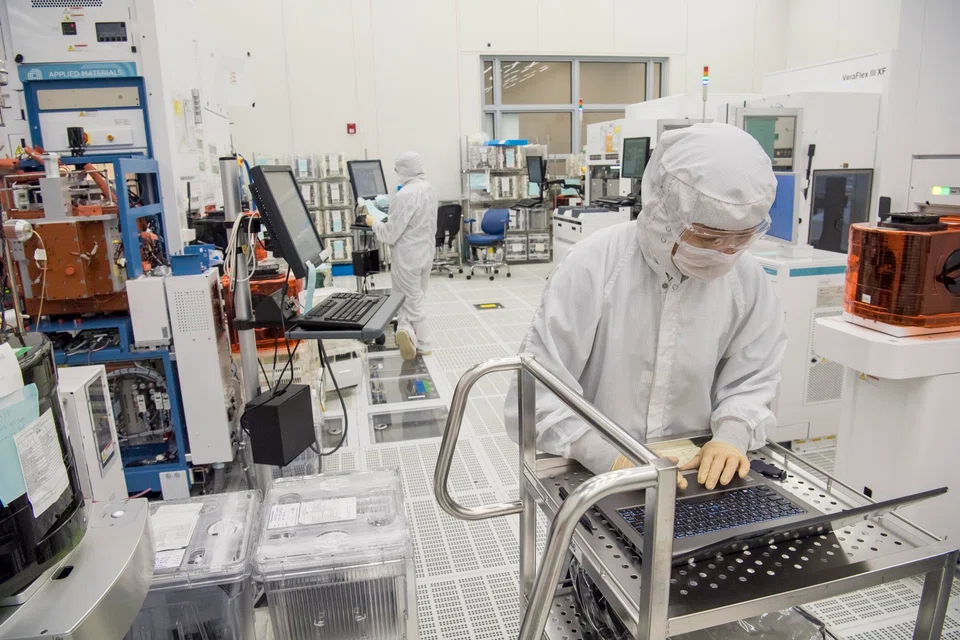
Omkaram Nalamasu told The Business Times that since chips are already used to power robotics, the semiconductor industry already has a vested interest in this segment.
But he took the point a step further, and said companies should, in fact, start thinking about how embodied AI will eventually alter manufacturing, even in the semiconductor space.
He noted that in a “lights-out” or dark factory, industrial facilities can run, “primarily with robots and minimal human involvement”.
The Xiaomi Smart Factory in Beijing is a well-known example: It has 11 fully automated production lines, managed entirely by the company’s HyperIMP intelligent manufacturing platform.
“It’s important to see how we can enable this and how we can collaborate with these companies,” noted Nalamasu.
- Joined
- May 16, 2023
- Messages
- 47,145
- Points
- 113

3:00
Next generation of cancer drugs could be made in space
Many companies are racing towards the space economy, a commercial sector projected to reach 1.8 trillion US dollars in the next decade. We're already turning to the stars for holidays with tour operators, farming, and one day soon the atmospheric conditions of space. Tech Now visits a London based startup aiming to improve disease treatment by building a pharmaceutical factory in space.This video is from Tech Now, the BBC's flagship technology programme.
- Joined
- May 16, 2023
- Messages
- 47,145
- Points
- 113
Final frontier for meds? UK startup sends drug-making into space
BioOrbit hopes drug-crystallisation technology will lead to self-injected cancer treatment that could save millions
Julia Kollewe
Sat 23 May 2026 10.00 BST
Share
Prefer the Guardian on Google
Onboard a SpaceX flight last week was a remarkable piece of cargo – a hi-tech box destined for the International Space Station to grow ultra-pure protein crystals, with the aim of producing self-injected cancer drugs.
A British startup, BioOrbit, has developed the drug-crystallisation technology at its labs in London and launched Box-E, a compact unit the size of a microwave, on the 15 May rocket from Kennedy Space Center in Florida.
The unit will stay in orbit for about six weeks where the effective weightlessness, or microgravity, enables pharmaceutical compounds to crystallise into pure, highly stable structures that enable drug formulations not achievable on Earth.
Once back on terra firma, these crystals can be turned into cancer medications that patients can keep in a fridge and inject themselves at home or at work, instead of having to go to hospital to have immunotherapies infused intravenously over several hours. The drugs also have a longer shelf life.
Dr Katie King, co-founder and chief executive of BioOrbit, who completed her PhD in nanomedicine at Cambridge University and did an internship at Nasa, describes the orbital tests as a “big step change towards large-scale production of protein crystals in space”. Gravity negatively impacts crystallisation, she says.
Perfect crystalline structure offer better yield and more potent anti cancer drugs
- Joined
- Mar 3, 2024
- Messages
- 8,585
- Points
- 113
3:00
Next generation of cancer drugs could be made in space
Many companies are racing towards the space economy, a commercial sector projected to reach 1.8 trillion US dollars in the next decade. We're already turning to the stars for holidays with tour operators, farming, and one day soon the atmospheric conditions of space. Tech Now visits a London based startup aiming to improve disease treatment by building a pharmaceutical factory in space.
This video is from Tech Now, the BBC's flagship technology programme.
This is good for the globetards aka space fantasy fanboys. Faster take and let AI rules the world
Similar threads


- Replies
- 0
- Views
- 379

- Replies
- 1
- Views
- 1K


- Replies
- 13
- Views
- 2K

