

- Joined
- Aug 20, 2022
- Messages
- 32,730
- Points
- 113
HIP re-poll for Tiong Bahru flats could raise questions on legitimacy of voting process: Observers
Published Dec 04, 2025, 08:50 PMUpdated Dec 05, 2025, 02:06 PM
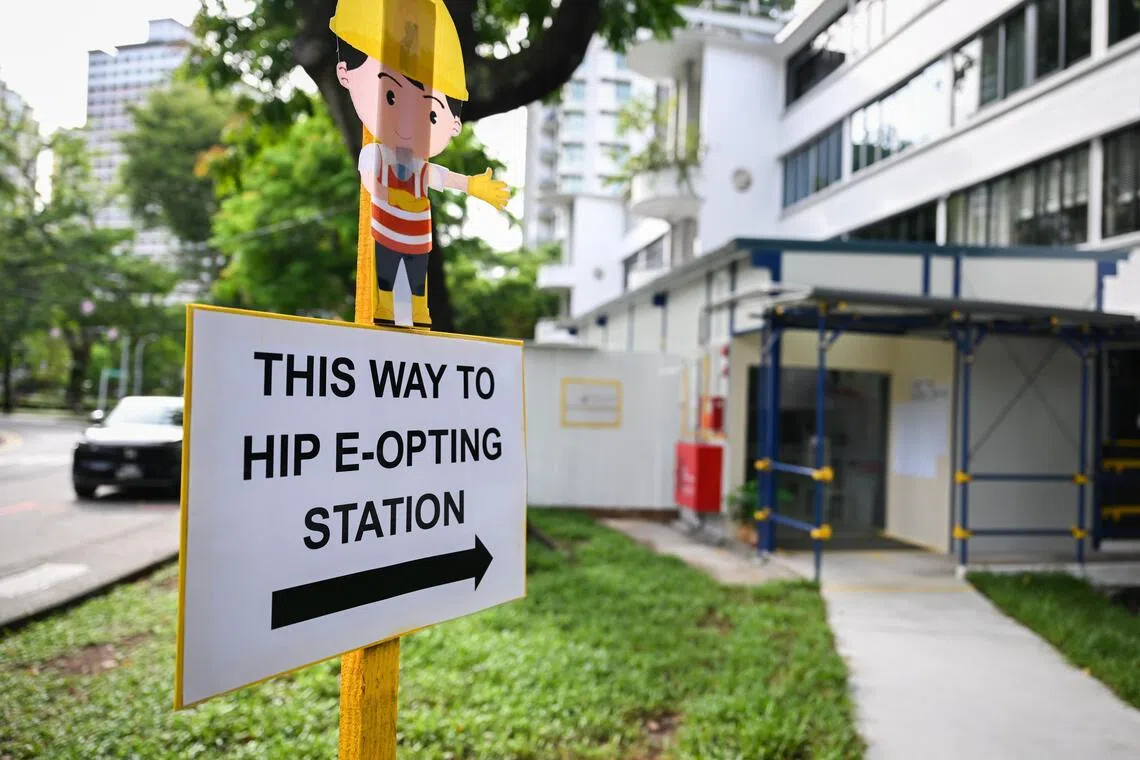
Voting must be seen as a fair process and it is also important to hear and understand the views of those who do not want HIP works to be carried out, said observers.
ST PHOTO: SHINTARO TAY
They stressed that voting must be seen as a fair process, adding that it is also important to hear and understand the views of those who do not want HIP works to be carried out.
For one thing, the manner in which the re-poll is conducted is important, said Institute of Policy Studies deputy director and senior research fellow Christopher Gee.
“If it is done in a heavy-handed way – re-poll until you get the result you want – it sends a wrong signal to everyone looking at this as a fair exercise,” he said.
Tanjong Pagar GRC MP Foo Cexiang said on Dec 4 that he will ask HDB to conduct a re-poll
if he gets enough support from residents. He and grassroots volunteers will continue to reach out to households that did not vote in favour of HIP and address their concerns.
The two blocks in his constituency – Block 34 Kim Cheng Street and Block 35 Lim Liak Street – had failed to garner enough votes to pass the 75 per cent threshold
by a narrow margin of two votes and one vote, respectively.
They were among 29 blocks in the neighbourhood that voted in November on whether to carry out HIP improvements. Voting was successful for the other 27 blocks. All the blocks are four-storey walk-up flats built in 1949 by the Singapore Improvement Trust, the predecessor to HDB.
Mr Gee said the views of residents who did not vote or voted “no” should be aired, heard and understood, as some may have underlying valid reasons for not being comfortable with HIP works.
“(The authorities) need to be very careful in how they go about it – it is a process that needs to be seen as fair,” he said.
Singapore Management University law don Eugene Tan noted that the Housing and Development Act, which sets out the voting rules, does not appear to explicitly prohibit re-polling. But having a second poll soon after an initial unfavourable result could undermine the integrity of the voting process, he said.
“This raises the fair question of the legitimacy of the entire polling process for upgrading works in HDB precincts,” he added.
Associate Professor Tan said it would be prudent for HDB to place re-polls on a firmer legislative footing “so that the validity of any re-poll will not be challenged”, and suggested that changes could also specify the minimum time interval between two polls.
He noted that at present, re-polling appears to work “one way” to secure the threshold support for upgrading, but does not seem likely to be carried out if a successful ballot has been attained.
“In other words, the flat owner’s remorse works one way – that of having upgrading done – but not the other, that upgrading not be done despite the successful poll,” said Prof Tan.
Dr Walter Theseira, an associate professor of economics at the Singapore University of Social Sciences, said the allowance of a re-poll concerns policy consistency and fairness.
A reason to allow a re-poll is that people may have changed their minds or their circumstances may have changed. This should go both ways – including for those in successful blocks who have changed their minds and wished to vote “no” instead, he added.
“I think a balance has to be struck between recognising that circumstances may change and providing residents with assurance of finality if circumstances do not change,” he said.
Observers also said a re-poll could make residents feel pressured into voting in favour of HIP.
HDB said on Nov 28 that a re-poll was previously allowed for four blocks that had failed to get enough votes for HIP in 2017 and 2023. One block in Serangoon and three in Lengkong Tiga eventually garnered enough votes to pass the 75 per cent threshold, and upgrading works were carried out.
Professor Sing Tien Foo, provost’s chair professor of real estate at NUS Business School, said a re-poll would be prudent if the poll result is close, as the authorities could address concerns from the minority. But if the HIP vote fails by a big margin, the poll result should be respected.
He said the Tiong Bahru blocks are a good test case to see whether to review the 75 per cent threshold before HIP II – another round of upgrading that will be conducted when blocks reach 60 to 70 years old – and the Voluntary Early Redevelopment Scheme (Vers).
Vers, which has yet to be rolled out, will allow owners of flats that are 70 years old and above to vote on whether the Government should buy back their homes before their leases run out. It is the proposed solution to lease decay – the erosion of a flat’s value as the end of its 99-year lease approaches.


