

- Joined
- Apr 5, 2013
- Messages
- 528
- Points
- 0
North Korea refuses to atone for deadly 2010 ship sinking despite Seoul embargo
PUBLISHED : Tuesday, 24 March, 2015, 3:53pm
UPDATED : Tuesday, 24 March, 2015, 4:22pm
Agence France-Presse in Seoul
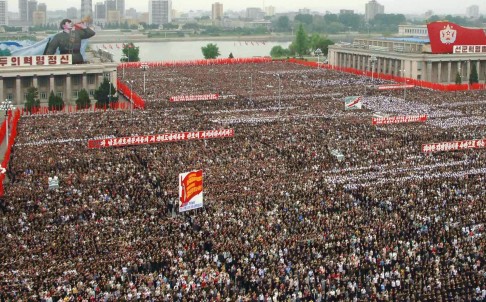
Pyongyang holds a rally in 2010 after the South accuses the North Korean navy of attacking the Cheonan ship with a torpedo. Photo: AP
North Korea today ruled out any apology over the 2010 sinking of the South Korean navel corvette Cheonan - even as Seoul requires Pyongyang to show contrition before lifting an effective trade embargo.
Two days ahead of the fifth anniversary of the sinking, in which 46 South Korean seamen died, the North’s top military body, the National Defence Commission (NDC), condemned Seoul’s steadfast insistence on the “cock-and-bull” idea that Pyongyang was responsible.
The Cheonan was carrying 104 personnel when it sank near the disputed Yellow Sea maritime border between North and South Korea on March 26. It was one of the deadliest incidents between the two Koreas since the end of the 1950-1953 Korean war.
A South Korean-led investigation involving a team of international experts concluded it was sunk by a North Korean submarine torpedo.
In its response today, Seoul slammed North Korea’s latest denial of its involvement in the sinking.
“It has been concluded [the sinking was the act of] North Korea’s submarine, and thus North Korea’s claim is unacceptable,” South Korea’s Defence Ministry spokesman Kim Min-seok told reporters.
Seoul had five years ago responded with the so-called “May 24 measures”, which amounted to an effective trade embargo and suspension of large-scale aid on North Korea, which remain in place today.
South Korea has insisted it will only consider lifting the sanctions after the North acknowledges its responsibility and apologises.
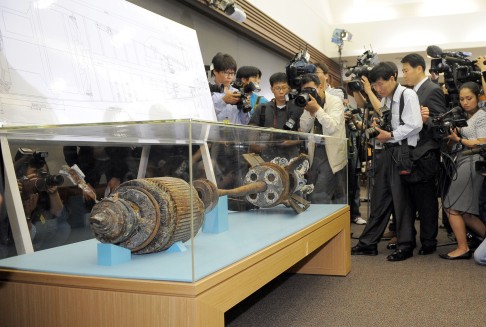
South Korean cameramen take footage of torpedo parts salvaged from the Yellow Sea, after Seoul concluded that the Cheonan ship sank from a projectile attack. Forty-six South Korean seamen died. Photo: AFP
The NDC statement today demanded the immediate end of the trade embargo, arguing that it was based on a “fictitious story about the North’s involvement”.
“We remain unchanged in our stand that the south has to immediately lift the ill-famed ‘step’ which they cooked up under the absurd pretext of the Cheonan warship sinking case, not dragging on time,” a spokesman for the Policy Department of the NDC said in a statement carried by the official Korean Central News Agency.
“The South should clearly understand that its sophism that [an] ‘apology’ and ‘expression of regret’ have to precede the lifting of the ‘step’ can never work,” the spokesman said.
Calling for an apology in such circumstances amounted to an “intolerable mockery” of the North’s dignity, the spokesman said.
Some influential South Korean business leaders and politicians have also called for the May 24 measures to be lifted, but President Park Geun-hye’s administration has held firm to the condition of a sincere apology.
A 2013 documentary by the left-wing South korean director Chung Ji-Young, Project Cheonan, stirred heated debate by exploring alternative explanations for the sinking, including suggestions that the vessel might have hit a reef or collided with an unidentified submarine.
The Cheonan incident and the trade measures imposed by the South triggered a dangerous surge in cross-border tensions.
In November 2010, the North shelled a South Korean border island, killing four people including two civilians and sparking brief fears of a full-scale conflict.


