

- Joined
- Aug 20, 2022
- Messages
- 32,068
- Points
- 113
New PMA rules kick in Jun 1, but some users say they will not comply
New personal mobility aid rules take effect in June, more than two years after they were first announced.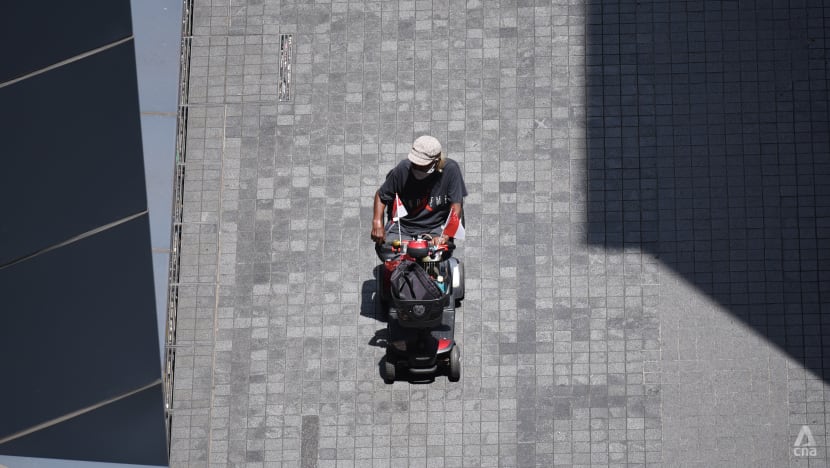
A man on a personal mobility aid. (File photo: CNA/Gaya Chandramohan)

Justin Ong Guang-Xi
29 May 2026 06:00AM(Updated: 29 May 2026 07:57AM)SINGAPORE: Some personal mobility aid (PMA) users have told CNA that they will continue riding devices that breach tightened rules taking effect on Jun 1, despite the risk of enforcement action.
Several have not obtained a certificate of medical need to prove their eligibility and have no plans to do so. Others appeared to be using devices larger than the new dimension limits set by the Land Transport Authority (LTA).
CNA observed both during interviews with PMA users outside Northpoint City in Yishun.
One couple in their 60s were riding a large PMA that appeared to exceed the allowable length of 1.2m. The woman said they were aware of the upcoming restrictions but felt they were doing "nothing wrong".
“We aren’t going too fast, and we live around here,” she said. “Normally, what we are doing is okay.”
The Yishun resident uses the device to get around the neighbourhood and to accompany her husband to hospital appointments. Her husband has early-onset dementia, she said, and she does not trust him to ride alone on a compliant single-user device.
"When he's alone, I'm also scared," she said.
The couple have not obtained a certificate of medical need and have no plans to do so, even though both are below 70, the age at which users are exempted from the requirement.
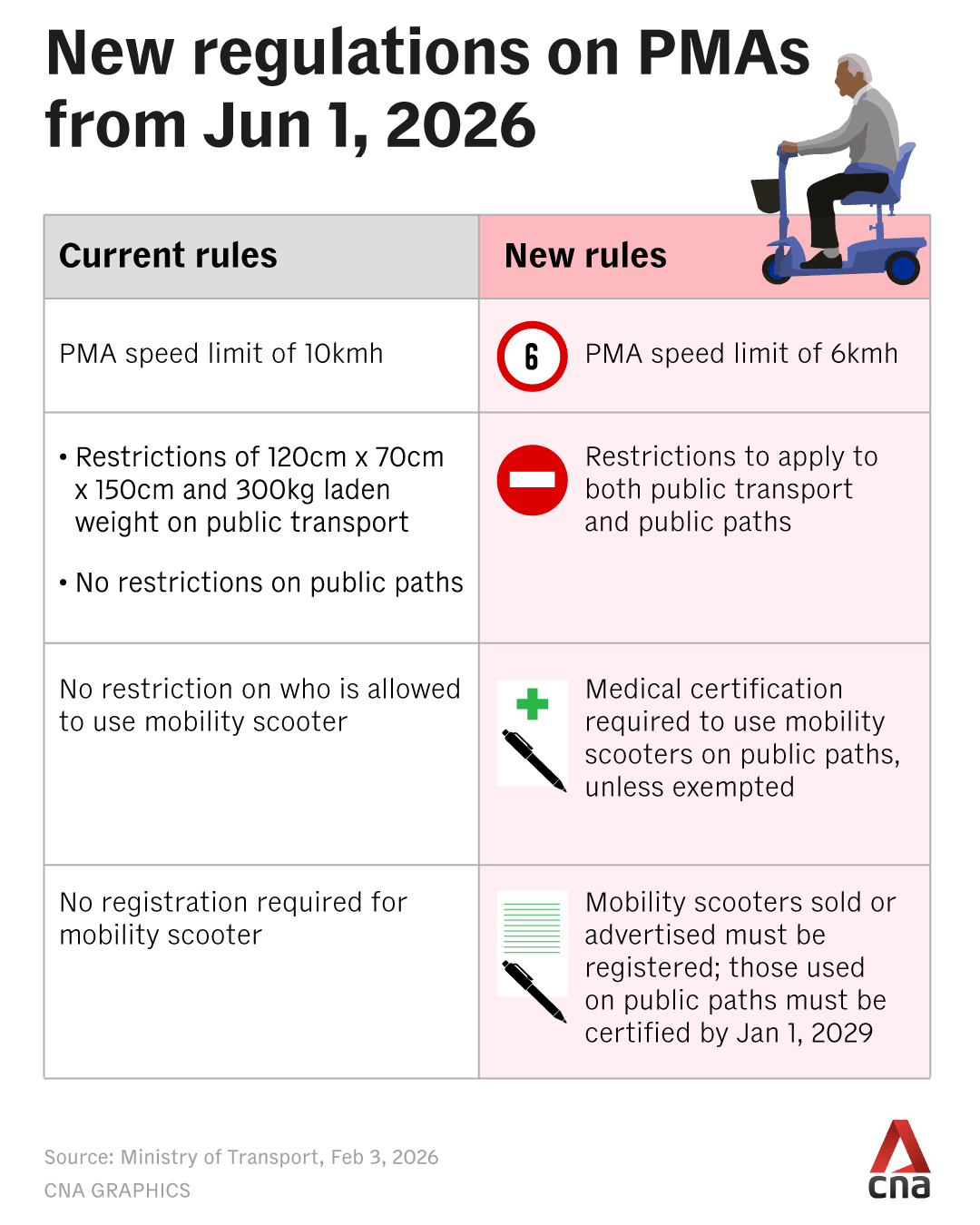
Under the new regulations, all PMAs used on public paths must be no more than 1.2m long, 0.7m wide and 1.5m high, with a total weight – including the user – not exceeding 300kg.
Users of mobility scooters must also obtain a certificate of medical need from a Singapore-registered doctor or occupational therapist unless they qualify for an exemption, such as being aged 70 or older.
The speed limit for all motorised PMAs on public paths will also be cut from 10kmh to 6kmh.
CNA also observed several PMAs travelling at what appeared to be well above the new 6kmh limit. The users did not stop when waved down.
Anyone caught driving a mobility vehicle above 6kmh on public paths faces fines of up to S$2,000 (US$1,560), up to six months' imprisonment, or both, with stiffer penalties for repeat offenders.
In February, Minister of State for Transport Baey Yam Keng said in parliament that the rules will take effect on Jun 1, more than two years after recommendations by the Active Mobility Advisory Panel were accepted by the government.
My Baey said that enforcement officers would focus on visibly able-bodied individuals misusing mobility scooters.
To tackle errant riders, enforcement officers will patrol public paths and conduct checks on user and device compliance, he said. CCTV cameras that are focused on paths have also been deployed islandwide.
ENFORCEMENT NOT A DETERRENT TO SOME
Another elderly couple were seen along Yishun Central riding a large PMA – one that also appeared to exceed the 1.2m length limit – with their primary school-going granddaughter on board.The woman, 67, said she and her 72-year-old husband had grown used to using the device to ferry their granddaughter to and from school. Her husband also uses it to drop her off at work.
While her husband is above 70 and exempt from the certificate requirement, she will need one but has no plans to apply.
“I will see how first, because if we can’t even ride on a PMA with two people, then it would be a waste of our PMA anyway,” she said. Asked if she would consider buying a compliant device, she said money was tight.
Her husband said the 6kmh limit and single-rider rule were too strict. “I don’t agree. I want to fetch my wife, and I want to fetch my granddaughter. All along there has been no problem,” he said.
Those caught riding a mobility scooter without a valid certificate of medical need face fines of up to S$2,000, up to six months' jail, or both. Those caught on oversized devices face fines of up to S$10,000, up to six months' imprisonment, or both.
COMPLYING WITH THE NEW RULES
Not all PMA users CNA met were resistant to the changes.One food delivery rider, who wanted to be known only as Joseph, bought a new PMA for S$1,300 in April because his previous device would have breached the new size limits.
The 48-year-old stroke survivor, who has difficulty walking, already holds a medical certificate documenting his condition and has confirmed with the authorities that he does not need a new one.
His main concern is the lower speed limit. At 10kmh, he can make up to 25 food deliveries a day; at 6kmh, he estimates that will fall to about 16.
"I have to extend my working hours to maintain my earnings," he said.
Another food delivery rider, who wanted to be known only as Mr Chua, said he had changed his phone wallpaper to display his certificate of medical need. The 41-year-old has degenerative disc disease, an invisible condition affecting the spine.
Like Joseph, he fears the speed limit will hit his earnings and is exploring a home-based food business to supplement his income.
"Six kilometres per hour is really difficult for us to earn a living," he said.
Earlier this year, platform operators warned that the tightened PMA rules could lead to longer delivery times. LTA told CNA it has been engaging groups including the National Delivery Champions Association and food delivery platforms on the new rules since 2024.
LTA also said more than 1,000 users have already obtained their certificate of medical need. It has published a list of clinics offering assessments, produced outreach materials in the four official languages, and publicised the rules through walkway banners, MRT in-train advertisements and social media.
RETAILERS SAY COSTS RISING
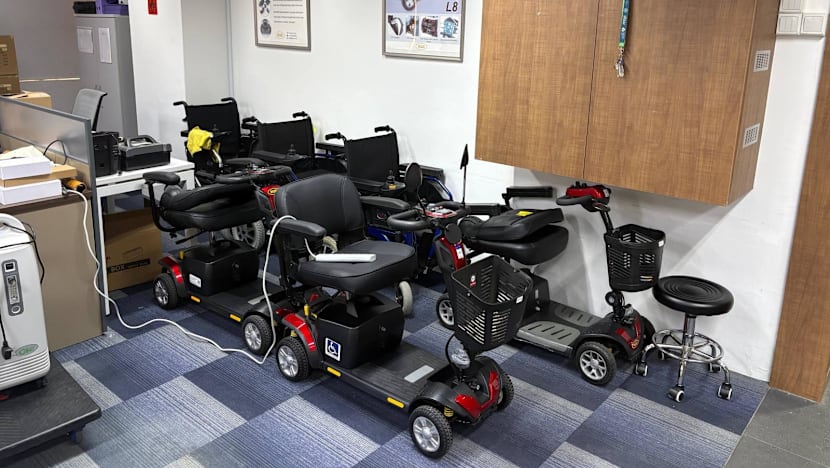
PMA retailers say they have incurred significant costs adapting to the new regulations and have had to raise prices.From Jun 1, retailers can only display, advertise or sell registered mobility scooters and equivalent devices. They must submit models to LTA for approval, and must verify a buyer's medical eligibility before completing a sale, with ownership transferred through LTA's OneMotoring portal.
Mr Chew Boon Hur, manager of personal mobility device retailer MOBOT, said new mobility scooters now cost the firm about S$100 more per device after factoring in registration fees, inspection fees, and the logistics and manpower needed to prepare and transport stock. MOBOT has also hired a new staff member to manage ownership transfers.
Mr George Lee, business development manager at AGIS Medical, said his firm faces a similar increase of about S$100 per device – accounting for roughly 15 per cent of operating costs.
Combined with higher shipment costs and factory price increases, the firm has raised product prices for the first time in three years. "Our shipment costs all rose by a lot, and our factories are also increasing their prices," he said.
AGIS director James Lee said the firm had little choice but to comply. "We don't think of it as fair or unfair, but if it's good for the people, we must do it," he said.
ELFIGO founder Warren Chew said registration requirements have pushed up costs by about S$150 per device. He began preparing in 2024, sourcing smaller PMAs that comply with the new limits, but felt the two-year lead time had hurt business by leaving buyers uncertain about what to purchase.
“There was a lot of uncertainty, and buyers were not sure what to buy,” he said. “The longer the delay, the more it affected business.”
LTA said it has engaged retailers and industry players to familiarise them with the requirements, and noted that retailers have had more than two years to adjust inventory since the rules were announced in March 2024.
"Based on our ground checks, many retailers have already stopped selling PMAs that do not comply with the upcoming requirements," its spokesperson said.


