

- Joined
- Jan 23, 2010
- Messages
- 1,746
- Points
- 0
Public transport: Most users happy
By Elgin Toh
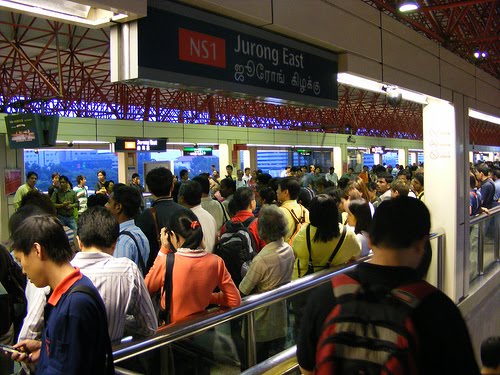
OVERALL commuter satisfaction with public transport services remained high last year despite a significant increase in ridership.
That is according to an annual survey by the Land Transport Authority, which Transport Minister Raymond Lim cited yesterday to show that public transport is 'heading in the right direction'.
The level of satisfaction was 92.2 per cent last year. It was 93.8 per cent in 2009 and 89.5 per cent in 2008. The survey also found that commuters were happier with MRT services than bus services.
Safety and security remained the most important service attribute to commuters, with travel time coming in second. Accessibility of stops replaced waiting time in third place.
Mr Lim said the survey, conducted annually since 2006, helps the Government focus on what matters most to commuters.
It was one of three surveys he cited - two were by The Straits Times - to make his point that service standards held steady in the face of a 9 per cent rise in ridership to 5.37 million trips last year.
He said improving the system is a top priority for the Government as most Singaporeans rely on buses or trains as their main means of transport.
'This is why we're doing everything possible to improve our rail system, our bus system, and to ensure that all the pieces of our public transport system fit together, with the commuter as our focus,' he said during the debate on his ministry's budget.
The survey, conducted by SIM University last October, interviewed some 3,100 commuters at bus interchanges, bus stops and MRT stations.
Bus commuters were most satisfied with the accessibility of stops (90.1 per cent) and least satisfied with waiting time (64.1 per cent), although the rating of the latter improved from 60.3 per cent in 2009. On the other hand, MRT commuters were most impressed by safety and security (93.3 per cent), but least happy with comfort (80.3 per cent).
On the whole, commuters gave the public transport system a 7.3 rating out of 10, compared to 7.4 in 2009 and 7.1 in 2008.
By Elgin Toh
OVERALL commuter satisfaction with public transport services remained high last year despite a significant increase in ridership.
That is according to an annual survey by the Land Transport Authority, which Transport Minister Raymond Lim cited yesterday to show that public transport is 'heading in the right direction'.
The level of satisfaction was 92.2 per cent last year. It was 93.8 per cent in 2009 and 89.5 per cent in 2008. The survey also found that commuters were happier with MRT services than bus services.
Safety and security remained the most important service attribute to commuters, with travel time coming in second. Accessibility of stops replaced waiting time in third place.
Mr Lim said the survey, conducted annually since 2006, helps the Government focus on what matters most to commuters.
It was one of three surveys he cited - two were by The Straits Times - to make his point that service standards held steady in the face of a 9 per cent rise in ridership to 5.37 million trips last year.
He said improving the system is a top priority for the Government as most Singaporeans rely on buses or trains as their main means of transport.
'This is why we're doing everything possible to improve our rail system, our bus system, and to ensure that all the pieces of our public transport system fit together, with the commuter as our focus,' he said during the debate on his ministry's budget.
The survey, conducted by SIM University last October, interviewed some 3,100 commuters at bus interchanges, bus stops and MRT stations.
Bus commuters were most satisfied with the accessibility of stops (90.1 per cent) and least satisfied with waiting time (64.1 per cent), although the rating of the latter improved from 60.3 per cent in 2009. On the other hand, MRT commuters were most impressed by safety and security (93.3 per cent), but least happy with comfort (80.3 per cent).
On the whole, commuters gave the public transport system a 7.3 rating out of 10, compared to 7.4 in 2009 and 7.1 in 2008.


