

- Joined
- Feb 20, 2010
- Messages
- 2,818
- Points
- 48
https://www.reuters.com/article/us-...-as-fresh-food-prices-soar-idUSKCN1BC3DH?il=0
Business News
September 1, 2017 / 8:26 AM / a year ago
South Korea inflation hits five-year high in August as fresh food prices soar
2 Min Read
SEOUL (Reuters) - South Korea’s annual inflation surged in August to its highest in more than five years as heavy rain and a summer heatwave pushed up the price of fresh foods, government data showed on Friday.
A fish dealer waits for customers at a fishery market in central Seoul September 13, 2013. REUTERS/Lee Jae-Won
The consumer price index rose 2.6 percent in August from a year earlier, Statistics Korea said, accelerating from a 2.2 percent rise in July, and marking its fastest rise since April 2012 when the index also gained 2.6 percent on-year.
Related Coverage
It compared to a 2.2 percent rise tipped in a Reuters survey of analysts’ expectations.
“Seasonal factors such as the heatwave, as well as the incident related to contaminated eggs across the country lifted up fresh food prices,” said Kim Doo-un, an economist at Hana Financial Investment.
Kim said the sudden surge in prices was not from an increase in domestic demand, adding that he saw consumer prices remaining volatile through the October shopping season when South Koreans celebrate the national Chuseok holiday.
The price of eggs soared 53.3 percent in August on-year after eggs from some local farms were found to be contaminated with a potentially harmful pesticide.
The price of radish and tomatoes surged 71.4 percent and 45.3 percent respectively, pushing up the overall price gains of fresh food costs to 18.3 percent on-year.
In monthly terms, inflation gained 0.6 percent from July.
Core inflation, which strips out volatile food and fuel prices, was 1.8 percent in August, unchanged from July.
Inflation this year has lingered near the Bank of Korea’s inflation target of 2 percent as private consumption has improved.
Revised second quarter gross domestic product growth data issued released earlier on Friday showed the economy expanded 0.6 percent from a quarter earlier versus 1.1 percent growth in the first quarter.
Reporting by Cynthia Kim and Christine Kim; Additional reporting by Dahee Kim; Editing by Eric Meijer
Our Standards:The Thomson Reuters Trust Principles.
https://digital.library.unt.edu/ark:/67531/metadc503954/
Some Causes of Inflation in Korea

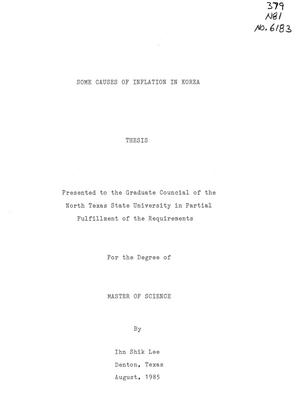


Showing 1-4 of 69 pages in this thesis.
PDF Version Also Available for Download.
DescriptionBookmark this section
The purpose of this study is to find causes of inflation in Korea. We hypothesized that inflation in Korea was a "mixed" inflation generated by not only monetary factors but also nonmonetary factors. The data was obtained mainly from International Finance Statistics (IMF) and Monthly Bulletin (The Bank of Korea). The first chapter introduces the Korean economy. Chapter two surveyed the effects of import prices, wages, and money supply in inflationary process. The third chapter studied some theoretical backgrounds of inflation. Chapter four analyzed the results of statistical tests. Finally, chapter five consisted of summary and policy implications.
Physical DescriptionBookmark this section
v, 63 leaves : ill.
Creation InformationBookmark this section
Lee, Ihn Shik August 1985.
ContextBookmark this section
This thesis is part of the collection entitled: UNT Theses and Dissertations and was provided by UNT Libraries to Digital Library, a digital repository hosted by the UNT Libraries. It has been viewed 516 times , with 36 in the last month . More information about this thesis can be viewed below.
https://www.straitstimes.com/busine...lation-rises-at-fastest-pace-in-almost-a-year
South Korean inflation rises at fastest pace in almost a year
The consumer price index in South Korea rose 0.9 per cent in October from a year earlier, Statistics Korea said on Tuesday (Nov 3).PHOTO: BLOOMBERG
Published
Nov 3, 2015, 8:07 am SGT
Facebook Twitter Email
SEOUL (BLOOMBERG) - Inflation in South Korea unexpectedly increased at the fastest pace in almost a year as domestic consumption and industrial production improved.
The price gains help back the government's assessment that the economy is in a "turn-around" from the effects of an outbreak of a respiratory illness earlier this year that scared away shoppers and foreign tourists.
The consumer price index rose 0.9 per cent in October from a year earlier, after a 0.6 per cent advance in September, Statistics Korea said on Tuesday (Nov 3). That was the strongest number since November last year and beat the median estimate of 0.7 per cent in a Bloomberg survey. The price gauge was unchanged from a month earlier.
"Improving private consumption is the main driver for the economy and accelerating price gains," LG Economic Research Institute economist Shin Min Young said before the data was released. "By next year, South Korean inflation should well be above 1 per cent."
Asia's fourth-largest economy expanded 1.2 per cent in the three months through September. That was the fastest pace since 2010 and significant improvement from 0.3 per cent in the previous quarter.
Despite the pickup in prices in October, inflation is still well below the central bank's target of 2.5 per cent to 3.5 per cent, and has been since late 2012.
The Bank of Korea is talking with the government about a revised target, to start in 2016, with economists surveyed by Bloomberg projecting the midpoint to be revised to 2.5 per cent from the current 3 per cent.
The central bank in October cut its estimates for inflation this year and next and left the benchmark interest rate unchanged at a record low 1.5 per cent.
Business News
September 1, 2017 / 8:26 AM / a year ago
South Korea inflation hits five-year high in August as fresh food prices soar
2 Min Read
SEOUL (Reuters) - South Korea’s annual inflation surged in August to its highest in more than five years as heavy rain and a summer heatwave pushed up the price of fresh foods, government data showed on Friday.
A fish dealer waits for customers at a fishery market in central Seoul September 13, 2013. REUTERS/Lee Jae-Won
The consumer price index rose 2.6 percent in August from a year earlier, Statistics Korea said, accelerating from a 2.2 percent rise in July, and marking its fastest rise since April 2012 when the index also gained 2.6 percent on-year.
Related Coverage
It compared to a 2.2 percent rise tipped in a Reuters survey of analysts’ expectations.
“Seasonal factors such as the heatwave, as well as the incident related to contaminated eggs across the country lifted up fresh food prices,” said Kim Doo-un, an economist at Hana Financial Investment.
Kim said the sudden surge in prices was not from an increase in domestic demand, adding that he saw consumer prices remaining volatile through the October shopping season when South Koreans celebrate the national Chuseok holiday.
The price of eggs soared 53.3 percent in August on-year after eggs from some local farms were found to be contaminated with a potentially harmful pesticide.
The price of radish and tomatoes surged 71.4 percent and 45.3 percent respectively, pushing up the overall price gains of fresh food costs to 18.3 percent on-year.
In monthly terms, inflation gained 0.6 percent from July.
Core inflation, which strips out volatile food and fuel prices, was 1.8 percent in August, unchanged from July.
Inflation this year has lingered near the Bank of Korea’s inflation target of 2 percent as private consumption has improved.
Revised second quarter gross domestic product growth data issued released earlier on Friday showed the economy expanded 0.6 percent from a quarter earlier versus 1.1 percent growth in the first quarter.
Reporting by Cynthia Kim and Christine Kim; Additional reporting by Dahee Kim; Editing by Eric Meijer
Our Standards:The Thomson Reuters Trust Principles.
https://digital.library.unt.edu/ark:/67531/metadc503954/
Some Causes of Inflation in Korea
Showing 1-4 of 69 pages in this thesis.
PDF Version Also Available for Download.
DescriptionBookmark this section
The purpose of this study is to find causes of inflation in Korea. We hypothesized that inflation in Korea was a "mixed" inflation generated by not only monetary factors but also nonmonetary factors. The data was obtained mainly from International Finance Statistics (IMF) and Monthly Bulletin (The Bank of Korea). The first chapter introduces the Korean economy. Chapter two surveyed the effects of import prices, wages, and money supply in inflationary process. The third chapter studied some theoretical backgrounds of inflation. Chapter four analyzed the results of statistical tests. Finally, chapter five consisted of summary and policy implications.
Physical DescriptionBookmark this section
v, 63 leaves : ill.
Creation InformationBookmark this section
Lee, Ihn Shik August 1985.
ContextBookmark this section
This thesis is part of the collection entitled: UNT Theses and Dissertations and was provided by UNT Libraries to Digital Library, a digital repository hosted by the UNT Libraries. It has been viewed 516 times , with 36 in the last month . More information about this thesis can be viewed below.
https://www.straitstimes.com/busine...lation-rises-at-fastest-pace-in-almost-a-year
South Korean inflation rises at fastest pace in almost a year
The consumer price index in South Korea rose 0.9 per cent in October from a year earlier, Statistics Korea said on Tuesday (Nov 3).PHOTO: BLOOMBERG
Published
Nov 3, 2015, 8:07 am SGT
Facebook Twitter Email
SEOUL (BLOOMBERG) - Inflation in South Korea unexpectedly increased at the fastest pace in almost a year as domestic consumption and industrial production improved.
The price gains help back the government's assessment that the economy is in a "turn-around" from the effects of an outbreak of a respiratory illness earlier this year that scared away shoppers and foreign tourists.
The consumer price index rose 0.9 per cent in October from a year earlier, after a 0.6 per cent advance in September, Statistics Korea said on Tuesday (Nov 3). That was the strongest number since November last year and beat the median estimate of 0.7 per cent in a Bloomberg survey. The price gauge was unchanged from a month earlier.
"Improving private consumption is the main driver for the economy and accelerating price gains," LG Economic Research Institute economist Shin Min Young said before the data was released. "By next year, South Korean inflation should well be above 1 per cent."
Asia's fourth-largest economy expanded 1.2 per cent in the three months through September. That was the fastest pace since 2010 and significant improvement from 0.3 per cent in the previous quarter.
Despite the pickup in prices in October, inflation is still well below the central bank's target of 2.5 per cent to 3.5 per cent, and has been since late 2012.
The Bank of Korea is talking with the government about a revised target, to start in 2016, with economists surveyed by Bloomberg projecting the midpoint to be revised to 2.5 per cent from the current 3 per cent.
The central bank in October cut its estimates for inflation this year and next and left the benchmark interest rate unchanged at a record low 1.5 per cent.


