

- Joined
- Sep 22, 2008
- Messages
- 97,559
- Points
- 113
Artichokes to Ricotta: How Arab Rule Changed Sicilian Cuisine
The cultivation methods, crops and dishes that Arabs introduced in Sicily not only survive but thrive today through foods that are integral and widely celebrated.
September-October-20256 min
September 02, 2025
Written by Jack Zahora Photographed by Tara Todras-Whitehill
Salvo Nicolosi points to the side of a dirt road that cuts through kilometers of orange groves and ancient fields of grain in Lorenzo Frasson, a former aristocratic plantation in his hometown of Ramacca, Sicily, which is now one of the largest farms on the island.
Littering the soil are shards of red brick and painted ceramic that likely predate the ninth century CE, he says. Nicolosi, who was once mayor of Ramacca, travels with several paperback books, which he independently wrote about Sicilian history, in the trunk of his car. “This clay tells a story about how this area was once ruled by powerful empires and kingdoms,” says Nicolosi, “that early on included the Romans, Vandals, Ostrogoths and Byzantines.”
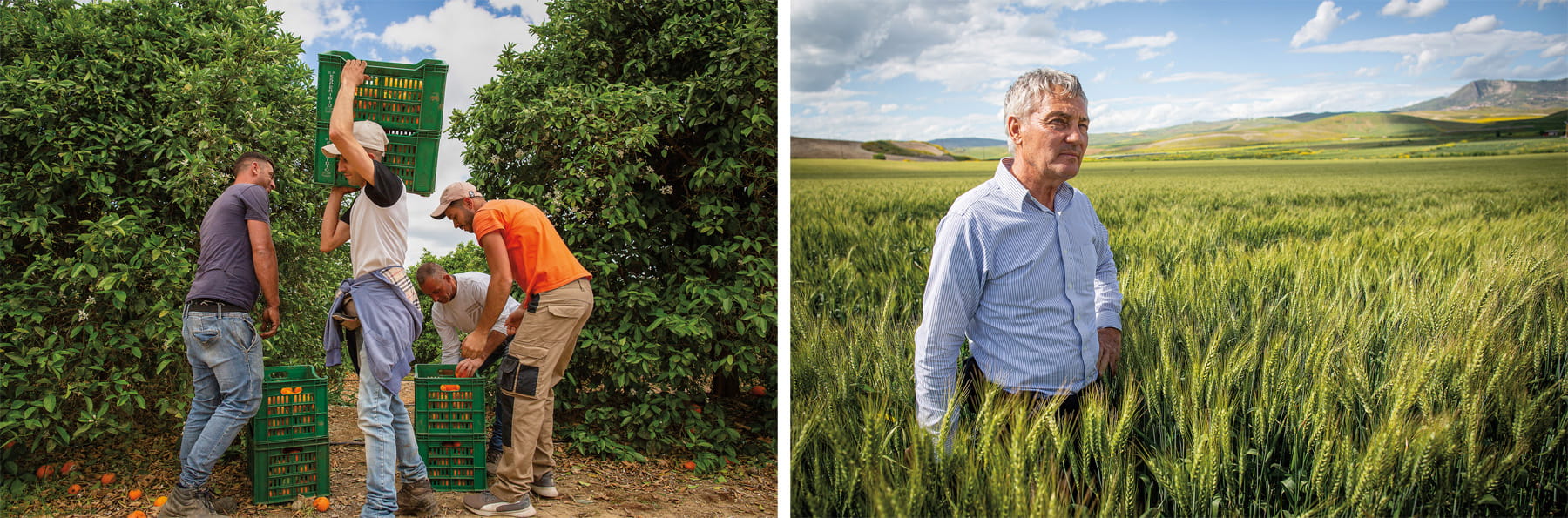
Left: Oranges are harvested at the Lorenzo Frasson farm. Arabs introduced irrigation methods that enabled the growth of orange groves in Sicily. Right: Lorenzo Frasson owns the company bearing his name, which has used seeds from Syria and other Arab countries for grains and pastas.
It’s an exhilarating find for the uninitiated, who might see such artifacts only in a museum. However, one’s gaze should focus on the oranges as well because, as some historians maintain, they recall the next chapter in the island’s history that began in 827 CE.
At the time, the commander of Sicily’s maritime fleet, Euphemius, was in revolt against the Byzantine Emperor Michael II, says Luca D’Anna, an associate professor of Arabic dialectology at the University of Naples. To aid in his rebellion, Euphemius called on armies in Ifriqiya, which were located across the Mediterranean Sea in present-day Tunisia. These forces eventually would defeat the Byzantines, and while doing so, sidelined Euphemius to become the first of three Arab dynasties to rule over the island until 1091 CE.
What transpired over these two-and-a-half centuries would result in a complete transformation of the agricultural and culinary landscape. And while direct paths are sometimes difficult to pinpoint, it’s clear that the cultivation techniques, crops and dishes that Arabs introduced in Sicily not only survive but thrive today through foods that are integral and widely celebrated


