• IP addresses are NOT logged in this forum so there's no point asking. Please note that this forum is full of homophobes, racists, lunatics, schizophrenics & absolute nut jobs with a smattering of geniuses, Chinese chauvinists, Moderate Muslims and last but not least a couple of "know-it-alls" constantly sprouting their dubious wisdom. If you believe that content generated by unsavory characters might cause you offense PLEASE LEAVE NOW! Sammyboy Admin and Staff are not responsible for your hurt feelings should you choose to read any of the content here.

    The OTHER forum is HERE so please stop asking.

How CATL Made Batteries 90% Cheaper (And What Happens Next)

Hightech88

Alfrescian
Loyal
Joined
Jul 18, 2014
Messages
6,454
Points
113
Rather than waiting for Solid State Batteries to commercialize at high costs, this could be the real game changer.
 
Nippon is focusing on the solid state battery, wait another 12-18mth more bah

No hurry
 
Nippon is focusing on the solid state battery, wait another 12-18mth more bah

No hurry

Solid State Battery (SSB) is good tech but it's costs will be much higher (3-4 X) than normal batteries at least for the next 3 years after production, so also not worth.
Initially for the first few years it will likely be applied first to niche, higher-margin products like advanced power banks and premium EVs before widespread EV use.

Costs of production is the main issue, rest is secondary.
 
Solid State Battery (SSB) is good tech but it's costs will be much higher (3-4 X) than normal batteries at least for the next 3 years after production, so also not worth.
Initially for the first few years it will likely be applied first to niche, higher-margin products like advanced power banks and premium EVs before widespread EV use.

Costs of production is the main issue, rest is secondary.
A better peace of mind than becum a roasted Babi , right?
 
I’m really curious to see how fast real products use this jump in cost cuts, because cheaper batteries could push more affordable EVs and home storage way sooner than anyone expected.
 
Nippon is focusing on the solid state battery, wait another 12-18mth more bah

Solid State Battery (SSB) is good tech but it's costs will be much higher (3-4 X) than normal batteries at least for the next 3 years after production, so also not worth.
Initially for the first few years it will likely be applied first to niche, higher-margin products like advanced power banks and premium EVs before widespread EV use.

The cantonese in guangzhou have the solution.

Lei Kang Apr 14, 2026, 1:43 PM GMT+8
0

3

+G
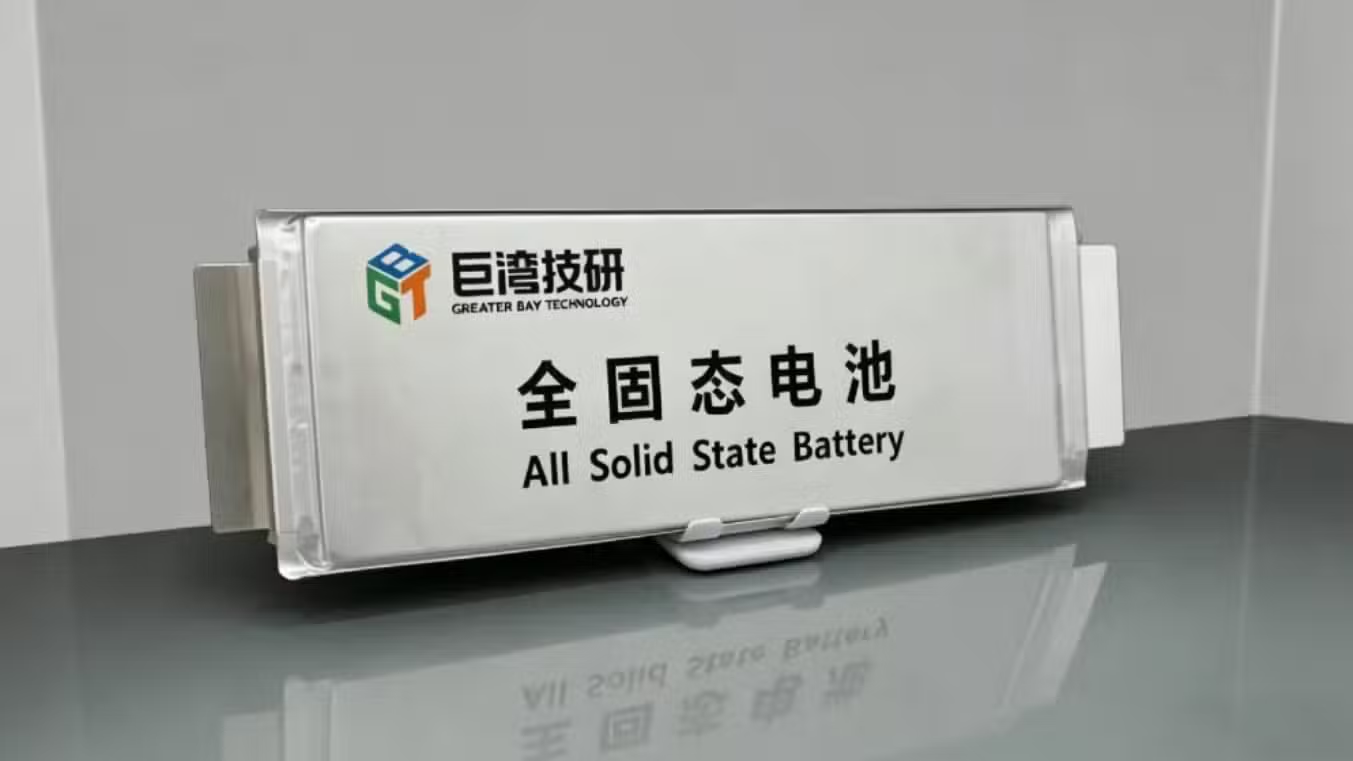
  • Greater Bay announced the roll-out of its all-solid-state A-sample cells, claiming key performance breakthroughs and targeting GWh-level mass production in 2026.
  • The composite electrolyte route emerges as a differentiated bet, as the company seeks to seize an early commercialization advantage in the global solid-state battery race.
GAC-backed Greater Bay claims breakthrough in solid-state batteries with new prototype roll-out
(Image credit: Greater Bay Technology)
Greater Bay Technology has seen its A-sample all-solid-state battery cell come off the production line, marking a key step forward for the GAC Group-backed battery manufacturer in the race for next-generation batteries.

Greater Bay announced the development on Monday, saying it validates the feasibility of taking the composite electrolyte route from the laboratory to industrialization, laying the foundation for large-scale mass production.

The A-sample cells are completely free of liquid electrolytes and achieved "no fire, no explosion" results in nail penetration, crushing, and thermal shock tests, averting the thermal runaway risks of traditional lithium batteries by design, the battery maker said.
 
Of course, another way to.increase range is by adding gears . Introducing mercedes with its two speed EV with over 900km wltp range.

2026 Mercedes-Benz EQS revealed with 925km EV range claim​

Mercedes-Benz has fired back at BMW in the battle to sell the longest-range electric car, its new EQS flagship claiming enough for Sydney to Melbourne – with, on paper at least, distance to spare.
EnergyIcon
Electric Cars

Samantha Stevens
Samantha Stevens
08:0114 April 2026
CommentIcon10
ShareIcon


2026 Mercedes-Benz EQS revealed with 925km EV range claim
PhotoIcon
+ 8Photos
The 2026 Mercedes-Benz EQS will claim up to 925km of electric driving range when it goes on sale in Europe later this year.
The 925km headline figure on Europe's WLTP test cycle beats the 900km quoted by the BMW i3 electric sedan, and is the highest range claimed by an electric car under the same testing procedures.
Australian deliveries are due to commence between October and December 2026, but it is unclear if the EQS450+ variant with the 925km claim will be offered locally and, if so, whether it will ride on larger wheels that will hurt its aerodynamics.


The updated EQS introduces steer-by-wire technology, and adopts an 800-volt electrical architecture from the latest CLA and GLC, with in-house developed electric motors that Mercedes-Benz claims are more compact and robust.
MORE: Mercedes-Benz to debut steer-by-wire tech in updated EQS
2026 Mercedes-Benz EQS revealed with 925km EV range claim
PhotoIcon
+ 8Photos
The long-range EQS450+ now achieves a WLTP range rating of 925km, a 13 per cent improvement over its predecessor.
 
Of course, another way to.increase range is by adding gears . Introducing mercedes with its two speed EV with over 900km wltp range.

2026 Mercedes-Benz EQS revealed with 925km EV range claim​

Mercedes-Benz has fired back at BMW in the battle to sell the longest-range electric car, its new EQS flagship claiming enough for Sydney to Melbourne – with, on paper at least, distance to spare.
EnergyIcon
Electric Cars

Samantha Stevens
Samantha Stevens
08:0114 April 2026
CommentIcon10
ShareIcon


2026 Mercedes-Benz EQS revealed with 925km EV range claim
PhotoIcon
+ 8Photos
The 2026 Mercedes-Benz EQS will claim up to 925km of electric driving range when it goes on sale in Europe later this year.
The 925km headline figure on Europe's WLTP test cycle beats the 900km quoted by the BMW i3 electric sedan, and is the highest range claimed by an electric car under the same testing procedures.
Australian deliveries are due to commence between October and December 2026, but it is unclear if the EQS450+ variant with the 925km claim will be offered locally and, if so, whether it will ride on larger wheels that will hurt its aerodynamics.


The updated EQS introduces steer-by-wire technology, and adopts an 800-volt electrical architecture from the latest CLA and GLC, with in-house developed electric motors that Mercedes-Benz claims are more compact and robust.
MORE: Mercedes-Benz to debut steer-by-wire tech in updated EQS
2026 Mercedes-Benz EQS revealed with 925km EV range claim
PhotoIcon
+ 8Photos
The long-range EQS450+ now achieves a WLTP range rating of 925km, a 13 per cent improvement over its predecessor.

This car weighs 2.5 ton car which would wear the tyres up to 30% faster than its ICE variant the S-class S500 which weighs 2065kg, not forgetting need to pay higher road tax $1K higher LOL.
 
Back
Top