

- Joined
- Jun 17, 2020
- Messages
- 17,356
- Points
- 113
For decades, most people assumed cheese was still made the traditional way — milk, cultures and natural enzymes passed down through generations of farming and craftsmanship.
But what many consumers don’t realize is that around 80–90% of cheese produced in the United States now relies on a genetically engineered enzyme originally commercialized through biotechnology by Pfizer in the 1990s.
The enzyme is called fermentation-produced chymosin (FPC), a lab-created alternative to traditional animal rennet historically taken from the stomach lining of calves.
Using genetic engineering, scientists inserted the gene responsible for producing chymosin into microorganisms such as fungi, yeast and bacteria. These microorganisms are then used in industrial fermentation tanks to mass-produce the enzyme used in modern cheese manufacturing.
Supporters say the process is efficient, cheaper, more scalable and avoids the need for animal-derived rennet. Regulators and food scientists insist the enzyme has been considered safe for decades.
But for many people, the revelation raises a much larger question:
How much of our modern food system has quietly become engineered, industrialized and disconnected from traditional food production without the public fully realizing it?
The topic has exploded online as consumers increasingly question why chronic digestive issues, food sensitivities and lactose intolerance appear dramatically more common today than they were generations ago.
Scientists say there is currently no direct evidence linking biotech-produced chymosin itself to lactose intolerance. Medical experts point out that lactose intolerance is primarily connected to reduced lactase enzyme production, genetics, gut microbiome health and aging.
However, critics argue modern dairy products are vastly different from what humans consumed historically.
Many alternative health researchers point toward:
* ultra-processing,
* additives,
* homogenization,
* industrial farming,
* pesticide exposure,
* altered cattle feed,
* pasteurization methods,
* A1 vs A2 milk proteins,
* and genetically engineered food technologies
as possible contributors to the growing number of people reporting digestive problems and food sensitivities.
Others question why so many individuals claim they can tolerate traditional farm cheeses or European dairy products far better than heavily processed supermarket dairy sold in the United States.
Whether coincidence, environmental changes or a sign of a much deeper problem within the industrial food system, the discussion taps into a growing distrust toward large corporations controlling both medicine and food production.
To critics, the idea that one of the world’s largest pharmaceutical corporations helped pioneer technology now used in the vast majority of cheese production symbolizes how deeply intertwined biotechnology and the modern food industry have become.
While the viral memes circulating online often exaggerate the situation in sensational ways, the core fact remains true:
Most cheese in the United States is no longer made using traditional animal rennet — but with a biotech-derived enzyme developed through genetic engineering.
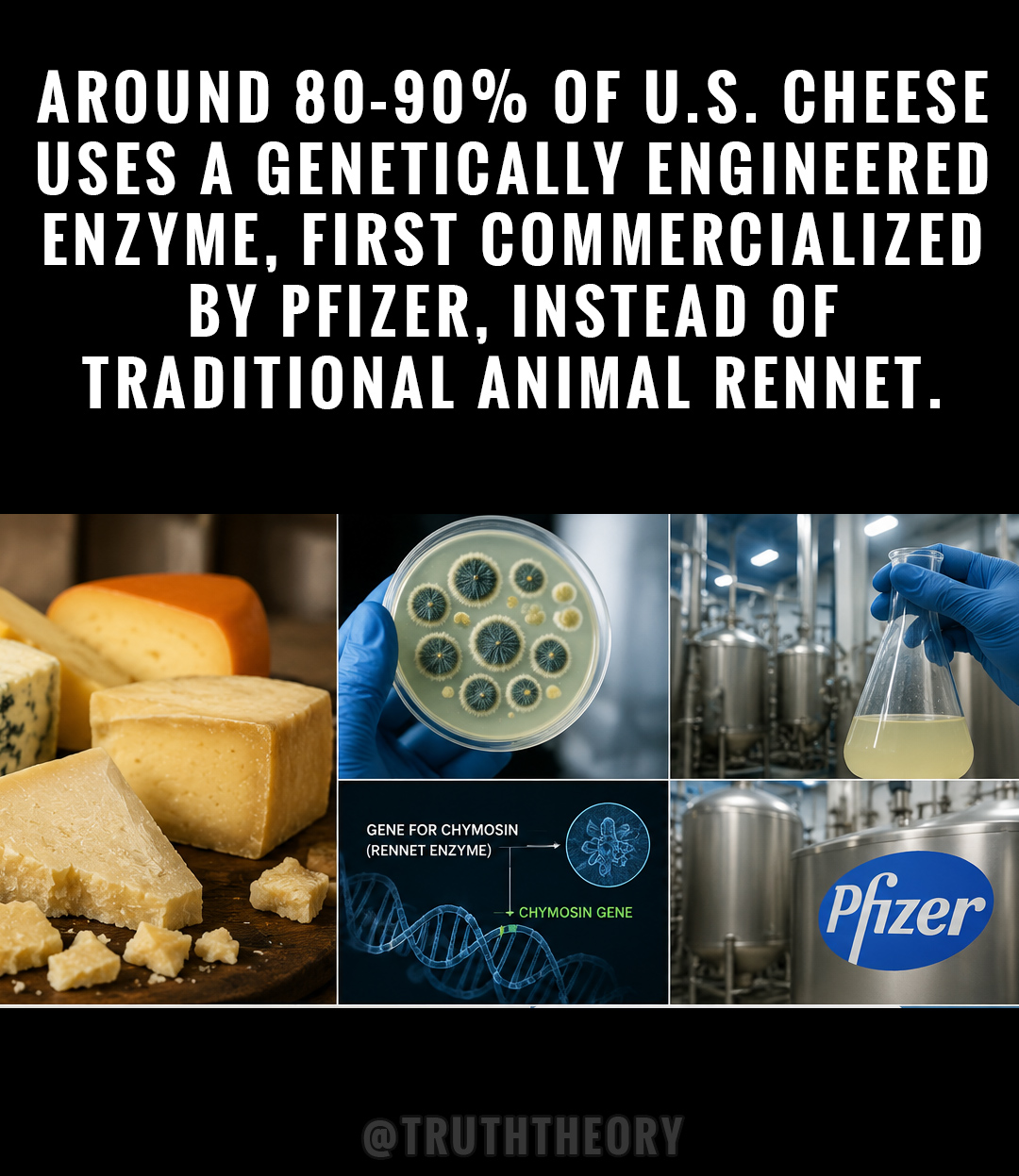
But what many consumers don’t realize is that around 80–90% of cheese produced in the United States now relies on a genetically engineered enzyme originally commercialized through biotechnology by Pfizer in the 1990s.
The enzyme is called fermentation-produced chymosin (FPC), a lab-created alternative to traditional animal rennet historically taken from the stomach lining of calves.
Using genetic engineering, scientists inserted the gene responsible for producing chymosin into microorganisms such as fungi, yeast and bacteria. These microorganisms are then used in industrial fermentation tanks to mass-produce the enzyme used in modern cheese manufacturing.
Supporters say the process is efficient, cheaper, more scalable and avoids the need for animal-derived rennet. Regulators and food scientists insist the enzyme has been considered safe for decades.
But for many people, the revelation raises a much larger question:
How much of our modern food system has quietly become engineered, industrialized and disconnected from traditional food production without the public fully realizing it?
The topic has exploded online as consumers increasingly question why chronic digestive issues, food sensitivities and lactose intolerance appear dramatically more common today than they were generations ago.
Scientists say there is currently no direct evidence linking biotech-produced chymosin itself to lactose intolerance. Medical experts point out that lactose intolerance is primarily connected to reduced lactase enzyme production, genetics, gut microbiome health and aging.
However, critics argue modern dairy products are vastly different from what humans consumed historically.
Many alternative health researchers point toward:
* ultra-processing,
* additives,
* homogenization,
* industrial farming,
* pesticide exposure,
* altered cattle feed,
* pasteurization methods,
* A1 vs A2 milk proteins,
* and genetically engineered food technologies
as possible contributors to the growing number of people reporting digestive problems and food sensitivities.
Others question why so many individuals claim they can tolerate traditional farm cheeses or European dairy products far better than heavily processed supermarket dairy sold in the United States.
Whether coincidence, environmental changes or a sign of a much deeper problem within the industrial food system, the discussion taps into a growing distrust toward large corporations controlling both medicine and food production.
To critics, the idea that one of the world’s largest pharmaceutical corporations helped pioneer technology now used in the vast majority of cheese production symbolizes how deeply intertwined biotechnology and the modern food industry have become.
While the viral memes circulating online often exaggerate the situation in sensational ways, the core fact remains true:
Most cheese in the United States is no longer made using traditional animal rennet — but with a biotech-derived enzyme developed through genetic engineering.


