

- Joined
- Aug 20, 2022
- Messages
- 32,234
- Points
- 113
Couple sues condominium management over termite damage, wins in what appears to be first such case
The judge took issue with the expert called by the condominium management of Freesia Woods, as he was the owner of the pest control company that had conducted inspections for the condo for years but overlooked the termite infestation.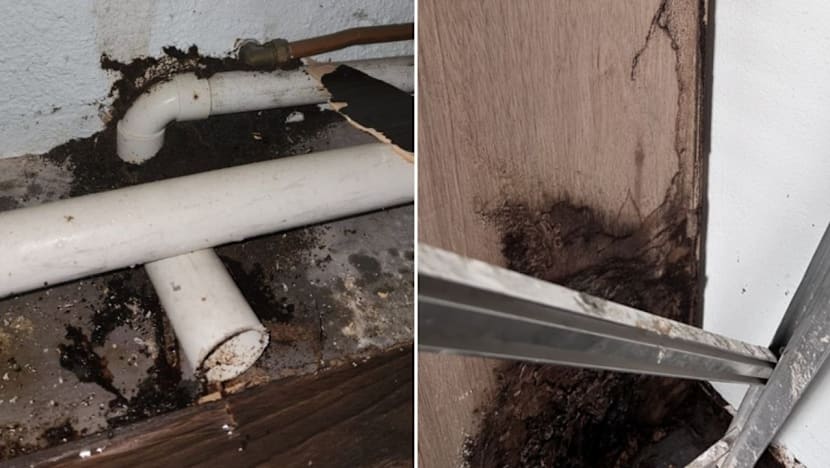
Damage found in the home of a couple who sued their condominium management over a termite infestation. (Photos: Glenford Tan)

Lydia Lam
16 Jul 2026 12:18PM(Updated: 16 Jul 2026 01:33PM)SINGAPORE: A couple living in a condominium in Clementi sued the management to recover the cost of repairing termite damage to their unit.
The Management Corporation Strata Title of Freesia Woods condominium contended that the damage was a result of the couple's "unauthorised and illegal" installation of a kitchen, which it said created a damp environment.
The court found instead that subterranean termites had been nesting in the ground soil and that the condominium management had failed to keep it free from such termites.
The claimants were awarded S$10,978 (US$8,520), along with costs and disbursements of about S$42,750.
This case appears to be the first reported one on the duty of management corporations to maintain common property in relation to termite prevention, according to a judgment published on Wednesday (Jul 15).
THE CASE
Mr Glenford Tan Ming Loon and Ms Vivien Loo Hwee-Wen own a unit at the top of low-rise condominium development Freesia Woods at 61 Sunset Way.In December 2023, the couple discovered a termite infestation that damaged parts of their unit. The wooden cabinet was eaten by the termites, and the attached basin sink, marble top and backing had to be reinstalled with the cabinet.
They launched a claim against the condominium's management, claiming that the latter had breached its duties by failing to ensure that the soil in the common property was free from subterranean termites.
They also argued that the condo failed to undertake all anti-termite treatment to the soil and allowed such termites to nest in or traverse through the soil and make their way to their unit.
The condominium's management, defended by Eden Law, did not deny the infestation but said it was not caused by subterranean termites, which nest underground.
They argued that the couple had installed a kitchen in their unit illegally, creating a damp environment that caused their unit to be more susceptible to termite infestation.
The management also argued that some of the rectification works by the couple was unrelated to the termite damage.
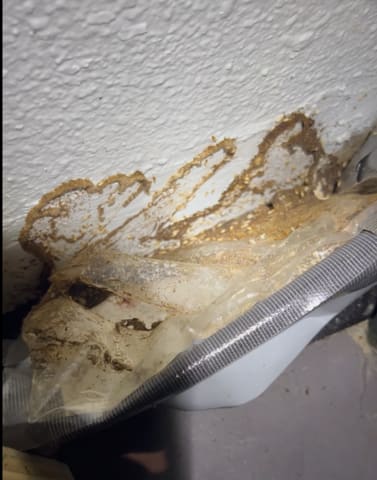
Damage found in the home of a couple who sued their condominium management over a termite infestation. (Photo: Glenford Tan)
JUDGE'S FINDINGS
District Judge Chiah Kok Khun agreed with the claimants that the damage had been caused by subterranean termites.He accepted the testimony of an expert they called but took issue with the evidence of the expert called by the condo, as he was the owner of the pest control company hired to do inspections for the condo. He also failed to tender any expert report and lacked the required specialist knowledge.
The claimants' entomologist, Ms Teh Jo Lynn, gave a report stating that she had inspected the development and found extensive subterranean termite activity across the common property, originating from the ground in the estate.
The condominium had appointed pest control company Lucky Pest Control Co for pest inspections and treatment from July 2023, with service reports recording what they did.
The condo's position was that there were no subterranean termites in the ground soil because visual inspections by Lucky Pest in November 2023 did not uncover any termite infestation.
The owner of Lucky Pest said it was highly improbable for subterranean termites from the ground soil to reach the top floor without affecting any of the lower floors.
However, Ms Teh testified that it was possible for termites to emerge in random units along a vertical stack while bypassing lower ones, evidence Lucky Pest did not refute.
PREVENTIVE MAINTENANCE DUTY
Judge Chiah found that the condo management knew of a history of subterranean termite infestation in its development.It thus would know that the infestation could recur and had a duty to guard against it and keep the ground soil free from such termites.
While there is no reported case authority in Singapore on the duty of management corporations to maintain common property with specific reference to termite prevention, the judge said parliament had regard to Australian legislation in enacting the Building (Strata Management) Act (BSMA).
Under state legislation in Queensland, Australia, there is a duty similar to that under the BSMA imposed on body corporates - the Australian equivalent of management corporations - to maintain common property.
The claimants' lawyers from Lee & Lee referred to an Australian case where it was held that termite prevention and treatment was an issue of maintenance and includes work to minimise future maintenance needs.
Another Australian case similarly held that the duty to maintain common property includes preventive maintenance.
The couple's expert, Ms Teh, had testified that a management corporation requires continuous and effective subterranean termite management and a monitoring programme consisting of three elements.
These are: in-ground subterranean termite treatment, routine inspection and spot treatment for incidental infestation using tools targeted for colony elimination.
Ms Teh said all three elements are necessary and performing two out of three would be ineffective, and that this three-pronged approach is the general standard of termite management in Singapore. This evidence was not challenged by the condo management.
The judge noted that Lucky Pest acted only when termites were found, took no preventive measures and limited its role to "search and destroy".
He also said that while Lucky Pest carried out regular inspections for years, it failed to pick up widespread signs of termite infestation that Ms Teh found on a single inspection.
Thus, he found that the condominium management had failed to take reasonable steps to keep the ground soil of the common property free from subterranean termites.
NO EVIDENCE OF ILLEGAL WORKS
As for the suggestion of unauthorised works in the unit, the judge found that there was no reference as to how the works were illegal.Judge Chiah said the installation of a sitting area and a sink with cabinetry within the claimants' private roof terrace was within their private property and it was within their right to install them as an internal renovation.
In fact, the condo management's witness acknowledged that this installation was not in breach of Urban Redevelopment Authority requirements, and said she was not even sure if the kitchen was illegal.
The judge said the condo management's conduct in proceedings was "highly unsatisfactory" but did not cross the threshold to attract an order for indemnity costs.
However, because of the way it conducted its defence, especially the way its purported expert evidence was put forth, the judge exercised his discretion to award higher costs.
https://www.channelnewsasia.com/pro...bookmark=8bc37152-0a3a-4baf-95ed-7dc01d69515c


