

- Joined
- Aug 20, 2022
- Messages
- 31,285
- Points
- 113
Choosing career or care: More men in Singapore exiting the workforce to look after their parents
The ultimate aim should not be to equalise the gender ratio of caregivers, but to ensure caregiving does not push people out of work unnecessarily, say experts.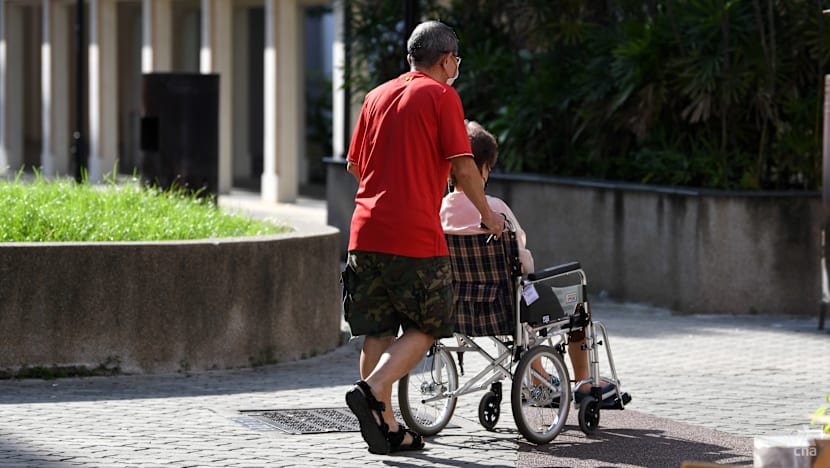
A man pushes an elderly woman in a wheelchair in Singapore. (Photo: CNA/Calvin Oh)
Davina Tham
18 Mar 2026 06:00AM
SINGAPORE: Mr Danny Soh, 50, left his job to look after his parents when his father suffered a stroke and developed vascular dementia in 2024.
The elderly man’s illness meant he could no longer take care of Mr Soh’s mother, who is unable to move about on her own after suffering three strokes between 2011 and 2015.
For more than a decade, Mr Soh’s father had been her main caregiver, assisting her daily at home and accompanying her to medical check-ups and rehabilitation sessions.
This allowed Mr Soh to continue working a full-time job, taking the occasional emergency leave when caregiving needs arose.
So when his father fell ill as well, Mr Soh, who is married with no kids, knew it was his turn to take up the mantle of caregiving.
“I think this is our duty, so I didn’t hesitate,” said the only child, even though leaving his job in his late 40s felt scary at first.
For several months, he was the main caregiver to his mother and father, who are 82 and 83 respectively, until he was able to find a maid to share the load.
Mr Soh is among a growing proportion of men in Singapore who are leaving the labour force to take care of their parents.
While he returned to work on a part-time basis after some months, others are making more lasting departures from the workplace.
Men made up 40.1 per cent of 12,300 Singaporeans and permanent residents who left their jobs to care for their parents last year.
This was up from 27.28 per cent of 12,000 such caregivers in 2021, according to a Ministry of Manpower (MOM) parliamentary reply on Feb 24.
Concurrently, the proportion of women among such caregivers fell to 59.9 per cent last year, from 72.2 per cent in 2021.
Parent caregivers are a subset of a larger group of adults who stop working to care for family members, who can also include children and other relatives.
The number of men who cited caregiving as their main reason for not working has fluctuated over the past five years, but generally rose from 11,300 in 2021 to 12,400 in 2025.
Over the same period, the number of women who left work for caregiving fell from 89,400 to 60,200.
MOM’s numbers suggest an encouraging shift towards a more gender-balanced approach to caregiving, at least for parents, experts told CNA.
But early departures from the workforce may also reflect a build-up of caregiving pressures among working adults, and have an impact on financial security and other life plans, such as starting a family.
Like Mr Soh, caregivers of working age face daunting choices around the trajectories of their lives and careers when duty comes knocking.
WHY MORE MEN STEP UP
With no siblings or other relatives to turn to for his parents’ care, Mr Soh typifies how some men come to be caregivers.Apart from evolving expectations around gender roles, changing family structures may explain why family care is becoming less skewed by gender.
“Smaller family sizes mean there are often fewer or no siblings available to share caregiving responsibilities,” said Ms Ariel Tan, social worker at Fei Yue Community Services.
This paves the way for the only child, whether a son or a daughter, to become the primary caregiver for elderly parents.
Another reason might be the narrowing pay gap between men and women, said Dr Rahul Malhotra, associate professor at Duke-NUS Medical School.
This could mean that when it comes to deciding whether a son or daughter gives up work to be the caregiver, considerations about the resulting income loss may matter less.
Greater public awareness about eldercare needs and services also matters, said Dr Millie Su of the Singapore University of Social Sciences (SUSS).
This may encourage families to view caregiving as a shared responsibility rather than a gendered one, said the senior lecturer in human resource management.
She added that the trend of more men leaving work to care for their parents should be interpreted carefully.
The bulk of those leaving the workforce for eldercare are in their 50s, with parents who might be in their mid-70s to 80s, she pointed out.
“This could mean that the caregiving pressure also peaks at this point, and that this pressure is strong enough to push people out of employment,” said Dr Su.
Having had a fruitful career in finance and technology, Mr Soh looked forward to returning to full-time work after hiring a maid.
But he found he could not “outsource” all caregiving tasks to the maid, especially hospital visits. With two seniors to look after, a second pair of hands was still needed.
“The reality dawns on you after a while. How am I going to do a full-time role with this?” he said.
At the same time, with his parents’ caregiving expenses adding up to at least S$24,000 (US$19,000) a year, a source of income was still needed.
Almost half a year after his father’s stroke, Mr Soh started working part-time in a healthcare firm. He considered himself lucky to have found the job through a friend.
He later pivoted into a part-time job in strategy at a social service agency focusing on eldercare. His workplace is opposite his parents’ home, allowing him to drop in conveniently.
He now shares the caregiving load with his parents’ maid, taking over fully on her weekends off.
BURNOUT AND NEGATIVE ASSOCIATIONS
Professional roles are closely tied to identity and self-worth, which can make leaving work emotionally and psychologically challenging, social worker Ms Tan pointed out.She added that male caregivers tend to ask for help less readily, often choosing to shoulder caregiving burdens on their own.
“As a result, many only seek support from counsellors or social workers in hospitals or social service agencies when they are already experiencing significant stress or burnout,” she said.
This was echoed by Mr Adrian Tan, 40, co-founder of social enterprise SG Assist and himself a caregiver to his mother through her diagnoses of breast cancer and depression.
He said some men who are caregivers are embarrassed about the role and feel it has “negative connotations”, such as depending on other breadwinners to support them.
SG Assist provides training, community support and resources for caregivers. It is striving for a “balance of narrative” to support men as caregivers, he said.
“I feel that men generally keep their feelings within themselves. They don’t like to share problems (with) other people,” he said.
Through the group’s work supporting caregivers who are women, he has found that they are more willing to share because they know they can receive support when they do so.
CARE-RELATED INTERRUPTIONS
The effects of interrupting a career to look after loved ones affect all carers. One potentially alarming observation is that the decision to leave work for caregiving may also be influenced by labour market and workplace changes, said Dr Su.As the economy transforms rapidly due to technological change and artificial intelligence, workers in their 50s may face growing pressure to adapt and update their skill sets.
“When combined with caregiving responsibilities at home, some may decide to exit the workforce earlier than planned,” she said.
This could have worrying consequences for retirement adequacy.
People in their 50s still have eight to 10 years of productive working life left, noted Dr Su. Singapore is also gradually raising the retirement age to 65 by 2030.
“Leaving the workforce prematurely may affect long-term financial security, and some may end up taking on gig or informal work – such as driving for ride-hailing platforms or delivery services – to supplement their income,” she said.
Mr Soh said financial literacy was essential as he has had to manage his finances “quite tightly” since he became a caregiver.
Being able to afford a maid is a key part of the puzzle for his caregiving arrangement. It helps that his wife also works and they have no children to look after.
The strain of caregiving can spill over into other parts of life, including family-planning. This was the case for Mr Tan Mingrui, 44, and his wife.
When Mr Tan’s mother suffered a stroke in 2021, he quit his job as a finance executive to look after her for several months during the COVID-19 pandemic.
After finding a maid to take over her care, Mr Tan worked as a security officer for a while before reprising a full-time role similar to his previous job.
But when it came to having a child, he and his wife, now 41, never quite picked up from where they left off.
Despite the maid’s help, caregiving still made a dent in the time, energy and finances they had available to start a family. The expenses for Mr Tan’s mother amounted to about S$4,000 a month before social assistance.
Mr Tan’s mother died in 2024. He and his wife, who is still a caregiver for her own mother, have not yet resumed their plans for a family.
FLEXI-WORK AND LEAVE
Before resigning in 2021, Mr Tan tried asking his employer for flexible work arrangements so he could put a caregiving system in place for his mother.He said the company, a large foreign firm, did not directly respond to his request but gave “a feeling that this is a no”.
“I don’t want to make things difficult, so the best option is to just quit first,” he said.
Caregivers – along with mothers and seniors – are among the targets of a push to normalise flexible work arrangements so more of them can join or remain in the workforce.
Since December 2024, all employers have been required to properly consider employees’ requests for flexible work arrangements.
Around seven in 10 firms offer such arrangements. This has supported Singapore’s labour force participation rate, MOM said in a recent update.
The ministry cited the falling share of caregivers aged 25 to 64 who were not working or looking for work – from 28.2 per cent in 2019, to 17.2 per cent in 2025.
It also pointed to women’s rising labour force participation rate, which hit 80.5 per cent in 2025. The corresponding rate for men was 91.8 per cent.
But MOM also said less than half of employees who needed “flexi-load” arrangements, which include part-time work, received them in 2024.
Employees who needed flexi-time and flexi-place arrangements – like staggered work hours or remote work – fared better, with 70 per cent of them getting such provisions.
MOM has said it is looking at how to enhance the Part-Time Re-employment Grant for seniors, to help employers provide more “flexi-load” jobs that could benefit caregivers too.
It has rejected suggestions to mandate flexible work arrangements, saying this would stifle business operations and competitiveness, and hurt employment opportunities in the long run.
Advocates of caregiver support have also called for parent-care leave to be mandated, like childcare leave. Currently, the practice differs in the public and private sectors.
The civil service offers two days of parent-care leave a year.
In the private sector, it is growing more common – around 5,000 firms, representing 29.3 per cent of companies with at least 25 employees, offered paid parent-care leave in 2024. That figure was 13.2 per cent in 2020.
MOM said it continues to study the feasibility of enhancing leave provisions to support caregivers, while noting this will need to strike a balance with employers’ operational needs.
But while flexible work arrangements and caregiver leave are important, they are only a part of the solution, said SUSS’ Dr Su.
“Employees – both men and women – should feel able to discuss caregiving responsibilities openly without fear that doing so will harm their career prospects,” she said, stressing the need to build caregiver-friendly workplace cultures.
Companies can also do more to prepare employees, especially those in their 50s, for life after retirement, she suggested.
“For many workers, particularly men whose identities are strongly tied to their careers, leaving the workforce abruptly can be disorienting,” she said.
“Pre-retirement programmes that address financial planning, caregiving responsibilities, and post-retirement purpose can help employees navigate these transitions more thoughtfully rather than making sudden exits from the workforce.”
A SOCIETY OF CAREGIVERS
The ultimate goal should not be to equalise the ratio of male and female caregivers, Dr Su said.“The more important objective is to ensure that caregiving responsibilities do not push individuals out of the workforce prematurely or unnecessarily, especially when many of these workers still have valuable experience and productive years ahead of them,” she said.
Dr Malhotra, who leads Duke-NUS’ Centre for Ageing Research and Education, agreed when asked about the kind of caregiver-friendly society for which Singapore should aim.
Singapore is projected to become “super-aged” this year, when the share of its population aged 65 and above crosses 21 per cent.
A super-aged society reflects not only more older individuals and a concurrent increase in those with care needs, but also fewer younger individuals, including those of working age, said Dr Malhotra.
“It is of value to retain individuals in the workforce for as long as possible, providing them with adequate support within and outside the workplace to fulfil their care and caregiving responsibilities and ensuring a good quality of care (and life) for them and their care recipients,” he said.
This could allow more caregivers like Mr Soh and Mr Tan to do the best they can in the roles where they find themselves at different points in life.
“My mother took care of me since I was a child. She was a full-time homemaker,” Mr Tan said in Mandarin.
“My own thinking is, because she’s my mother, so when there are situations and unexpected things happen, I should do what needs to be done.
“I can’t say I can do it to 100 per cent, but I can say I do my best. She’s my mother after all. If I don’t handle it, no one will.”


