• IP addresses are NOT logged in this forum so there's no point asking. Please note that this forum is full of homophobes, racists, lunatics, schizophrenics & absolute nut jobs with a smattering of geniuses, Chinese chauvinists, Moderate Muslims and last but not least a couple of "know-it-alls" constantly sprouting their dubious wisdom. If you believe that content generated by unsavory characters might cause you offense PLEASE LEAVE NOW! Sammyboy Admin and Staff are not responsible for your hurt feelings should you choose to read any of the content here.

    The OTHER forum is HERE so please stop asking.

China and Canada : A beautiful relationship in the making

China only started compulsory education in 1986...it is where it is today after only 40 years...my personal belief is there is an illuminati group that rules the earth and the rep from each continental changes once every 10 to 12 years...trump Biden trump means current term for USA is coming to an end and another continent rep will take over in 2030, in between likely an AI bubble burst (necessary just like the dotcom bubble burst, to improve and learn from current mistakes) in order to advance mankind into the new age of AI...go read the great sci fi novelists like Dick, Asimov, Le Guin, Heinlehn etc...they have already envisioned the future
 
I believe BYD already makes buses in Canada. Now more BYD EVs will be imported into Canada. And in the near future, BYD will make EVs in Canada. Canadians can rejoice!:biggrin:

Canada breaks with US, slashes 100% tariffs on Chinese EVs to 6%​

Fred Lambert | Jan 16 2026 - 6:56 am PT
Canada China trade deal


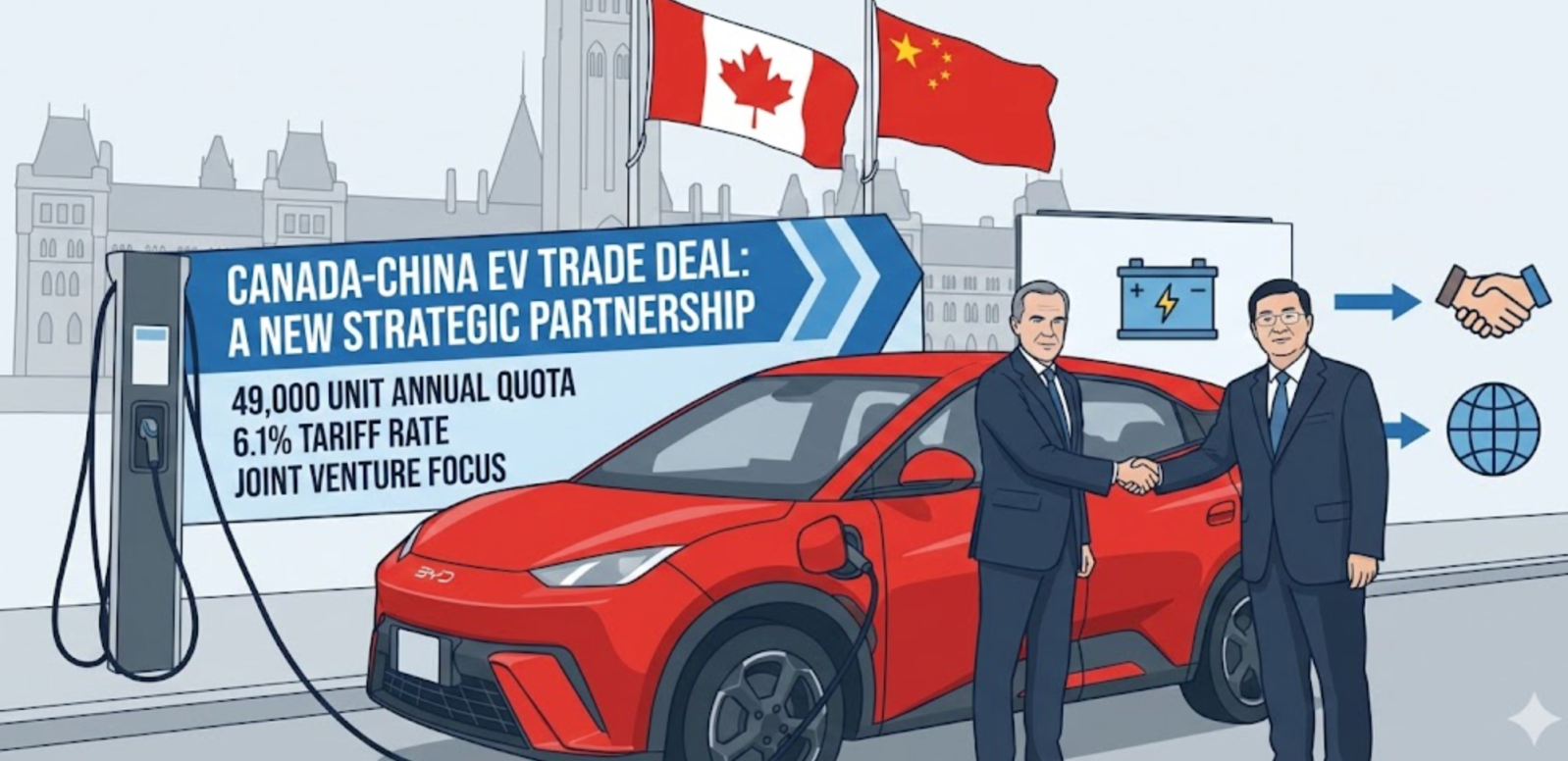
In a massive shift in North American trade policy, Prime Minister Mark Carney announced today a new “strategic partnership” with China that effectively reopens the Canadian border to Chinese electric vehicles.

The move marks a significant departure from the United States’ hardline protectionist stance and could bring affordable EV options like the BYD Seagull to Canadian roads as early as this year.

For the last two years, Canada has largely walked in lockstep with the US regarding Chinese EV tariffs. Following the Biden administration’s move to impose 100% tariffs on Chinese EVs, Canada implemented similar surtaxes, effectively freezing companies like BYD, Nio, and Zeekr out of the market.

Today, that ice is breaking.

As part of a broader trade agreement secured by Prime Minister Carney in Beijing this week, Canada has agreed to allow an annual quota of 49,000 Chinese electric vehicles into the country at the tariff rate of just 6.1%.

According to the Prime Minister’s office, this volume represents less than 3% of the Canadian new vehicle market. However, the deal explicitly targets the low end of the market, with the government anticipating that within five years, “more than 50% of these vehicles will be affordable EVs with an import price of less than $35,000.”

In exchange for opening the EV floodgates (or at least starting to break the dam), China has agreed to lower tariffs on Canadian canola seed from roughly 85% to 15% and to lift restrictions on Canadian lobster and crab.

The Canadian government claims this isn’t just about imports. The text of the agreement states that the deal is expected to “drive considerable new Chinese joint-venture investment in Canada” to build out the domestic EV supply chain.

Electrek’s Take​

While 49,000 vehicles might sound like a small number compared to the total market, it’s a specific, targeted wedge that changes the entire dynamic of the North American EV market.

For years, we at Electrek have argued that protectionism, while perhaps protecting legacy automaker jobs in the short term, ultimately hurts consumers and slows down the transition to sustainable transport.

Those 49K will sell in the first couple of months. Expect announcements of investment in manufacturing by Chinese companies (probably BYD) & hence the quota will be increased/removed.

Anyway, hopefully this spurs Electrek to report on the daily new releases & updates on Chinese vehicles, both consumer and commercial (Hungary is adding about 100 electric buses to its public transport from BYD’s local manufacturing plant)

Meanwhile, protecting domestic automakers from Chinese competition in their home market makes them less competitive on the global stage, virtually giving the global market to China.

The reality is that Chinese automakers are currently building some of the best, most affordable EVs in the world. Keeping them out entirely not only hurts consumers but also hurts innovation.

Of course, this is going to make Washington furious. The US has been trying to build a “Fortress North America” against Chinese EVs. By letting 49,000 units in tariff-free (or near tariff-free), Canada is effectively saying it values affordable climate solutions (and canola exports) more than complete alignment with US industrial policy, which is understandable since the US was the one to go hostile on trade with Canada.

The interesting detail here is the “Joint Venture” language. It looks like Carney is taking a page out of China’s own playbook. Canada seems to be using this quota as a carrot to get companies like BYD or CATL to set up shop in Canada and maybe help Canadian companies learn from those giants.

https://electrek.co/2026/01/16/canada-breaks-with-us-slashes-100-tariffs-chinese-evs/
 

Carney opens Canada to Chinese EVs, China cuts canola tariffs​

Xi Jinping and Mark Carney mark a new “strategic partnership.”

Mark Carney shakes hands with Xi Jinping in front of flags.

Prime Minister Mark Carney meets with President of China Xi Jinping at the Great Hall of the People in Beijing. | Sean Kilpatrick/The Canadian Press

By Zi-Ann Lum 01/16/2026 06:36 AM EST

Prime Minister Mark Carney is opening the door to more imports of electric vehicles from China with expectations the olive branch will lead to “considerable” Chinese investment in Canada’s auto sector “within three years” — risking potential blowback from Washington.

The move comes as Carney and Chinese President Xi Jinping chart a new era in Canada-China relations and diversify trade ties in response to U.S. President Donald Trump.

“In terms of the way that our relationship has progressed in recent months, with China, it is more predictable,” Carney told reporters in Beijing on Friday when asked about the unreliability of Washington as a trade partner.

The Canada-U.S. relationship is “more multifaceted, much deeper, much broader,” he said.

Carney said through a “preliminary but landmark” deal with China, Canada will allow up to 49,000 Chinese EVs into the country under the most-favored nation tariff rate of 6.1 percent. Under the agreement, the import limit will increase to 70,000 EVs by year five.

“That’s a return to levels last seen in 2023 … the last full year before the Canadian tariff actions,” Carney said.

The policy shift marks a reversal in Canadian trade policy from October 2024 when Ottawa moved in lockstep with Washington to implement the 100 percent tariff — a measure that effectively blocked all imports of Chinese EVs.

Mexico’s Senate approved a bill last month to increase its own tariff to 50 percent from 20 to further squeeze imports of Chinese EVs into the North American market as carmakers begin to retool assembly lines to build more electrified models. That tariff went into effect on Jan. 1.

Beijing has agreed in response to reduce its retaliatory tariff on imports of Canadian canola from a combined 85 percent duty rate to “approximately 15 percent” by March 1.

The prime minister brushed off concerns the new Chinese EV quotas pose an existential risk to the Canadian auto sector.

“It’s still in low, single-digit proportion of the size of the Canadian auto sector,” Carney said. “Canadians buy about 1.8 million autos a year.”

Trump’s bellicose approach to foreign affairs has forced Ottawa to look to China and the Middle East to grow trade and court foreign investment. The Carney government has set an ambitious goal to double non-U.S. trade in a decade to reduce reliance on the American market.

American and Canadian lawmakers and union leaders have argued in recent years that an influx of cheap Chinese imports endangers the future of the North American industry.

Ontario Premier Doug Ford implored Carney not to drop the tariffs on Chinese EVs for fear of cheap imports flooding the Canadian market.

“We can’t back down, simple as that,” Ford told reporters last week, but revealed the conditions under which he would be comfortable with lowering or scrapping tariffs.

“They want to come and open a big manufacturing facility and employ Unifor employees, well, let’s talk. But don’t be shipping cars in (that are) not manufactured by Ontarians.”

Canada’s shift on its hawkish policy targeting Chinese EVs doesn’t come out of the blue.

The Carney government launched an informal review of the tariff policy last year as China targeted Canada’s canola industry with punishing tariffs that closed the Chinese market to Canadian growers. The review has unfolded in secrecy, as the federal government declined to confirm its start or end.

The new trade détente with Beijing is another demonstration of the way Carney’s Liberal government is differentiating itself from Justin Trudeau’s era as prime minister, which held more hawkish policies on China.

Trudeau’s former industry minister, François-Philippe Champagne, introduced a national security review targeting Chinese investment in Canadian critical minerals.

Champagne was promoted to finance minister by Carney, but was not part of the federal delegation in China this week.

China is Canada’s second largest trading partner, after the United States, with total annual bilateral trade valued at C$118 billion.

https://www.politico.com/news/2026/01/16/china-ev-tariffs-canada-00733086
 
I believe BYD already makes buses in Canada. Now more BYD EVs will be imported into Canada. And in the near future, BYD will make EVs in Canada. Canadians can rejoice!:biggrin:

Canada breaks with US, slashes 100% tariffs on Chinese EVs to 6%​

Fred Lambert | Jan 16 2026 - 6:56 am PT
Canada China trade deal


In a massive shift in North American trade policy, Prime Minister Mark Carney announced today a new “strategic partnership” with China that effectively reopens the Canadian border to Chinese electric vehicles.

The move marks a significant departure from the United States’ hardline protectionist stance and could bring affordable EV options like the BYD Seagull to Canadian roads as early as this year.

For the last two years, Canada has largely walked in lockstep with the US regarding Chinese EV tariffs. Following the Biden administration’s move to impose 100% tariffs on Chinese EVs, Canada implemented similar surtaxes, effectively freezing companies like BYD, Nio, and Zeekr out of the market.

Today, that ice is breaking.

As part of a broader trade agreement secured by Prime Minister Carney in Beijing this week, Canada has agreed to allow an annual quota of 49,000 Chinese electric vehicles into the country at the tariff rate of just 6.1%.

According to the Prime Minister’s office, this volume represents less than 3% of the Canadian new vehicle market. However, the deal explicitly targets the low end of the market, with the government anticipating that within five years, “more than 50% of these vehicles will be affordable EVs with an import price of less than $35,000.”

In exchange for opening the EV floodgates (or at least starting to break the dam), China has agreed to lower tariffs on Canadian canola seed from roughly 85% to 15% and to lift restrictions on Canadian lobster and crab.

The Canadian government claims this isn’t just about imports. The text of the agreement states that the deal is expected to “drive considerable new Chinese joint-venture investment in Canada” to build out the domestic EV supply chain.

Electrek’s Take​

While 49,000 vehicles might sound like a small number compared to the total market, it’s a specific, targeted wedge that changes the entire dynamic of the North American EV market.

For years, we at Electrek have argued that protectionism, while perhaps protecting legacy automaker jobs in the short term, ultimately hurts consumers and slows down the transition to sustainable transport.

Those 49K will sell in the first couple of months. Expect announcements of investment in manufacturing by Chinese companies (probably BYD) & hence the quota will be increased/removed.

Anyway, hopefully this spurs Electrek to report on the daily new releases & updates on Chinese vehicles, both consumer and commercial (Hungary is adding about 100 electric buses to its public transport from BYD’s local manufacturing plant)

Meanwhile, protecting domestic automakers from Chinese competition in their home market makes them less competitive on the global stage, virtually giving the global market to China.

The reality is that Chinese automakers are currently building some of the best, most affordable EVs in the world. Keeping them out entirely not only hurts consumers but also hurts innovation.

Of course, this is going to make Washington furious. The US has been trying to build a “Fortress North America” against Chinese EVs. By letting 49,000 units in tariff-free (or near tariff-free), Canada is effectively saying it values affordable climate solutions (and canola exports) more than complete alignment with US industrial policy, which is understandable since the US was the one to go hostile on trade with Canada.

The interesting detail here is the “Joint Venture” language. It looks like Carney is taking a page out of China’s own playbook. Canada seems to be using this quota as a carrot to get companies like BYD or CATL to set up shop in Canada and maybe help Canadian companies learn from those giants.

https://electrek.co/2026/01/16/canada-breaks-with-us-slashes-100-tariffs-chinese-evs/
pending disaster for canada as byd evs will be stranded in the cold during winter months. sexpect more canadians to die alone in byd cars.
 
pending disaster for canada as byd evs will be stranded in the cold during winter months. sexpect more canadians to die alone in byd cars.
Oh dearie me, this is scary!:eek: Is this happening during the cold winter months in Europe where BYD EVs are free to roam? Has this happened with Tesla EVs in Canada where they've been roaming for forever?
 
Oh dearie me, this is scary!:eek: Is this happening during the cold winter months in Europe where BYD EVs are free to roam? Has this happened with Tesla EVs in Canada where they've been roaming for forever?
moreover, tiong evs are underperforming and underselling in europe. majority of them are stranded in european ports unable to move to dealerships and sales as euro consumers don’t buy them.
https://vnauto.net/2024/06/20/chinese-cars-stranded-at-european-ports/
 
Back
Top