
- Joined
- Apr 14, 2011
- Messages
- 21,806
- Points
- 113
Will go buy candles to burn and pray for him tonight!
Singapore and PM Lawrence Wong targeted in AI-driven disinformation campaign on YouTube
A CNA investigation has found hundreds of videos spreading lies about Singapore’s foreign policy, economy and leadership. Multiple accounts involved in the operation, which has been going on for several months, appear to be centrally coordinated.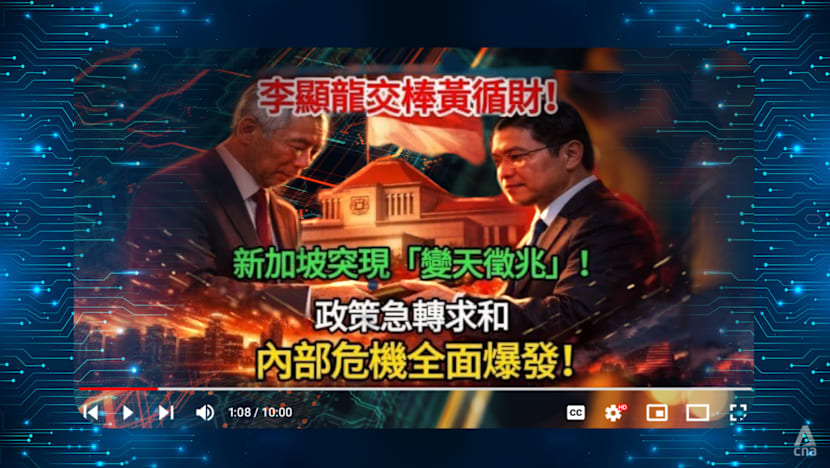
Listen
10 min
CNA Verification
25 Feb 2026 06:00AM(Updated: 25 Feb 2026 01:10PM)Bookmark
WhatsAppTelegramFacebookTwitterEmailLinkedIn
Set CNA as your preferred source on Google
Read a summary of this article on FAST.
FAST
SINGAPORE: Hundreds of AI-generated, Chinese-language YouTube videos have been targeting Singapore and Prime Minister Lawrence Wong as part of an ongoing disinformation campaign, CNA has found.
Seven in 10 videos attack Mr Wong specifically, fabricating narratives about his leadership role being under threat, and spreading conspiracy theories about political infighting in Singapore.
ADVERTISEMENT
The videos have racked up millions of views since surfacing late last year, though experts suggested that bot traffic or automation could be responsible. In aggregate, these videos represent one of the largest and most persistent public campaigns against Singapore in recent years.
CNA analysed nearly 300 such videos over three weeks, as part of this investigation. They were uploaded by more than 30 YouTube channels, alongside videos targeting other world leaders, and featured Mandarin computer-generated voiceovers as well as subtitles in traditional Chinese characters.
Another distinctive trait of the operation was the aggressive use of hashtags referencing Singapore or Mr Wong. This tactic, known as SEO (search engine optimisation) “poisoning”, serves the purpose of “contaminating” Chinese-language search results on YouTube and drawing viewers who might not otherwise engage with such videos.
Some clips and their associated channels have since been deleted, only for fresh videos to surface swiftly, making it challenging to determine the true scale and reach of the operation.
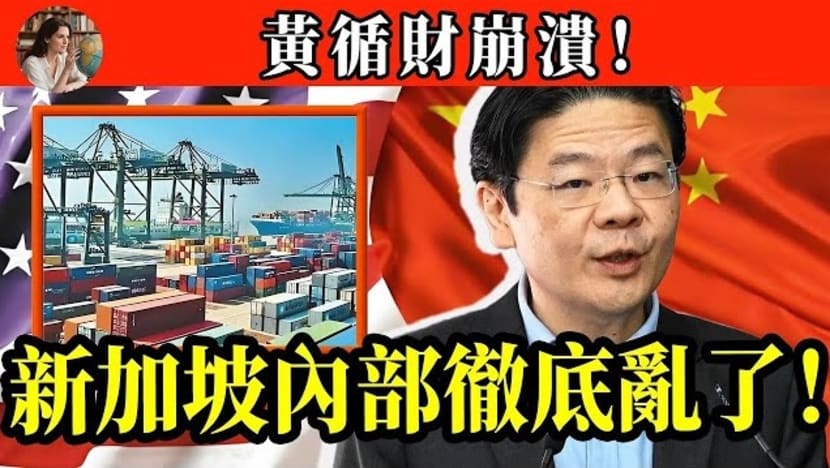
FABRICATIONS AND FALSEHOODS
Among multiple false narratives pushed was a conspiracy theory claiming Mr Wong was about to be sacked by his predecessor, Senior Minister Lee Hsien Loong, whom the videos alleged to be plotting to reclaim leadership of Singapore. Strident, hyperbolic video titles declared Mr Wong had “fallen from power” and referred to him as the “shortest-serving PM”.Another theme repeated throughout the campaign’s lengthy videos — which average about half an hour each, with the longest close to an hour — was Singapore’s purported impending economic “doom”. Videos claimed the trade hub was being threatened by a Hainan port becoming fully operational in December, citing unverifiable statistics on Singapore’s "collapsing" shipping volume and a mass exodus of Fortune 500 companies.
In reality, Singapore’s port handled a record 44.66 million containers in 2025 and remains the world’s second-busiest container port — an accolade it has held for the past 15 years.
Elsewhere, the disinformation operation also focused on Singapore’s foreign relations, with some videos deriding the country as an American puppet or pawn, while others fabricated news of Singapore “betraying” the United States for economic reasons.
As part of its investigation, CNA sent questions about this disinformation campaign as well as examples of two YouTube accounts posting videos propagating the false narratives to Google, the owner of YouTube. Within 12 hours, both accounts had been terminated.
A YouTube spokesperson said in response: “YouTube doesn’t allow spam, scams, or other deceptive practices that take advantage of the YouTube community. In accordance with these policies, we’ve since terminated the flagged channels.”
However, most of the 300 videos analysed by CNA remain online, and in fact, searches on YouTube weeks after the initial investigation continued to turn up more such videos attacking Singapore.
PULLING THE STRINGS
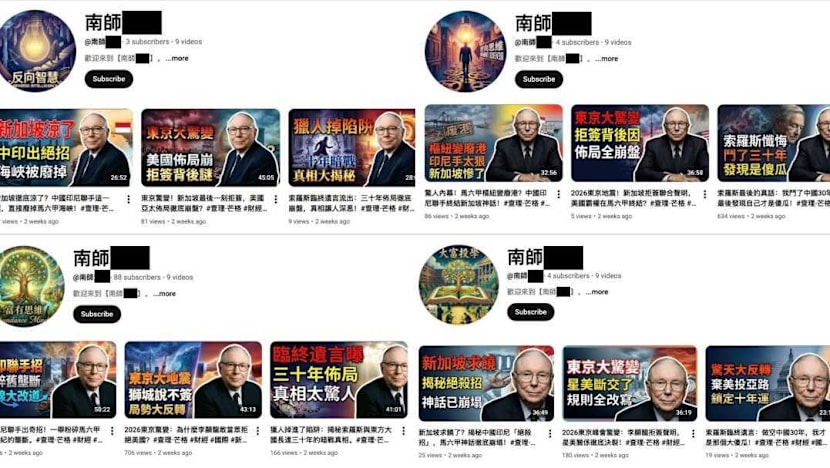
The existence of the campaign was first reported by Chinese-language newspaper Lianhe Zaobao. CNA can now additionally show, through manual and AI-assisted analysis of visuals, text and account behaviour, that at least 10 YouTube channels were likely to be acting in concert – a hallmark of influence operations to manipulate public opinion.These accounts were likely controlled by a common operator or group of operators, based on multiple lines of converging evidence which included, in the starkest instances, videos being posted at the exact same second or using the exact same script and voiceover.
Consider four YouTube channels that share a naming prefix of “Southern Master” (CNA is not providing exact usernames or URLs, to avoid further spreading disinformation). The quartet was created within a 20-minute window on Jan 18, with a mere 13-second gap between two channels. All four accounts published exactly nine videos, consistently scheduled for the 10am hour, and either seconds apart or at fixed 15 or 30-minute intervals.
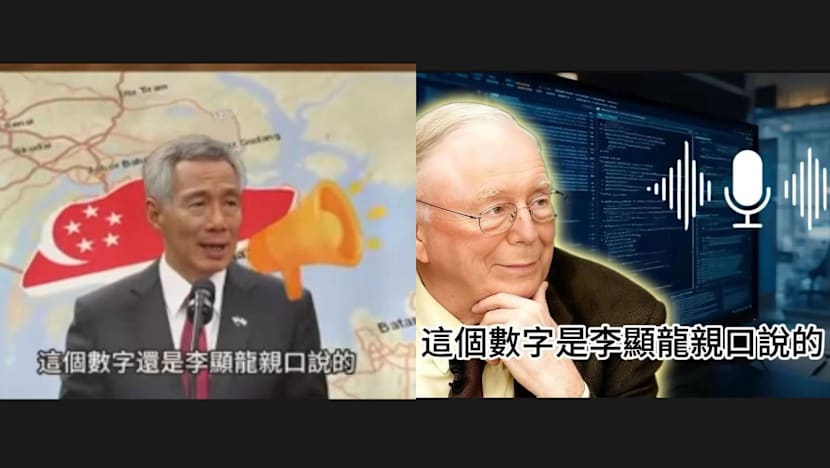
These videos shared near-identical titles and received extremely low to zero engagement. Most prominently, they adopted the same visual template, with only slight variations, centred on a deepfake of late American investor Charlie Munger.
TOOLS AND TEMPLATES
It’s not entirely clear why Munger was picked as an avatar, but his AI-generated presence extends to videos posted by over half of the YouTube channels in the campaign.Other techniques on display in the campaign included universal use of text-to-speech voiceovers and multiple channels sharing the exact or near-identical AI-generated thumbnails.
Of particular note among nearly all the videos was the use of hashtags written in both traditional and simplified Chinese, specifically on Singapore or Mr Wong, and aimed at flooding Chinese-language search results on YouTube.
The use of traditional Chinese characters – uncommon in Singapore – could be an attempt to mask the origins of the videos and channels, said political scientist Chong Ja Ian from the National University of Singapore.
He told CNA the campaign at large could be aimed at causing domestic uncertainty or to shake confidence in the Singapore system, including among ethnic Chinese-linked individuals around the world.
“The volume and scale of the campaign suggest a state backer,” said the associate professor. “However, it is also possible that a well-funded private entity could be behind the campaign.”
Related:
'Flood' of disinformation ahead of Bangladesh election

Commentary: The real political risk of AI isn’t deepfakes
GLOBAL CAMPAIGN
Assoc Prof Chong noted that the campaign’s characteristics appeared consistent with documented influence operations detailed by several think-tanks over the years.In recent times, Singapore has moved to publicly flag and act against coordinated online influence risks, under a foreign interference law passed in 2021.
This latest campaign analysed by CNA was not aimed solely at Singapore and Mr Wong. US President Donald Trump, various Western leaders and Japanese Prime Minister Sanae Takaichi were also targeted in other videos posted by the same channels.
On Monday (Feb 23), Japanese newspaper Yomiuri Shimbun reported on Takaichi and her government being targeted by a similarly coordinated, long-term campaign featuring thousands of social media accounts.
Citing research by the Tokyo-based Japan Nexus Intelligence analyst group, the report noted the accounts spreading fabrications in both Japanese and English, and using AI-generated images.
The false claims, posted in late January ahead of election campaigning, included how Takaichi was “opening the path to military expansionism and historical revisionism”, as well as Japan’s supposed increasing social security burden on the younger generation.
BUILDING DEFENCES
Singapore’s Ministry of Digital Development and Information (MDDI) told CNA it was aware of several online accounts publishing numerous videos in recent weeks to make “wholly fabricated and outlandish claims” about Singapore’s foreign policy and domestic politics.“It would be clear to Singaporeans, and those who live here, that the videos contain entirely made-up storylines about Singapore’s current affairs.”
A spokesperson noted that Singapore was not immune to attempts by others to sow distrust, influence public opinion or interfere in its domestic politics.
“Beyond regulatory measures, a well-informed, vigilant and discerning public is our first and most crucial layer of defence against misinformation,” MDDI added, pointing to public education measures and government-developed resources.
The ministry urged members of the public to check official sources for accurate information, and to avoid forwarding content from unknown or unverified sources.
S. Rajaratnam School of International Studies (RSIS) senior fellow Benjamin Ang noted that when people in Singapore encounter misinformation or biased narratives in their mother tongue, it can appeal to their identity.
“If English-speaking fact-checkers (or the government) try to debunk in English, there is a serious disconnect,” he added. “There is a serious need for capability-building and support in mother tongue.”
Beyond YouTube, Mr Ang’s team has been looking at similar Chinese-language videos on TikTok. On Facebook, CNA has also found duplicates or near-identical copies of several videos in the campaign.
Mr Ang, who heads the centre of excellence for national security as well as digital impact research at RSIS, cautioned against rushing to attribute deceptive or harmful content to foreign interference.
He pointed to research finding a range of other motives, including how sensational and political content can draw clicks which in turn build advertising revenue – or build followings that can be exploited later.
Assoc Prof Chong said that as disinformation efforts become increasingly advanced, videos and networks have also grown in numbers, variety, narratives and even production quality.
Hence the importance of media and civic literacy in battling these attempts to erode social cohesion and resilience.
“Such phenomena will only become more widespread,” he said. “Future output will likely be even more sophisticated.”


