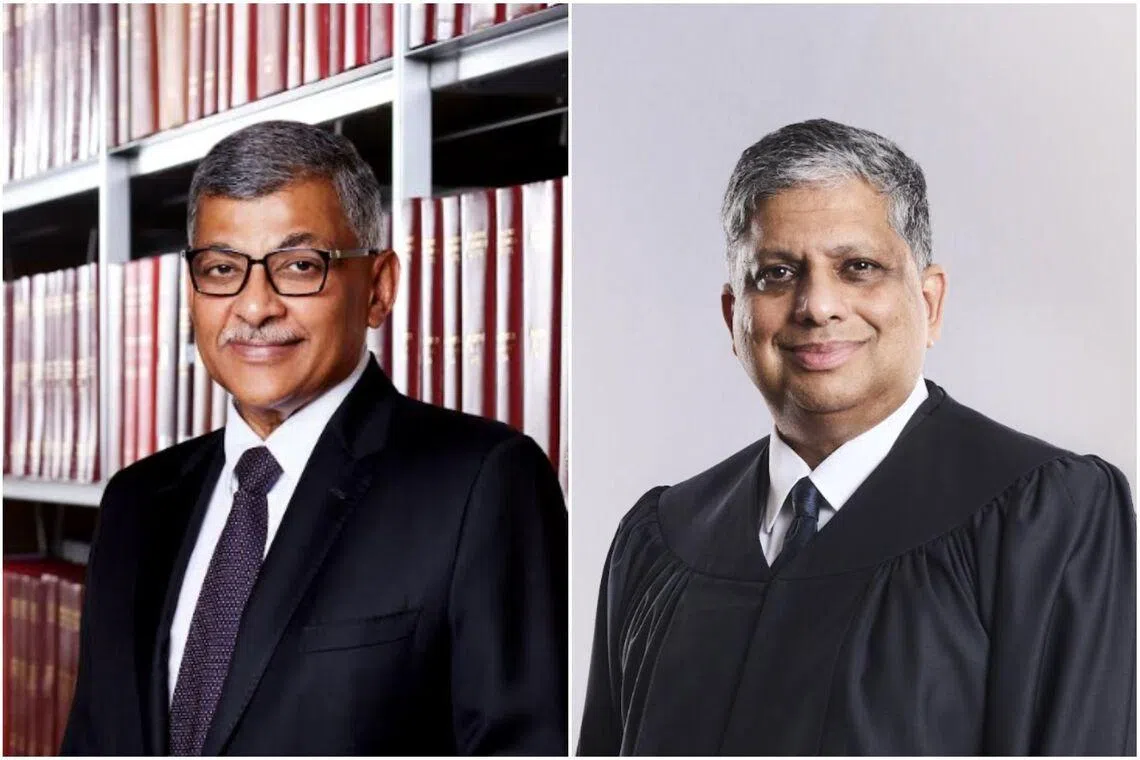
Menon will be a GRC MP next GE….
ai gen.
Under Singapore law, whether a Supreme Court judge—including the Chief Justice—receives a lifelong pension depends entirely on **when they were first appointed to the judicial bench**.
The rules are governed by the *Judges' Remuneration Act 1994*:
* **Appointed BEFORE January 1, 2015:** Judges appointed before this date fall under the pension scheme (governed by the *Pensions Act 1956*). They are eligible for a traditional pension for life upon retirement.
* **Appointed ON OR AFTER January 1, 2015:** In line with broader civil service reforms, Singapore shifted newer judicial appointments to a **gratuity scheme**. Instead of a lifelong pension, these judges receive a one-off lump-sum gratuity payout upon retirement, calculated based on their years of continuous service.
### The Case of Chief Justice Sundaresh Menon
Because Chief Justice Menon was first appointed as a Judicial Commissioner in 2006 and subsequently as Chief Justice in 2012—well before the 2015 cutoff—his retirement benefits fall under the older system.
Therefore, he is eligible for a pension for life.
His successor, Justice Sushil Sukumaran Nair (who joins the Supreme Court bench as a judicial officer after the cutoff date), along with other newer judges, will be under the modern gratuity framework rather than a lifelong pension system.
...
A lifelong pension under Singapore’s statutory framework functions as a guaranteed income stream provided by the state to support eligible public officers after their service ends.
### 1. What Exactly is a Lifelong Pension?
A lifelong pension is a monthly payment made directly from the government’s Consolidated Fund (the state's main bank account) to the retired official.
* **The "Lifelong" Nature:** Once it begins, it is paid every single month without fail for the remainder of the retiree's natural life.
* **Protection:** By law, this pension cannot be frozen, seized, or attached by creditors for private debts; it is completely protected to ensure the retiree’s financial security.
### 2. When Does It Start and Cease?
* **Start Date:** The pension payments commence on the **very first day of retirement** (immediately following the official's last active day in office).
For Chief Justice Menon, who is set to retire in 2027, the regular monthly distributions will begin that same year.
* **Ceasing Date:** The payments cease strictly upon the **death of the recipient**. It does not have an "expiration date" or age cap.
### 3. Approximate Amount for Chief Justice Menon
Calculating the exact payout requires internal judicial service data (such as precise months of total reckonable service and chosen lump-sum commutation factors), but we can look at the baseline numbers set by law:
* **The Pensionable Salary:** Under the *Judges' Remuneration (Annual Pensionable Salary) Order*, the designated annual pensionable salary for the Chief Justice of Singapore is **$347,400**.
* **The Math:** In the older pension scheme, an official's monthly pension is calculated using a formula based on their highest pensionable salary and length of service, capped at a maximum fraction (historically two-thirds) of their final pensionable salary.
* **The Payout Structure:** Retirees under this scheme typically choose between two options:
1. Receiving the full monthly pension for life.
2. Taking a massive **one-off lump-sum cash payout** upfront at retirement in exchange for a slightly reduced monthly pension for the rest of their life.
Given the $347,400 pensionable base, the lifelong baseline value of the package is multi-million dollar in scale, distributed via steady monthly income.
*(Note: A judge's actual gross annual remuneration package while working is higher because it includes non-pensionable allowances, but the pension itself is strictly calculated from the pensionable salary base).*
### 4. Post-Retirement Medical Benefits
Yes, because Chief Justice Menon falls under the pre-2015 framework, his post-retirement medical benefits are also **awarded for life**.
Judges appointed under the older system are tethered to the comprehensive civil service medical schemes (such as the comprehensive *Comprehensive Co-payment Scheme* or legacy schemes depending on their exact entry timeline).
* **What it covers:** It provides subsidized outpatient treatment and highly subsidized hospital care at Public Healthcare Institutions (PHIs).
* **For life:** Just like the financial pension, these medical subsidies do not expire as he ages. They continue to cover him for the rest of his life to ensure that healthcare costs do not erode his retirement security.
...
Beyond the core cash pension and the medical benefits, a retiring Chief Justice under the legacy scheme is eligible for a few distinct structural privileges, legal protections, and supplementary allowances.
### Monetary Benefits (For Life)
* **The "Singapore Allowance" (Cost-of-Living Protection):** Under Singapore’s pension framework, the government periodically reviews and adjustments a component called the *Singapore Allowance*.
This is an additional monthly layer paid on top of the base pension to safeguard the purchasing power of retired public officers against high inflation.
* **State-Backed Payout Guarantee:** By statutory mandate via the *Judges' Remuneration Act*, the retirement package is legally charged directly to the state's
**Consolidated Fund**. This is a massive structural benefit because it means the payouts are guaranteed by the full financial backing of the Singapore government, entirely insulated from any standard public sector budget cuts or institutional restructuring.
* **Asset Protection from Creditors:** For life, the pension payouts are strictly non-assignable, non-transferable, and **cannot be seized, attached, or sequestered** by any court or creditor for private financial debts.
The only legal exceptions permitted by law are if the individual owes a direct debt to the Government or faces a court order regarding family maintenance.
### Non-Monetary Benefits (For Life)
* **Lifetime Extension of Medical Benefits to Eligible Dependants:**
The specialized medical coverage provided to pre-2015 retirees isn't just limited to the individual officer. Under legacy Civil Service provisions, the comprehensive medical subsidies—covering outpatient treatments and heavily subsidized hospital care at Public Healthcare Institutions—**extend to his legal spouse for life**, as well as any eligible dependent children under the age of 18.
* **State-Funded Dental Benefits:**
Alongside the regular healthcare coverage, legacy pension frameworks include long-term co-payment or reimbursement structures for **dental claims and clinical treatments**, which carry forward throughout the duration of retirement.
* **The Title of "Chief Justice Emeritus" or Judicial Distinction:**
While it does not pay an active salary, retiring Supreme Court Judges retain their official designations, post-nominal titles, and deep institutional privileges.
They hold permanent, lifelong standing within Singapore’s legal fraternity and formal state functions.
...