

- Joined
- Jul 10, 2008
- Messages
- 67,815
- Points
- 113
Premium Story From Today’s Herald …
Expert advice in late 2021 would have justified the Government loosening vaccine requirements for those aged 12-17, allowing some young people to avoid social or educational exclusion, or even getting sick. A member of the expert group has labelled those requirements a ‘100% gold plated BAD IDEA.’
‘Ostracised, angry and heart-inflamed: Families vent over Covid vaccine rules.’
Ashley had been unable to partake in her usual sporting and social activities: playing tennis at an indoor venue, or joining friends at the Dunedin cinema, swimming pool or ice-skating rink.
Ashley’s mother, Paula Beulink, had done her own research and didn’t want Ashley to get the jab because of the risk of heart inflammation. But she respected Ashley’s decision when her daughter decided the social and sporting costs were too great.
“The next morning [after dose two], she woke up complaining that her chest was really sore, like the stitch when she breathed in,” Beulink told the Herald. “It was radiating up into her neck and her jaw.”
Ashley was eventually diagnosed with vaccine-induced pericarditis, missing school for most of the first term in 2022, heading to the ED when the pain heightened, and becoming one of the 1740 successful ACC claims for vaccine-related injuries.
The incentive – or coercion, as some described it – was similar for the teenage sons of Wellington-based teacher Marie Butel.
“My preference was for the boys to have one vaccination, not two, which I felt was the best for protecting them from infection without exposing them to extra risk,” Butel told the Herald.
“But for my two older sons [ages 15 and 17 at the time] at high school who were very involved with rowing – 20 to 30 hours a week – they had to be double-vaccinated to continue. They needed it to continue to do what they love to do.”
After his second dose, her 15-year-old son, whom she preferred not to name, developed pericarditis.
“It’s not okay to put young men at risk because you want everybody to get two doses,” Butel said.
This type of impact led to the Government dropping vaccine passes for school-organised gatherings, but not until mid-March.
By then, tens of thousands of young people in the 12 to 17 age group had had a second dose since December 2021, when expert advice had landed on the desk of Sir Ashley Bloomfield who was head of the response then.
It had come from the Ministry of Health’s Covid-19 Vaccine Technical Advisory Group (CV Tag), which warned that a second dose may add “unnecessary risk” of myocarditis (heart inflammation) or pericarditis (inflammation of the sac around the heart) for under-18s.
The CV Tag recommended considering changing vaccine mandate requirements for the 12-17 age group (under-12s couldn’t get vaccinated at that point) from two doses to one.
Ashley Beulink was in the Dunedin Hospital ED in February 2022 after having chest pains following her second dose of the Pfizer vaccine. She was later diagnosed with vaccine-induced pericarditis.
But the advice was never delivered to ministers or made public in a timely manner, which the Ministry of Health conceded was a ‘significant failing’.
“It does make me angry,” Beulink told the Herald. “It took a real toll, on Ashley’s health and my mental health as a parent, and it could’ve been avoided.”
She acknowledged it was hard for decision-makers in a fast-changing environment with high uncertainty.
“But I personally don’t think they were justified in including that 12 to 17 age group in the vaccine passes. The Government wasn’t transparent with that information. I believe they were just more concerned about getting their vaccination rates up.”
New Zealand had been free of the virus for several months in August 2021, when the CV Tag told Bloomfield it supported including everyone 12 and older in the vaccine rollout.
This was a change to its advice just a week and a half earlier, which had said the 12-15s should not be routinely vaccinated at this time (16s and older were already included in the rollout by then).
Professor Peter McIntyre of the CV Tag said the change was a signal to parents, if they wanted their children to be vaccinated, that it was a safe and effective vaccine for this age group.
It was also a response to the higher severity and contagiousness of the Delta variant, which was ravaging communities overseas, and arrived in New Zealand only days later.
The context was very different in December 2021, when the updated CV Tag advice about the risk of vaccine mandates for under-18s was sent to Bloomfield.
Delta had been circulating in Auckland which, with the rest of the country, had moved to the vaccine pass system after more than three months in a form of lockdown.
“So all of this took on a totally different flavour,” McIntyre, who is head of Otago University’s department of paediatrics and child health, told the Herald.
“It wasn’t just 12- to 17-year-olds who might have been in some kind of paid employment [and affected by workforce mandates]. We were hearing reports of children being denied participation in sport – that kind of thing.
“In that environment, my memory of the views on the CV Tag is: ‘Although the vaccine is safe and effective, a mandatory two dose-approach is not appropriate for 12- to 17-year-olds, because if otherwise healthy they are at low risk of severe illness from Covid, and there is some suggestive evidence that the low risk of myocarditis and pericarditis may be higher in younger age groups, especially boys, and following the second dose’.”
At the time, the vaccination rate for the eligible population was nearing 90%, and the Government had started rolling out booster shots for the most vulnerable.
“I personally think it’s unequivocal that the vaccine requirements were a bad idea. And it’s absolutely 100% gold-plated that they were a bad idea for 12- to 17-year-olds,” McIntyre said.
“To justify that, you need really good evidence. Was that evidence there? That it was going to increase coverage to the level that was going to provide significant additional community protection? No.
“The predictable harm to social interaction and educational opportunity from exclusion of this age group far outweighed any uncertain benefits to individuals in this age group or the community.
“That is different to the benefits of the vaccine itself – my youngest son was in this age group at the time and he received two doses."
But the CV Tag did not recommend changing vaccine requirements for 12-17s from two doses to one. It only recommended considering this.
Contrast this with CV Tag advice for the 5-11 age group a week later, which said they “must not” be subjected to any mandatory vaccine doses. They were not eligible for the vaccine at that point.
McIntyre said the more diplomatic wording for the 12-17s was because they were already captured by some of the vaccine requirements.
“It was also trying to accommodate parents who were anxious about the disease and wished to obtain protection,” he said.
The Royal Commission of Inquiry into Covid-19 Lessons Phase One report said the vaccine mandates and vaccine passes in late 2021 were “reasonable”, based on information available at the time. By early 2022, the public health case for them “was weak” as immunity waned, and while vaccination was beneficial for individual protection, it was less effective at preventing the spread of Omicron.
“Some workplace, occupational and other vaccine requirements were applied too broadly and remained in place for too long, which caused harm to individuals and families and contributed to loss of social capital,” the report said.
Shops around Newmarket in Auckland get ready for vaccine pass and traffic light Covid-19 restrictions in November 2021. Photo / Alex Robertson
“The Government might have considered removing vaccine passes and mandate requirements in January and February 2022. However, like most decisions made in a pandemic, this move would not have been risk-free.
“Even if vaccines were not as good at stopping the transmission of Omicron as other variants, it is likely they would have helped to flatten the first wave to some degree. Vaccine requirements would also have helped dampen down any outbreaks of the Delta variant, which it was feared could return.”
This uncertainty was reflected in other advice to the Government in March 2022.
“The Ministry of Health notes that data about onward transmission is scarce and only available for ‘all vaccines’ and not Pfizer alone,” a Cabinet paper in March 2022 said. “Non-peer-reviewed data from a small study suggest that vaccinated people infect fewer people in their household.”
A public health group led by epidemiologist Sir David Skegg also told ministers, in March 2022, that the case for vaccine mandates had become ‘finely balanced’.
When Cabinet met shortly afterwards, it agreed to end vaccine passes and begin ending the occupational mandates.
‘I cannot tell you why’ – Dame Jacinda Ardern
The recent report from the Royal Commission of Inquiry into Covid-19 Lessons Phase Two said there was insufficient monitoring of the effects of vaccine requirements.
It’s unknown how many lost their jobs because of the vaccine rules, or were excluded from social or school activities, or felt coerced into getting vaccinated, or were ostracised as conspiracy theorists or anti-vax for not wanting the jab due to known – but rare – health risks.
While the education workforce mandate covered a very small subset of all 12- to 17-year-olds, the vaccine passes had a much longer reach, especially for the active or social.
At the end of 2021, nearly 76% of the total age group had had two doses. By the time vaccine passes were dumped altogether at the start of April 2022, the rate was more than 92%. This means about 60,000 more young people had a second dose after Bloomfield received the CV Tag advice, and while the vaccine passes were in place.
The number of 12- to 17-year-olds who suffered from heart inflammation because of a second or third dose is also unknown. A Herald analysis of the Medsafe data suggests there were dozens of cases in 2022, though whether they were caused by the vaccine is unclear; a Covid infection is generally considered more likely to cause heart inflammation than the vaccine.
One 13-year-old died of myocarditis in a case where the coroner could not rule out the vaccine as the cause.
It’s also unknowable how many young people might have avoided such inflammation if they’d had no doses, or only one. This hasn’t stopped some parents from believing their heart-inflamed children would never have got sick if they’d avoided a second dose.
The side-effects of the vaccine were known and well-publicised, but the commission’s report said this shouldn’t diminish how vaccine requirements reflected outdated advice, “when advice informed by additional evidence was available”.
Interview transcripts reveal that the Commission asked Dame Jacinda Ardern about the CV Tag advice from December 2021 and why the education mandate requirements for 12-17s weren’t changed from two doses to one.
“I cannot tell you why, but I wonder if it’s because essentially no one under the age of 17 essentially ended up being covered,” the former Prime Minister replied during her hearing in October 2025.
She wondered if the age specifications in the mandate (12 and older) had simply followed the age range of who was eligible for the vaccine at the time (also 12 and older).
“But the intention of Cabinet has been that it’s obviously adults that it’s covering, and CV Tag have made a recommendation based, I imagine, on technically what’s before them on paper.”
She would have been “perturbed” if anyone that young had been covered by the mandate, she added.
Former Covid Response Minister Chris Hipkins has told the Herald the education mandate was applicable to a small number of 12-17s such as in home-based early childhood learning.
Ardern was not specifically asked about why the vaccine-pass requirements for 12-17s weren’t changed to reflect the CV Tag advice (which was provided in the context of workforce mandates).
A spokesman for Ardern said she had nothing further to add to her previous comment about accepting the findings and recommendations of both the Phase One and Phase Two reports.
Hipkins: Ask Sir Ashley
The Royal Commission also asked Hipkins why vaccine requirements in the education mandate for 12-17s weren’t changed from two doses to one, based on the CV Tag advice.
“I certainly don’t recall that having ever made its way up to ministerial level,” Hipkins said during his September 2025 hearing.
“So it’s probably a better question for Ashley or whoever the recipient of that was.”
Bloomfield had appeared before the commission four days before Hipkins, but was not asked about that specific CV Tag advice. He has declined all interview requests on the commission’s report.
As the Herald has revealed, the advice was summarised in a cabinet paper in Hipkins name in March 2022. This was part of a bundle of papers that preceded Cabinet ending the vaccine passes and the education mandate.
Similar but less firm CV Tag advice – from November 2021 - was referenced in a briefing from Bloomfield to Hipkins at the end of 2021, and was considered by Labour’s Ayesha Verrall in January 2022, when Hipkins was on leave.
The Herald can also reveal that both Hipkins and Bloomfield were presented with proposals to change vaccine requirements for 12-17s in February 2022.
This was when the Department of Prime Minister and Cabinet (DPMC) presented a paper to Hipkins about the exclusion of some 12-17s from extracurricular school activities. It made two recommendations:
• drop vaccine passes for 12-17s altogether;
• drop them for any school-run extracurricular activity
Hipkins opted for the latter which was implemented in March 2022. The DPMC paper did not include any advice from the CV Tag.
An application was also made to drop the education mandate earlier, in February 2022, according to an affidavit from Bloofield that was quoted to him during his Royal Commission hearing in September 2025.
Bloomfield opposed this, citing several reasons including the risk of Omicron spread, especially in classrooms where only 46% of 5-11s were vaccinated (they had become eligible in mid-January 2022).
He also cited the need for “clear, consistent messaging”.
“For Government to remove this mandate at this particular point risks undermining the message about the importance of as many people as possible being vaccinated as we address the Omicron outbreak,” his February 2022 affidavit said, as read to him during the hearing.
He was asked how much the mandates were justified on public health grounds and how much was based on the need for consistent messaging. He didn’t recall those details, he replied, adding that the affidavit would have been based on public health advice at the time.
“At any point of time, there’s a matter of judgement about whether or not the benefits outweigh the disbenefits,” Bloomfield told the commission.
“The advice I was receiving and therefore conclusions I put forward, the balance was still in favour of maintaining the mandates.”
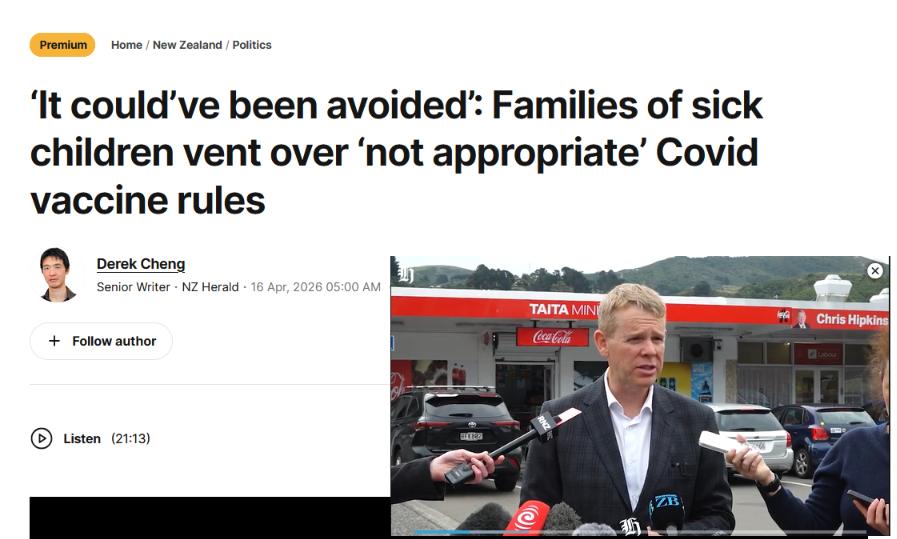
Labour leader Chris Hipkins said he doesn't know what he would have done if the expert CV Tag advice had been delivered to him in December 2021 – but he almost certainly would have asked more questions.
‘Shortfalls In Clarity’ – Royal Commission
Hipkins has told the Herald he doesn’t know what he would’ve done if the CV Tag advice in December 2021 had been delivered to him in a timely way. At the time, an estimated 91,000 people aged 12-17 were still yet to have a second dose.
“It almost certainly would have resulted in more questions being asked.”
He defended not publicly announcing the advice in March 2022, when it was included in his Cabinet paper, saying it was information best shared by health officials or vaccinators on the front lines.
But local health providers didn’t always communicate the risks to people getting vaccinated, the Phase Two report said, nor were they always required to do so.
“Communications around risks from Covid-19 vaccines were extensive and followed established procedures. Even so, shortfalls in clarity and effectiveness existed in terms of what providers heard about risks and, in turn, communicated to consumers.”
The shortfalls are a reference to a request from the Ministry of Health to the heads of district health boards (DHBs) to send a letter to local providers.
The request was made on December 15, 2021, six days after Bloomfield had received the CV Tag concerns about the possibility of unnecessary risk for under-18s following a mandatory second dose.
The Royal Commission Phase Two report said vaccinators didn't always tell clients about the risks of getting vaccinated, nor did their guidelines always require them to. Photo / 123rf
The letter from DHB heads asked local providers to make those getting the vaccine aware of the possible symptoms of myocarditis or pericarditis.
“Despite these communications, guidance was not always explicit about the need to discuss the risk of myocarditis and pericarditis, including before vaccinating as part of the informed consent process,” the commission’s report said.
Nor was a pre-vaccination discussion about myocarditis risk recommended in the ministry’s earlier guidance, in September 2021, for DHBs and providers.
The commission noted the September guidance mentioned inflammation of the heart as a rare side effect, “but did not recommend it be discussed with patients before administering the vaccine”.
“We saw evidence that vaccinators sometimes did not give information on myocarditis and pericarditis because they did not want to worry people or felt pressured with time, and that brochures on myocarditis and pericarditis were not always passed on to consumers."
The importance of this was underlined in a 2024 report from the Health and Disability Commissioner about a man in his 20s who died in 2021 from myocarditis caused by the vaccine he’d received at a pharmacy 12 days earlier.
“The consumer was not informed about the risk of myocarditis either prior to receiving the vaccine (as part of the informed consent process) or after (as part of safety-netting advice),” the report said.
“Notwithstanding the low probability of occurrence, the risk of myocarditis was something that a reasonable consumer at the time would have expected to be informed about.
“Official information sources did not make it adequately clear to vaccinators that consumers needed to be told about myocarditis prior to receiving the vaccination.”
Derek Cheng is a senior journalist who started at the Herald in 2004. He has worked several stints in the press gallery team and is a former deputy political editor.
Expert advice in late 2021 would have justified the Government loosening vaccine requirements for those aged 12-17, allowing some young people to avoid social or educational exclusion, or even getting sick. A member of the expert group has labelled those requirements a ‘100% gold plated BAD IDEA.’
‘Ostracised, angry and heart-inflamed: Families vent over Covid vaccine rules.’
Ashley had been unable to partake in her usual sporting and social activities: playing tennis at an indoor venue, or joining friends at the Dunedin cinema, swimming pool or ice-skating rink.
Ashley’s mother, Paula Beulink, had done her own research and didn’t want Ashley to get the jab because of the risk of heart inflammation. But she respected Ashley’s decision when her daughter decided the social and sporting costs were too great.
“The next morning [after dose two], she woke up complaining that her chest was really sore, like the stitch when she breathed in,” Beulink told the Herald. “It was radiating up into her neck and her jaw.”
Ashley was eventually diagnosed with vaccine-induced pericarditis, missing school for most of the first term in 2022, heading to the ED when the pain heightened, and becoming one of the 1740 successful ACC claims for vaccine-related injuries.
The incentive – or coercion, as some described it – was similar for the teenage sons of Wellington-based teacher Marie Butel.
“My preference was for the boys to have one vaccination, not two, which I felt was the best for protecting them from infection without exposing them to extra risk,” Butel told the Herald.
“But for my two older sons [ages 15 and 17 at the time] at high school who were very involved with rowing – 20 to 30 hours a week – they had to be double-vaccinated to continue. They needed it to continue to do what they love to do.”
After his second dose, her 15-year-old son, whom she preferred not to name, developed pericarditis.
“It’s not okay to put young men at risk because you want everybody to get two doses,” Butel said.
This type of impact led to the Government dropping vaccine passes for school-organised gatherings, but not until mid-March.
By then, tens of thousands of young people in the 12 to 17 age group had had a second dose since December 2021, when expert advice had landed on the desk of Sir Ashley Bloomfield who was head of the response then.
It had come from the Ministry of Health’s Covid-19 Vaccine Technical Advisory Group (CV Tag), which warned that a second dose may add “unnecessary risk” of myocarditis (heart inflammation) or pericarditis (inflammation of the sac around the heart) for under-18s.
The CV Tag recommended considering changing vaccine mandate requirements for the 12-17 age group (under-12s couldn’t get vaccinated at that point) from two doses to one.
Ashley Beulink was in the Dunedin Hospital ED in February 2022 after having chest pains following her second dose of the Pfizer vaccine. She was later diagnosed with vaccine-induced pericarditis.
But the advice was never delivered to ministers or made public in a timely manner, which the Ministry of Health conceded was a ‘significant failing’.
“It does make me angry,” Beulink told the Herald. “It took a real toll, on Ashley’s health and my mental health as a parent, and it could’ve been avoided.”
She acknowledged it was hard for decision-makers in a fast-changing environment with high uncertainty.
“But I personally don’t think they were justified in including that 12 to 17 age group in the vaccine passes. The Government wasn’t transparent with that information. I believe they were just more concerned about getting their vaccination rates up.”
New Zealand had been free of the virus for several months in August 2021, when the CV Tag told Bloomfield it supported including everyone 12 and older in the vaccine rollout.
This was a change to its advice just a week and a half earlier, which had said the 12-15s should not be routinely vaccinated at this time (16s and older were already included in the rollout by then).
Professor Peter McIntyre of the CV Tag said the change was a signal to parents, if they wanted their children to be vaccinated, that it was a safe and effective vaccine for this age group.
It was also a response to the higher severity and contagiousness of the Delta variant, which was ravaging communities overseas, and arrived in New Zealand only days later.
The context was very different in December 2021, when the updated CV Tag advice about the risk of vaccine mandates for under-18s was sent to Bloomfield.
Delta had been circulating in Auckland which, with the rest of the country, had moved to the vaccine pass system after more than three months in a form of lockdown.
“So all of this took on a totally different flavour,” McIntyre, who is head of Otago University’s department of paediatrics and child health, told the Herald.
“It wasn’t just 12- to 17-year-olds who might have been in some kind of paid employment [and affected by workforce mandates]. We were hearing reports of children being denied participation in sport – that kind of thing.
“In that environment, my memory of the views on the CV Tag is: ‘Although the vaccine is safe and effective, a mandatory two dose-approach is not appropriate for 12- to 17-year-olds, because if otherwise healthy they are at low risk of severe illness from Covid, and there is some suggestive evidence that the low risk of myocarditis and pericarditis may be higher in younger age groups, especially boys, and following the second dose’.”
At the time, the vaccination rate for the eligible population was nearing 90%, and the Government had started rolling out booster shots for the most vulnerable.
“I personally think it’s unequivocal that the vaccine requirements were a bad idea. And it’s absolutely 100% gold-plated that they were a bad idea for 12- to 17-year-olds,” McIntyre said.
“To justify that, you need really good evidence. Was that evidence there? That it was going to increase coverage to the level that was going to provide significant additional community protection? No.
“The predictable harm to social interaction and educational opportunity from exclusion of this age group far outweighed any uncertain benefits to individuals in this age group or the community.
“That is different to the benefits of the vaccine itself – my youngest son was in this age group at the time and he received two doses."
But the CV Tag did not recommend changing vaccine requirements for 12-17s from two doses to one. It only recommended considering this.
Contrast this with CV Tag advice for the 5-11 age group a week later, which said they “must not” be subjected to any mandatory vaccine doses. They were not eligible for the vaccine at that point.
McIntyre said the more diplomatic wording for the 12-17s was because they were already captured by some of the vaccine requirements.
“It was also trying to accommodate parents who were anxious about the disease and wished to obtain protection,” he said.
The Royal Commission of Inquiry into Covid-19 Lessons Phase One report said the vaccine mandates and vaccine passes in late 2021 were “reasonable”, based on information available at the time. By early 2022, the public health case for them “was weak” as immunity waned, and while vaccination was beneficial for individual protection, it was less effective at preventing the spread of Omicron.
“Some workplace, occupational and other vaccine requirements were applied too broadly and remained in place for too long, which caused harm to individuals and families and contributed to loss of social capital,” the report said.
Shops around Newmarket in Auckland get ready for vaccine pass and traffic light Covid-19 restrictions in November 2021. Photo / Alex Robertson
“The Government might have considered removing vaccine passes and mandate requirements in January and February 2022. However, like most decisions made in a pandemic, this move would not have been risk-free.
“Even if vaccines were not as good at stopping the transmission of Omicron as other variants, it is likely they would have helped to flatten the first wave to some degree. Vaccine requirements would also have helped dampen down any outbreaks of the Delta variant, which it was feared could return.”
This uncertainty was reflected in other advice to the Government in March 2022.
“The Ministry of Health notes that data about onward transmission is scarce and only available for ‘all vaccines’ and not Pfizer alone,” a Cabinet paper in March 2022 said. “Non-peer-reviewed data from a small study suggest that vaccinated people infect fewer people in their household.”
A public health group led by epidemiologist Sir David Skegg also told ministers, in March 2022, that the case for vaccine mandates had become ‘finely balanced’.
When Cabinet met shortly afterwards, it agreed to end vaccine passes and begin ending the occupational mandates.
‘I cannot tell you why’ – Dame Jacinda Ardern
The recent report from the Royal Commission of Inquiry into Covid-19 Lessons Phase Two said there was insufficient monitoring of the effects of vaccine requirements.
It’s unknown how many lost their jobs because of the vaccine rules, or were excluded from social or school activities, or felt coerced into getting vaccinated, or were ostracised as conspiracy theorists or anti-vax for not wanting the jab due to known – but rare – health risks.
While the education workforce mandate covered a very small subset of all 12- to 17-year-olds, the vaccine passes had a much longer reach, especially for the active or social.
At the end of 2021, nearly 76% of the total age group had had two doses. By the time vaccine passes were dumped altogether at the start of April 2022, the rate was more than 92%. This means about 60,000 more young people had a second dose after Bloomfield received the CV Tag advice, and while the vaccine passes were in place.
The number of 12- to 17-year-olds who suffered from heart inflammation because of a second or third dose is also unknown. A Herald analysis of the Medsafe data suggests there were dozens of cases in 2022, though whether they were caused by the vaccine is unclear; a Covid infection is generally considered more likely to cause heart inflammation than the vaccine.
One 13-year-old died of myocarditis in a case where the coroner could not rule out the vaccine as the cause.
It’s also unknowable how many young people might have avoided such inflammation if they’d had no doses, or only one. This hasn’t stopped some parents from believing their heart-inflamed children would never have got sick if they’d avoided a second dose.
The side-effects of the vaccine were known and well-publicised, but the commission’s report said this shouldn’t diminish how vaccine requirements reflected outdated advice, “when advice informed by additional evidence was available”.
Interview transcripts reveal that the Commission asked Dame Jacinda Ardern about the CV Tag advice from December 2021 and why the education mandate requirements for 12-17s weren’t changed from two doses to one.
“I cannot tell you why, but I wonder if it’s because essentially no one under the age of 17 essentially ended up being covered,” the former Prime Minister replied during her hearing in October 2025.
She wondered if the age specifications in the mandate (12 and older) had simply followed the age range of who was eligible for the vaccine at the time (also 12 and older).
“But the intention of Cabinet has been that it’s obviously adults that it’s covering, and CV Tag have made a recommendation based, I imagine, on technically what’s before them on paper.”
She would have been “perturbed” if anyone that young had been covered by the mandate, she added.
Former Covid Response Minister Chris Hipkins has told the Herald the education mandate was applicable to a small number of 12-17s such as in home-based early childhood learning.
Ardern was not specifically asked about why the vaccine-pass requirements for 12-17s weren’t changed to reflect the CV Tag advice (which was provided in the context of workforce mandates).
A spokesman for Ardern said she had nothing further to add to her previous comment about accepting the findings and recommendations of both the Phase One and Phase Two reports.
Hipkins: Ask Sir Ashley
The Royal Commission also asked Hipkins why vaccine requirements in the education mandate for 12-17s weren’t changed from two doses to one, based on the CV Tag advice.
“I certainly don’t recall that having ever made its way up to ministerial level,” Hipkins said during his September 2025 hearing.
“So it’s probably a better question for Ashley or whoever the recipient of that was.”
Bloomfield had appeared before the commission four days before Hipkins, but was not asked about that specific CV Tag advice. He has declined all interview requests on the commission’s report.
As the Herald has revealed, the advice was summarised in a cabinet paper in Hipkins name in March 2022. This was part of a bundle of papers that preceded Cabinet ending the vaccine passes and the education mandate.
Similar but less firm CV Tag advice – from November 2021 - was referenced in a briefing from Bloomfield to Hipkins at the end of 2021, and was considered by Labour’s Ayesha Verrall in January 2022, when Hipkins was on leave.
The Herald can also reveal that both Hipkins and Bloomfield were presented with proposals to change vaccine requirements for 12-17s in February 2022.
This was when the Department of Prime Minister and Cabinet (DPMC) presented a paper to Hipkins about the exclusion of some 12-17s from extracurricular school activities. It made two recommendations:
• drop vaccine passes for 12-17s altogether;
• drop them for any school-run extracurricular activity
Hipkins opted for the latter which was implemented in March 2022. The DPMC paper did not include any advice from the CV Tag.
An application was also made to drop the education mandate earlier, in February 2022, according to an affidavit from Bloofield that was quoted to him during his Royal Commission hearing in September 2025.
Bloomfield opposed this, citing several reasons including the risk of Omicron spread, especially in classrooms where only 46% of 5-11s were vaccinated (they had become eligible in mid-January 2022).
He also cited the need for “clear, consistent messaging”.
“For Government to remove this mandate at this particular point risks undermining the message about the importance of as many people as possible being vaccinated as we address the Omicron outbreak,” his February 2022 affidavit said, as read to him during the hearing.
He was asked how much the mandates were justified on public health grounds and how much was based on the need for consistent messaging. He didn’t recall those details, he replied, adding that the affidavit would have been based on public health advice at the time.
“At any point of time, there’s a matter of judgement about whether or not the benefits outweigh the disbenefits,” Bloomfield told the commission.
“The advice I was receiving and therefore conclusions I put forward, the balance was still in favour of maintaining the mandates.”
Labour leader Chris Hipkins said he doesn't know what he would have done if the expert CV Tag advice had been delivered to him in December 2021 – but he almost certainly would have asked more questions.
‘Shortfalls In Clarity’ – Royal Commission
Hipkins has told the Herald he doesn’t know what he would’ve done if the CV Tag advice in December 2021 had been delivered to him in a timely way. At the time, an estimated 91,000 people aged 12-17 were still yet to have a second dose.
“It almost certainly would have resulted in more questions being asked.”
He defended not publicly announcing the advice in March 2022, when it was included in his Cabinet paper, saying it was information best shared by health officials or vaccinators on the front lines.
But local health providers didn’t always communicate the risks to people getting vaccinated, the Phase Two report said, nor were they always required to do so.
“Communications around risks from Covid-19 vaccines were extensive and followed established procedures. Even so, shortfalls in clarity and effectiveness existed in terms of what providers heard about risks and, in turn, communicated to consumers.”
The shortfalls are a reference to a request from the Ministry of Health to the heads of district health boards (DHBs) to send a letter to local providers.
The request was made on December 15, 2021, six days after Bloomfield had received the CV Tag concerns about the possibility of unnecessary risk for under-18s following a mandatory second dose.
The Royal Commission Phase Two report said vaccinators didn't always tell clients about the risks of getting vaccinated, nor did their guidelines always require them to. Photo / 123rf
The letter from DHB heads asked local providers to make those getting the vaccine aware of the possible symptoms of myocarditis or pericarditis.
“Despite these communications, guidance was not always explicit about the need to discuss the risk of myocarditis and pericarditis, including before vaccinating as part of the informed consent process,” the commission’s report said.
Nor was a pre-vaccination discussion about myocarditis risk recommended in the ministry’s earlier guidance, in September 2021, for DHBs and providers.
The commission noted the September guidance mentioned inflammation of the heart as a rare side effect, “but did not recommend it be discussed with patients before administering the vaccine”.
“We saw evidence that vaccinators sometimes did not give information on myocarditis and pericarditis because they did not want to worry people or felt pressured with time, and that brochures on myocarditis and pericarditis were not always passed on to consumers."
The importance of this was underlined in a 2024 report from the Health and Disability Commissioner about a man in his 20s who died in 2021 from myocarditis caused by the vaccine he’d received at a pharmacy 12 days earlier.
“The consumer was not informed about the risk of myocarditis either prior to receiving the vaccine (as part of the informed consent process) or after (as part of safety-netting advice),” the report said.
“Notwithstanding the low probability of occurrence, the risk of myocarditis was something that a reasonable consumer at the time would have expected to be informed about.
“Official information sources did not make it adequately clear to vaccinators that consumers needed to be told about myocarditis prior to receiving the vaccination.”
Derek Cheng is a senior journalist who started at the Herald in 2004. He has worked several stints in the press gallery team and is a former deputy political editor.


