Iran talk cock only. They know they are already losing this battle and their missile stocks are depleting fast day-by-day, but still want to create fear. WTF?View attachment 237566
IRGC announces 'blinding' US, Israel's eye in region; vows harsher retaliation coming
The Islamic Revolution Guards Corps (IRGC) has announced staging the 17th stage of its ongoing Operation True Promise 4 against Israeli and American targets throughout the region.
They have already challenged US to come to the ground.Iran talk cock only. They know they are already losing this battle and their missile stocks are depleting fast day-by-day, but still want to create fear. WTF?
They have already started to arm the Kurds for ground troops attack. Bloody US is just applying the 借刀杀人 tactic. Unfortunately, I think the Kurds may eventually be betrayed by the US.They have already challenged US to come to the ground.
Think you have comprehension issue. Did you even pass high school? Keep on evading to other issues. Those are for another day.Are you a retarded? It seems so. Who started the war? Who gives you covid vaccine?
How many living things have you killed in your entire life?
Hatred? I thought you have blind hatred for the Japanese who didn’t commit atrocities lol
I did told you they didn’t
But you believe in hearsay and mainstream propaganda lol
Please continue your Jewish vaccine when the next scamdemic comes lol
Don't be such a nuisance. Even if they to die, it for a good cause. Take over the country.They have already started to arm the Kurds for ground troops attack. Bloody US is just applying the 借刀杀人 tactic. Unfortunately, I think the Kurds may eventually be betrayed by the US.
Don't be naive lah. Changing a regime is never possible without having ground troops intervention. Just from air-fire power alone cannot effect a regime change. Tell me which country has been successful in this? I doubt you can.Don't be such a nuisance. Even if they to die, it for a good cause. Take over the country.
Now with air superior, American call in Apache ,call in their A-10. They have reaper drones hovering all over the air space. They can command the closes sub drones to conduct attack to the target with their AI.
So tell me... How is the Iranian going to stop these?
The American copied the Iranian drones and call it LUCAS.The Ayatollahs must be eliminated from this world. If not for their continuous Shahed drones supply to Russia, Ukraine would not have to suffer so much today and probably Bloodymir Putin would have not much choice but to come to a compromise to end the war in Ukraine.
But there was an important truth amid Augustine’s humour. These highly advanced war machines are formidable – but they are also scarce, slow to replace, and politically too sensitive to lose.In the year 2054, the entire defense budget will purchase just one tactical aircraft. This aircraft will have to be shared by the Air Force and Navy 3½ days each per week except for leap years, when it will be made available to the Marines for the extra day.
Ha ha, are these also using the YAMAHA 2-stroke engines?The American copied the Iranian drones and call it LUCAS.
![]()
Iranian Shahed-136 drone technology was adapted by the US military, then used against Iran. Pictorial Press/Alamy
The US is using repurposed Iranian drone technology to attack Iran – a military expert explains why
Published: March 4, 2026 4.54pm GMT
Arun Dawson, King's College London
theconversation.com
Amid the biggest concentration of American military power in the Middle East in decades, the significance – and irony – of one aspect of the US war on Iran has gone largely unnoticed.
In the opening salvoes of the attack, the US quietly introduced its Low-Cost Uncrewed Combat Attack System (Lucas), a one-way attack drone modelled on the cheap technology that Iran itself has been developing since the 1980s. Those Shahed drones were said to have been inspired by technology developed by Israel, which has co-led the assault with the US.
Necessitated by sanctions, Shahed drones have become (along with ballistic missiles) Iran’s primary domestically produced air weapon – a relatively cheap system designed not so much as to outmatch western defences as exhaust them. The original model (Shahed-131) made its operational debut in September 2019, during an attack on a Saudi oil refinery.
But what began as a military workaround has become a global weapon – used first by Iran’s regional proxies such as the Houthis in Yemen, then by Russia in its war on Ukraine. This led Ukrainian president Volodymyr Zelensky to call Iran “Putin’s accomplice” for not only supplying Russia with Shahed drones but also the technology to build its own.
Struck by the battlefield success of large-scale, low-cost drone attacks, the US made covert efforts to capture Shahed-136s for technical analysis. It reverse-engineered these specimens to create replicas for counter-drone training, which in turn were adapted into the current Lucas drone fleet.
The rollout has been swift. Within five months of the programme’s launch, the Pentagon had equipped US forces in the Middle East with Lucas drones. Their ability to be sea-launched was tested using a warship in the Arabian Gulf.
Then on February 28, US Central Command confirmed that Lucas drones had been used in combat for the first time. They were launched from ground positions by Scorpion Strike, a US task force established in December 2025 to “flip the script on Iran” with drone technology, according to one US official.
Lucas drones are also believed to have been used in Venezuela’s capital Caracas on January 3 2026, as part of the US mission to capture the country’s president, Nicolás Maduro. But their official operational debut in Iran signals a shift in the economics, and perhaps even the philosophy, of American air power.
On hearing of the Lucas system in December 2025, a senior Iranian official is reported to have gloated: “There is no greater honour than seeing self-proclaimed superpowers kneel before an Iranian drone and copy it.”
The arithmetic of modern warfare
For decades, western airpower has strived to build machines that go faster, higher and further. But as far back as 1979, Pentagon official Norm Augustine conducted a study of the spiralling costs of US fighter aircraft. This led him to conclude, with tongue firmly in cheek:
But there was an important truth amid Augustine’s humour. These highly advanced war machines are formidable – but they are also scarce, slow to replace, and politically too sensitive to lose.
The answer to this conundrum is “affordable mass”. Military experience in Israel and in Ukraine – where around 75% of battlefield casualties have been attributed to small drones – points to the benefit of having cheap, expendable systems that are complementary to the US’s most advanced aircraft.
At a cost of roughly US$35,000 (£26,000) each, Lucas embodies this logic – and the Trump administration’s “drone dominance” programme aims to have a stock of 340,000 comparable drones by early 2028. This builds on the earlier Replicator Initiative which started under Trump’s predecessor, Joe Biden.
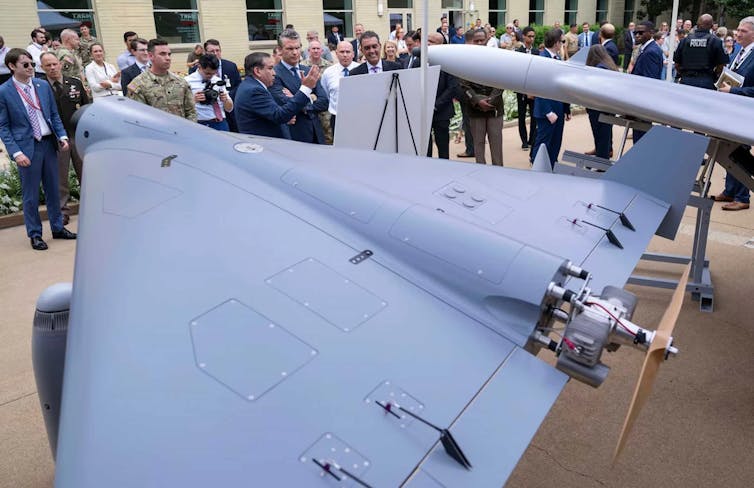
US Department of Defense![]()
How Iranian and US drones compare
Iran’s Shahed family of drones are built for long-range, one-way attack. The most widely used and effective variant, the Shahed-136, is a 3.5-metre drone made of foam and plywood which carries a 40-50kg explosive warhead.
These “loitering munitions” can fly to a target area more than a thousand miles away at around 115mph, then circle for up to six hours before diving at their target. Propelled by a 50-horsepower piston engine with a distinctive moped-like buzz, these drones use satellite navigation and a pre-programmed route with high accuracy, assuming they can overcome attempts by the enemy to jam their guidance system.
At a cost of upwards of US$20,000 each, they occupy the warfare space between manually piloted quadcopter drones, which are cheaper but cannot carry a large warhead, and costly cruise missiles. The Russian-assembled version known as Geran-2 has extended the drone menace to key national infrastructure, cities and military assets throughout Ukraine.
Read more: A visual guide to 14 of the drones wreaking havoc in Ukraine, Russia and beyond
Unlike Shahed-136s, the imitation model first used by the US military for counter-drone training codenamed FLM-136 – was lighter. This reduced its range to 400 miles as it could not carry as much fuel, and halved its weapon payload (though at 18kg, it’s still double that of a Hellfire, the US’s primary air-to-ground missile).
The Lucas drones have been observed to possess a nose-mounted gimballed camera system, and modules for satellite connectivity.
Compared with most pre-programmed Shahed systems, even intermittent connectivity would allow Lucas operators to re-task drones in flight, update target data or coordinate salvos more dynamically than earlier generations of one-way attack systems. Satellite links could also support AI-powered “swarm” tactics, when drones act as a coordinated attack team.
If used in numbers, Lucas drones could saturate Iran’s radar systems by presenting more objects than its operators can comfortably track. In doing so, they could create corridors through which more capable (but expensive) US and Israeli weapon systems can pass unharmed. These are needed to order to attack heavily protected targets such as strategic bunkers and nuclear facilities.
Low-cost, expendable drones work best in compact theatres such as the Middle East, where distances and logistics are manageable. But Lucas’s full potential in contested, jammed environments will depend on its ability to use AI-driven swarming techniques.
As yet, the US lacks the technology, public appetite and legal framework to introduce a true AI-powered air force. But it may be here before long.

You every day kill animals for your meal. Is it evil to you? Don’t evade my questionThink you have comprehension issue. Did you even pass high school? Keep on evading to other issues. Those are for another day.
Now is it evil for human to kill? Answer it.
The American copied the Iranian drones and call it LUCAS.
![]()
Iranian Shahed-136 drone technology was adapted by the US military, then used against Iran. Pictorial Press/Alamy
The US is using repurposed Iranian drone technology to attack Iran – a military expert explains why
Published: March 4, 2026 4.54pm GMT
Arun Dawson, King's College London
theconversation.com
Amid the biggest concentration of American military power in the Middle East in decades, the significance – and irony – of one aspect of the US war on Iran has gone largely unnoticed.
In the opening salvoes of the attack, the US quietly introduced its Low-Cost Uncrewed Combat Attack System (Lucas), a one-way attack drone modelled on the cheap technology that Iran itself has been developing since the 1980s. Those Shahed drones were said to have been inspired by technology developed by Israel, which has co-led the assault with the US.
Necessitated by sanctions, Shahed drones have become (along with ballistic missiles) Iran’s primary domestically produced air weapon – a relatively cheap system designed not so much as to outmatch western defences as exhaust them. The original model (Shahed-131) made its operational debut in September 2019, during an attack on a Saudi oil refinery.
But what began as a military workaround has become a global weapon – used first by Iran’s regional proxies such as the Houthis in Yemen, then by Russia in its war on Ukraine. This led Ukrainian president Volodymyr Zelensky to call Iran “Putin’s accomplice” for not only supplying Russia with Shahed drones but also the technology to build its own.
Struck by the battlefield success of large-scale, low-cost drone attacks, the US made covert efforts to capture Shahed-136s for technical analysis. It reverse-engineered these specimens to create replicas for counter-drone training, which in turn were adapted into the current Lucas drone fleet.
The rollout has been swift. Within five months of the programme’s launch, the Pentagon had equipped US forces in the Middle East with Lucas drones. Their ability to be sea-launched was tested using a warship in the Arabian Gulf.
Then on February 28, US Central Command confirmed that Lucas drones had been used in combat for the first time. They were launched from ground positions by Scorpion Strike, a US task force established in December 2025 to “flip the script on Iran” with drone technology, according to one US official.
Lucas drones are also believed to have been used in Venezuela’s capital Caracas on January 3 2026, as part of the US mission to capture the country’s president, Nicolás Maduro. But their official operational debut in Iran signals a shift in the economics, and perhaps even the philosophy, of American air power.
On hearing of the Lucas system in December 2025, a senior Iranian official is reported to have gloated: “There is no greater honour than seeing self-proclaimed superpowers kneel before an Iranian drone and copy it.”
The arithmetic of modern warfare
For decades, western airpower has strived to build machines that go faster, higher and further. But as far back as 1979, Pentagon official Norm Augustine conducted a study of the spiralling costs of US fighter aircraft. This led him to conclude, with tongue firmly in cheek:
But there was an important truth amid Augustine’s humour. These highly advanced war machines are formidable – but they are also scarce, slow to replace, and politically too sensitive to lose.
The answer to this conundrum is “affordable mass”. Military experience in Israel and in Ukraine – where around 75% of battlefield casualties have been attributed to small drones – points to the benefit of having cheap, expendable systems that are complementary to the US’s most advanced aircraft.
At a cost of roughly US$35,000 (£26,000) each, Lucas embodies this logic – and the Trump administration’s “drone dominance” programme aims to have a stock of 340,000 comparable drones by early 2028. This builds on the earlier Replicator Initiative which started under Trump’s predecessor, Joe Biden.
US Department of Defense![]()
How Iranian and US drones compare
Iran’s Shahed family of drones are built for long-range, one-way attack. The most widely used and effective variant, the Shahed-136, is a 3.5-metre drone made of foam and plywood which carries a 40-50kg explosive warhead.
These “loitering munitions” can fly to a target area more than a thousand miles away at around 115mph, then circle for up to six hours before diving at their target. Propelled by a 50-horsepower piston engine with a distinctive moped-like buzz, these drones use satellite navigation and a pre-programmed route with high accuracy, assuming they can overcome attempts by the enemy to jam their guidance system.
At a cost of upwards of US$20,000 each, they occupy the warfare space between manually piloted quadcopter drones, which are cheaper but cannot carry a large warhead, and costly cruise missiles. The Russian-assembled version known as Geran-2 has extended the drone menace to key national infrastructure, cities and military assets throughout Ukraine.
Read more: A visual guide to 14 of the drones wreaking havoc in Ukraine, Russia and beyond
Unlike Shahed-136s, the imitation model first used by the US military for counter-drone training codenamed FLM-136 – was lighter. This reduced its range to 400 miles as it could not carry as much fuel, and halved its weapon payload (though at 18kg, it’s still double that of a Hellfire, the US’s primary air-to-ground missile).
The Lucas drones have been observed to possess a nose-mounted gimballed camera system, and modules for satellite connectivity.
Compared with most pre-programmed Shahed systems, even intermittent connectivity would allow Lucas operators to re-task drones in flight, update target data or coordinate salvos more dynamically than earlier generations of one-way attack systems. Satellite links could also support AI-powered “swarm” tactics, when drones act as a coordinated attack team.
If used in numbers, Lucas drones could saturate Iran’s radar systems by presenting more objects than its operators can comfortably track. In doing so, they could create corridors through which more capable (but expensive) US and Israeli weapon systems can pass unharmed. These are needed to order to attack heavily protected targets such as strategic bunkers and nuclear facilities.
Low-cost, expendable drones work best in compact theatres such as the Middle East, where distances and logistics are manageable. But Lucas’s full potential in contested, jammed environments will depend on its ability to use AI-driven swarming techniques.
As yet, the US lacks the technology, public appetite and legal framework to introduce a true AI-powered air force. But it may be here before long.
US and Israel should have hoot the funeral also. That would be icing on the cake.Funeral ceremony was held in Karaj for two martyrs who were killed in US-Israeli strikes.
View attachment 237475
View attachment 237478
View attachment 237479
View attachment 237480
View attachment 237481
View attachment 237482
View attachment 237483
View attachment 237484
View attachment 237486