- Joined
- Oct 23, 2013
- Messages
- 26,183
- Points
- 113
Japan gov't says safe to release contaminated Fukushima water into ocean
mainichi.jp
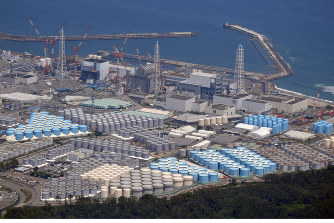
In this Aug. 1, 2019 photo taken from a Mainichi helicopter, storage tanks for radioactively contaminated water are seen on the grounds of the Fukushima Daiichi Nuclear Power Station in Okuma, Fukushima Prefecture. (Mainichi/Kaho Kitayama)
TOKYO (Kyodo) -- Japan's industry ministry said Monday it would be safe to release water contaminated by the Fukushima nuclear disaster into the ocean, stressing that the health risk to humans would be "significantly small."
Discharging the water into the Pacific Ocean over the course of a year would lead to between just one-1,600th and one-40,000th of the radiation that humans are naturally exposed to, the Ministry of Economy, Trade and Industry told a government subcommittee on the issue.
Water used to cool the melted-down cores and groundwater near the crippled plant contains some radioactive materials, and is currently being collected and stored in tanks on the plant grounds.
But space is fast running out, and the government is exploring ways to deal with the water -- already amounting to more than 1 million tons and increasing every day.
According to the ministry, annual radiation levels near the release point is estimated at between 0.052 and 0.62 microsievert at sea and 1.3 microsieverts in the atmosphere, compared with the 2,100 microsieverts that humans come into contact with in daily life.
One member of the subcommittee called on the ministry to provide detailed data showing the impact of different conditions such as ocean currents and weather.
Another member requested more information on the amount of radiation that people would be internally exposed to depending on how much fish and seaweed they consume.
The water is being treated using an advanced liquid processing system, or ALPS, though the system does not remove the relatively non-toxic tritium and has been found to leave small amounts of other radioactive materials.
The tanks storing the water are expected to become full by the summer of 2022, according to Tokyo Electric Power Company Holdings Inc., the operator of the Fukushima Daiichi nuclear power plant disabled by a magnitude-9.0 earthquake and ensuing tsunami on March 11, 2011.
While government officials say that no decision has been made on what to do with the water, local fishermen are opposed to discharging it into the ocean due to worries that it would cause reputational damage and hurt their livelihood.
South Korea has also expressed concern over the environmental impact. In September, Japanese and South Korean officials traded barbs over the issue at a meeting of the International Atomic Energy Agency in Vienna.
The same month, then-Environment Minister Yoshiaki Harada aroused controversy by saying there was "no other choice" but to release the water into the ocean.
mainichi.jp
In this Aug. 1, 2019 photo taken from a Mainichi helicopter, storage tanks for radioactively contaminated water are seen on the grounds of the Fukushima Daiichi Nuclear Power Station in Okuma, Fukushima Prefecture. (Mainichi/Kaho Kitayama)
TOKYO (Kyodo) -- Japan's industry ministry said Monday it would be safe to release water contaminated by the Fukushima nuclear disaster into the ocean, stressing that the health risk to humans would be "significantly small."
Discharging the water into the Pacific Ocean over the course of a year would lead to between just one-1,600th and one-40,000th of the radiation that humans are naturally exposed to, the Ministry of Economy, Trade and Industry told a government subcommittee on the issue.
Water used to cool the melted-down cores and groundwater near the crippled plant contains some radioactive materials, and is currently being collected and stored in tanks on the plant grounds.
But space is fast running out, and the government is exploring ways to deal with the water -- already amounting to more than 1 million tons and increasing every day.
According to the ministry, annual radiation levels near the release point is estimated at between 0.052 and 0.62 microsievert at sea and 1.3 microsieverts in the atmosphere, compared with the 2,100 microsieverts that humans come into contact with in daily life.
One member of the subcommittee called on the ministry to provide detailed data showing the impact of different conditions such as ocean currents and weather.
Another member requested more information on the amount of radiation that people would be internally exposed to depending on how much fish and seaweed they consume.
The water is being treated using an advanced liquid processing system, or ALPS, though the system does not remove the relatively non-toxic tritium and has been found to leave small amounts of other radioactive materials.
The tanks storing the water are expected to become full by the summer of 2022, according to Tokyo Electric Power Company Holdings Inc., the operator of the Fukushima Daiichi nuclear power plant disabled by a magnitude-9.0 earthquake and ensuing tsunami on March 11, 2011.
While government officials say that no decision has been made on what to do with the water, local fishermen are opposed to discharging it into the ocean due to worries that it would cause reputational damage and hurt their livelihood.
South Korea has also expressed concern over the environmental impact. In September, Japanese and South Korean officials traded barbs over the issue at a meeting of the International Atomic Energy Agency in Vienna.
The same month, then-Environment Minister Yoshiaki Harada aroused controversy by saying there was "no other choice" but to release the water into the ocean.