
• IP addresses are NOT logged in this forum so there's no point asking. Please note that this forum is full of homophobes, racists, lunatics, schizophrenics & absolute nut jobs with a smattering of geniuses, Chinese chauvinists, Moderate Muslims and last but not least a couple of "know-it-alls" constantly sprouting their dubious wisdom. If you believe that content generated by unsavory characters might cause you offense PLEASE LEAVE NOW! Sammyboy Admin and Staff are not responsible for your hurt feelings should you choose to read any of the content here.

    The OTHER forum is HERE so please stop asking.

Why the midlife crisis for millennials looks different in Singapore

Tragedeigh

Stupidman
Loyal
Joined
Aug 20, 2022
Messages
26,689
Points
113

Why the midlife crisis for millennials looks different in Singapore​

Every generation has its own version of the midlife crisis, but millennials and experts tell CNA TODAY that the scale and complexity of the angst that adults now in their 30s and early 40s are experiencing sets them apart from their predecessors.
Why the midlife crisis for millennials looks different in Singapore

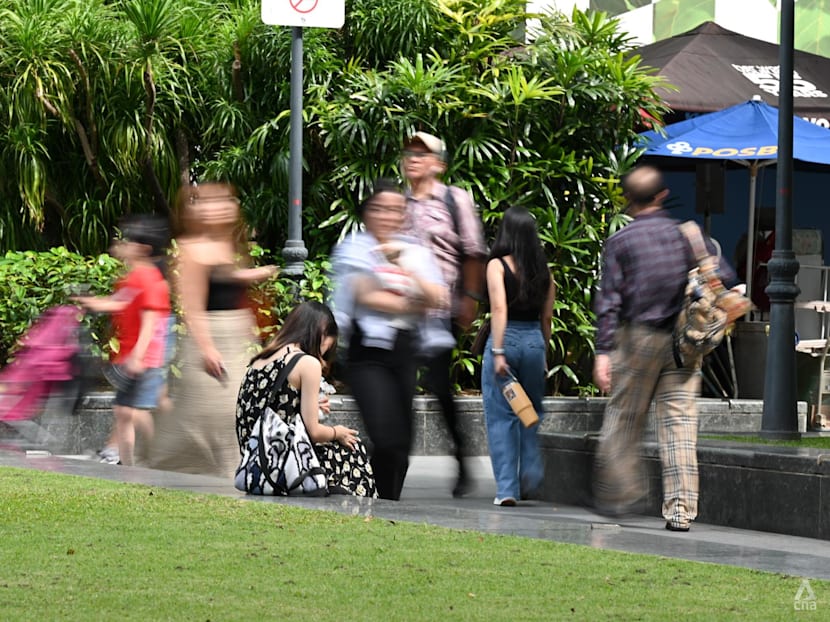
A woman sitting at an open space in Raffles Place as people walk by on Feb 11, 2026. (Photo: CNA/Justin Tan)

Nicole Lam
13 Feb 2026 09:30PM (Updated: 14 Feb 2026 07:42AM)

All his life, Mr Christopher Boey has followed the prescribed Singaporean script for a "good" life to the letter: good grades, a scholarship for his engineering degree, a steady climb up the corporate ladder into middle management, a master's degree, marriage and, mere weeks ago, the arrival of his first child.

Despite these sure proofs of success, of late, the 36-year-old finds himself increasingly gripped by a quiet, chronic restlessness.

"I have a roof over my head and I'm not jobless. I've got food on the table. (But I still think) to myself: Do I want to aspire for more?" Mr Boey said.

He described feeling "stuck" every day – torn between climbing the corporate ladder and maintaining the status quo, or finally veering completely off the beaten path that he has trodden for decades.

He told CNA TODAY that his current state of perpetual frustration and anxiety largely stems from a growing yearning to do something more meaningful.

However, with an infant daughter to care for, mounting bills are a chief concern at present. "The thought of not having enough is always there."

Nevertheless, his quandary is not one he expects to be solved by simply quitting his job to find a new passion.

"Maybe changing my job might help (temporarily), but (this feeling) will just come back in a different form," he said.

Mr Boey's experience fits what is commonly known as a "midlife crisis" – a period in adult life marked not by sudden drastic changes, but by intense emotional turmoil and existential reckoning.

Many may assume the term "midlife crisis" denotes a specific period in life. After all, "midlife" is typically defined by an age range of 45 to 65 years.

However, experts told CNA TODAY that a midlife crisis may not necessarily be tied to one's age but to more gradual or qualitative changes such as parenthood, caregiving and career plateaus that trigger a series of deeper introspections and reflections.

Every generation undergoes its own unique version of the midlife crisis, but those now in their 30s and early 40s may be experiencing it in a different way, the experts said.

The scale or complexity of the psychological and emotional turmoil millennials face now, they explained, may be heightened due to broader factors at play in today's world. These include socio-economic pressures, the rise of social media and rapid technological advancement.

WHY DOES THE MILLENNIAL MIDLIFE CRISIS LOOK DIFFERENT?​

Dr Kevin SY Tan, a cultural anthropologist from the National University of Singapore (NUS), described the midlife crisis as a "disjuncture between reality and the expectations" of a person's wants and needs.

"Millennials are probably sensing the varied stresses that are mounting in their lives, on top of the fact that they are more self-aware of their own mortality as they have grown older – their time is limited," he said.
We were told that if we studied hard and worked hard, we would get financial stability. But when you finally get there, you start asking, 'Is that the full equation?'
Dr Kenneth Tan, assistant professor at Singapore Management University's School of Social Sciences, pointed out that the resulting feelings of existential turmoil are not merely personal to each person, but structural.

For decades, the norms and expectations embedded into Singapore society have promised generations of youth that good academic performance, promotions, marriage and property ownership will add up to success.

"Millennials were fed a narrative of the 'Singapore Dream' that meritocracy would guarantee a certain standard of living, but that is no longer guaranteed," Dr Kenneth Tan said.

"It's quite disconcerting how millennials can't afford the things their parents were able to, and this will only get worse with younger generations."

Therefore, many of them are ageing out of young adulthood to find that chasing this once-linear formula has left them feeling less fulfilled than ever.

This has led to the millennial midlife crisis increasingly taking on a shape that is completely different from the midlife crises of generations past.

WHEN MONEY CAN'T BUY FULFILMENT​

Upon graduating from university, Ms Lim Pei Ying spent the bulk of her 20s striving to enact this prescribed script to a tee.

After spending nearly 10 years working her way up in the finance industry, she hit a new peak in her mid-30s when she clinched the role of chief financial officer at a medical company.

It was everything she had been working for, but the conquest of what was supposed to be an exciting new summit left her feeling hollow and stuck.

"It felt like being on a hamster wheel that keeps turning and turning," Ms Lim, now 40, said. "The goals get bigger and bigger, but you are just running in the same place."

Instead of enjoying her professional achievements, she found herself questioning whether this was all that life was meant to be.

"For our generation, we were told that if we studied hard and worked hard, we would get financial stability," she said.

"But when you finally get there, you start asking, 'Is that the full equation?' I didn't feel the sense of fulfilment I was meant to feel."
Ms Teng Yi Ling, 41, faced a similar reckoning in her early 30s when she realised that she had spent her youth working towards things that were no longer what she wanted.

After completing her A-Levels, she won a scholarship offered by a Singapore firm, which sponsored her university education and bonded her to the organisation.

Upon graduating, she was promptly inducted into a fast-paced management associate programme, where she rotated through four roles in two years, and then spent the next few years climbing the corporate ladder quickly and efficiently.

When she became a mother at the age of 28, Ms Teng assumed that she could sustain the same pace while also being fully present at home.

But the strain intensified two years later, when she welcomed her second child.

Returning to work almost immediately after giving birth, she quickly found herself spread too thin, caring for a toddler and a newborn while juggling a senior corporate role.

"I felt like I needed to give 100 per cent in my children's life, 100 per cent in the office and 100 per cent in trying to figure my marriage and myself out," she said. "There is no 300 per cent of me to go around."

When she realised that there would never be a realistic way to balance that equation, Ms Teng felt a huge sense of failure.

The more she floundered under the conflicting pressures, the more it eroded both the health of her marriage and her personal sense of self.

"I decided (that) I couldn't go on like this forever."
At 33, Ms Teng took a one-year sabbatical from work, though privately, she knew she might not return.

"My husband and I came to the conclusion that more money wasn't going to be the solution," she said. "It might solve the logistical issues, but it wouldn't solve what was going on within me."

She and her husband reworked their finances to live on a single income, dropped their original plans to buy a condominium apartment or landed property, and let go of upward mobility to focus on stability.

"It was a huge reckoning. I was saying farewell to a part of the person I was and (started) working towards becoming the person I want to be."

UPHEAVALS THAT THROW YOU OFF COURSE​

For some millennials, the midlife crisis arrives as a brutal blow in the form of life lessons compressed into a few unforgiving years, forcing them to reassess everything they thought they knew about success, security and who they were becoming.

Ms Angela Tan, 32, once felt like the world was her oyster.

After receiving a government-linked scholarship to pursue a bachelor's degree in economics, politics and international relations in the United Kingdom, and her master's in social development, she returned to Singapore to work in public service.

At this point, she had her life's path all planned out: She would spend her 20s and 30s paying her dues and working her way up the ranks. By her 40s, she would have climbed to the highest levels of public service, shaping national policy with a particular focus on preventing and alleviating intergenerational poverty.

Then, things changed overnight.
Now, we are navigating a world where (we have) many choices but very little certainty.
Ms Tan was 25 when her father was diagnosed with stage-four gastric cancer; he died after just nine months of treatment.

At 29, she was devastated yet again by her mother's breast cancer diagnosis. After a nearly two-year battle, her mother died of the illness.

Overnight, the future that Ms Tan had spent years building suddenly felt not just precarious but meaningless.

"Something inside me went very empty, because all along, I've been seeking external validation," she said.

This led her to grapple with deeper questions about what happiness and success really meant to her, yearning for a fulfilment deeper than what titles and influence could provide her.

Further compounding Ms Tan's inner turbulence is an acute awareness that adulthood for her today is structurally different from the adulthood her parents were navigating when they were the same age 30 years ago.

In Ms Tan's view, despite some shared fears and anxieties, her parents and their peers had a "clear script" of job, house and family that anchored them as young adults.

However, where the older generation worried about survival, millennials now worry about the meaning to be found in life.

"Now, we are navigating a world where (we have) many choices but very little certainty," she said.

This fragility, she said, forces millennials to question their sense of identity and purpose in a world where everything can change overnight.

Ms Tan's perspective on these generational differences is not merely a feeling.

Associate Professor Joonmo Son, a sociology and anthropology lecturer at NUS, said that life was indeed more predictable for middle-aged adults in decades past. In the 1980s and 1990s, housing was almost guaranteed for most families in Singapore, and there was a stronger sense of stability.

Dr Sherwin Ignatius Chia, vice-dean at the Singapore University of Social Sciences' SR Nathan School of Human Development, said that a new, palpable source of shared anxiety has risen among middle-aged adults in recent years due to a myriad of interconnected changes.

For instance, life expectancy has gone up from 76 years to 84, but the retirement age has also increased from 55 years to 63, meaning younger generations will both live longer and work longer.

Add on other volatilities such as rising living costs, and today's middle-aged adults are generally less sure of what to expect than their predecessors were.

The experts also warned that rapid technological developments in recent years placed another layer of anxiety for the millennial generation.

As artificial intelligence and automation take up more of the spotlight, these adults are becoming increasingly worried about remaining relevant and employable in ways their predecessors did not.

For instance, where previous generations had to worry about reskilling and upskilling to be able to do more knowledge-based jobs, today's working adults have to worry about whether those jobs will exist at all in a few years' time.

GROWING SENSE OF DISSATISFACTION​

Dr Karen Pooh, a clinical psychologist at her eponymous practice, observed that Singapore's appetite for being first, whether in airports, airlines or education rankings, has hardened into a national instinct for comparison and performance.

"We have to be number one in everything. Collectively, we are driven by achievement and a relentless standard of excellence."

For Ms Siti Razalie, 45, the roots of her current existential turmoil began in 2014, when her husband died in a traffic accident.

At the start of their marriage, her husband had been running a successful business. The couple agreed he would be the sole breadwinner while Ms Razalie would stay home to take care of the children.

Unexpectedly widowed five years later with two young daughters to raise, Ms Razalie said she had no choice but to "get it together".

At age 33, she returned to a labour market that felt intimidatingly unfamiliar and unforgiving after five years of being a stay-at-home mother.

She spent the next decade or so grinding away in her business development job to support her family, but has recently started to feel that even moments of triumph have become thin and fleeting.

She recalled working and saving for several months in 2024 to take her daughters and mother to Scotland on holiday.

Upon returning from the 10-day trip, she found herself feeling deeply unsettled when sharing this personal achievement, which only drew comparisons from her friends, one of whom mentioned that she should take her family to Iceland next.

"(Even) for holidays, everybody is in competition over who can go the furthest and the longest," Ms Razalie added.

"You work your butt off for months and ... it's still not enough. I'm constantly in limbo."

Dr Pooh said that the Singaporean norms of competitive comparison can lead to a perpetual or growing sense of chronic dissatisfaction in many people, even when they do achieve the goals they had set.

This, she explained, is also known as hedonic adaptation: the tendency to get used to what you once wanted, so that after achieving or obtaining it, you quickly discover or develop a desire for something more.

Assoc Prof Son of NUS pointed to the heightened social comparison in the age of social media as a key factor, which both intensifies and accelerates an intense dissatisfaction with life for many millennials.

"In the past, you only compared yourself with your neighbours or colleagues," he said. "Now you can see what everyone else in your generation is doing in Singapore and across the world."

Because people tend to curate and post the best parts of their lives online, he added, comparisons become skewed.

"When you compare yourself (with others) and are feeling miserable to someone else's highlight reel, there is no way for you to win."

"WHY AM I NOT HAPPY?"​

At 34, Mr Eldred Wee is completely unabashed about describing his current phase of life as a midlife crisis.

He runs his own mergers and acquisitions firm, a steadily growing business where he has closed seven-figure deals.

He grew up in a single-parent household after his father's business failures splintered the family, and was determined to "be the dad I never had", building a stable venture that could provide for himself and his current family.

Many would agree that he has succeeded. Yet, after years of believing that achieving one financial milestone after another would translate neatly into fulfilment, Mr Wee now finds that his own success rings hollow.

"I work so hard, I chase so hard after the money," he said. "(But) when a deal closes and the money is in the bank, I think, 'Why am I not happy?'"
Financial security remains important to Mr Wee, for whom the stakes are now higher than ever.

"I'm pulled in various directions," he said. "Every bad year now delays something – time with my kid, my mum's retirement, my own future."

Ageing out of young adulthood has led Mr Wee to enter a period of "deep reflection and thinking", re-evaluating whether his long-held ambitions are serving him best.

For instance, a younger him would have insisted that he needed to keep scaling up his business, to accumulate S$2 million "in the bank" and to lock in a steady source of passive income before allowing himself the freedom to pursue personal fulfilment and contentment.

"How much is ever enough?" he asked. "It boils (down) to what really fuels you and makes you happy."

For him, what matters most now is being able to spend time with his son without applying for leave, being fully present with his loved ones instead of being distracted with work on his phone or laptop, or simply being at home with his wife and child.

Reframing one's career has worked for some others.

Ms Teng, the former corporate high-flyer, for instance, now runs a baby-planning service to help new parents ease into parenthood and adjust to their new phase in life.

Ms Tan, who once aspired to the highest levels of public service, has also started her own venture called Almost Peaceful, which runs communication and relationship education workshops.

Ms Lim, the former finance executive, now does life coaching, a field where she sees a similar shift among workers even younger than millennials.

"(In their careers,) Gen Zers are looking for purpose and meaning from the get-go. If a job or role doesn't align with that, they're ready to leave," she said.

However, as Mr Boey the engineering manager said, simply leaving one's job may not necessarily be a cure-all for the millennial midlife crisis.

Experts cautioned that amid the rapid pace of continued socioeconomic and geopolitical changes, the anxiety that millennials feel is unlikely to disappear overnight.

Even then, acknowledgement beats avoidance, they said.

"A midlife crisis is not necessarily a bad thing," Dr Pooh assured these adults. "It forces people to pause rather than run on autopilot.

"That pause can be an opportunity to reflect, clarify priorities and find what truly matters."
 

Why the midlife crisis for millennials looks different in Singapore​

Every generation has its own version of the midlife crisis, but millennials and experts tell CNA TODAY that the scale and complexity of the angst that adults now in their 30s and early 40s are experiencing sets them apart from their predecessors.
Why the midlife crisis for millennials looks different in Singapore

A woman sitting at an open space in Raffles Place as people walk by on Feb 11, 2026. (Photo: CNA/Justin Tan)

Nicole Lam
13 Feb 2026 09:30PM (Updated: 14 Feb 2026 07:42AM)

All his life, Mr Christopher Boey has followed the prescribed Singaporean script for a "good" life to the letter: good grades, a scholarship for his engineering degree, a steady climb up the corporate ladder into middle management, a master's degree, marriage and, mere weeks ago, the arrival of his first child.

Despite these sure proofs of success, of late, the 36-year-old finds himself increasingly gripped by a quiet, chronic restlessness.

"I have a roof over my head and I'm not jobless. I've got food on the table. (But I still think) to myself: Do I want to aspire for more?" Mr Boey said.

He described feeling "stuck" every day – torn between climbing the corporate ladder and maintaining the status quo, or finally veering completely off the beaten path that he has trodden for decades.

He told CNA TODAY that his current state of perpetual frustration and anxiety largely stems from a growing yearning to do something more meaningful.

However, with an infant daughter to care for, mounting bills are a chief concern at present. "The thought of not having enough is always there."

Nevertheless, his quandary is not one he expects to be solved by simply quitting his job to find a new passion.

"Maybe changing my job might help (temporarily), but (this feeling) will just come back in a different form," he said.

Mr Boey's experience fits what is commonly known as a "midlife crisis" – a period in adult life marked not by sudden drastic changes, but by intense emotional turmoil and existential reckoning.

Many may assume the term "midlife crisis" denotes a specific period in life. After all, "midlife" is typically defined by an age range of 45 to 65 years.

However, experts told CNA TODAY that a midlife crisis may not necessarily be tied to one's age but to more gradual or qualitative changes such as parenthood, caregiving and career plateaus that trigger a series of deeper introspections and reflections.

Every generation undergoes its own unique version of the midlife crisis, but those now in their 30s and early 40s may be experiencing it in a different way, the experts said.

The scale or complexity of the psychological and emotional turmoil millennials face now, they explained, may be heightened due to broader factors at play in today's world. These include socio-economic pressures, the rise of social media and rapid technological advancement.

WHY DOES THE MILLENNIAL MIDLIFE CRISIS LOOK DIFFERENT?​

Dr Kevin SY Tan, a cultural anthropologist from the National University of Singapore (NUS), described the midlife crisis as a "disjuncture between reality and the expectations" of a person's wants and needs.

"Millennials are probably sensing the varied stresses that are mounting in their lives, on top of the fact that they are more self-aware of their own mortality as they have grown older – their time is limited," he said.

Dr Kenneth Tan, assistant professor at Singapore Management University's School of Social Sciences, pointed out that the resulting feelings of existential turmoil are not merely personal to each person, but structural.

For decades, the norms and expectations embedded into Singapore society have promised generations of youth that good academic performance, promotions, marriage and property ownership will add up to success.

"Millennials were fed a narrative of the 'Singapore Dream' that meritocracy would guarantee a certain standard of living, but that is no longer guaranteed," Dr Kenneth Tan said.

"It's quite disconcerting how millennials can't afford the things their parents were able to, and this will only get worse with younger generations."

Therefore, many of them are ageing out of young adulthood to find that chasing this once-linear formula has left them feeling less fulfilled than ever.

This has led to the millennial midlife crisis increasingly taking on a shape that is completely different from the midlife crises of generations past.

WHEN MONEY CAN'T BUY FULFILMENT​

Upon graduating from university, Ms Lim Pei Ying spent the bulk of her 20s striving to enact this prescribed script to a tee.

After spending nearly 10 years working her way up in the finance industry, she hit a new peak in her mid-30s when she clinched the role of chief financial officer at a medical company.

It was everything she had been working for, but the conquest of what was supposed to be an exciting new summit left her feeling hollow and stuck.

"It felt like being on a hamster wheel that keeps turning and turning," Ms Lim, now 40, said. "The goals get bigger and bigger, but you are just running in the same place."

Instead of enjoying her professional achievements, she found herself questioning whether this was all that life was meant to be.

"For our generation, we were told that if we studied hard and worked hard, we would get financial stability," she said.

"But when you finally get there, you start asking, 'Is that the full equation?' I didn't feel the sense of fulfilment I was meant to feel."
Ms Teng Yi Ling, 41, faced a similar reckoning in her early 30s when she realised that she had spent her youth working towards things that were no longer what she wanted.

After completing her A-Levels, she won a scholarship offered by a Singapore firm, which sponsored her university education and bonded her to the organisation.

Upon graduating, she was promptly inducted into a fast-paced management associate programme, where she rotated through four roles in two years, and then spent the next few years climbing the corporate ladder quickly and efficiently.

When she became a mother at the age of 28, Ms Teng assumed that she could sustain the same pace while also being fully present at home.

But the strain intensified two years later, when she welcomed her second child.

Returning to work almost immediately after giving birth, she quickly found herself spread too thin, caring for a toddler and a newborn while juggling a senior corporate role.

"I felt like I needed to give 100 per cent in my children's life, 100 per cent in the office and 100 per cent in trying to figure my marriage and myself out," she said. "There is no 300 per cent of me to go around."

When she realised that there would never be a realistic way to balance that equation, Ms Teng felt a huge sense of failure.

The more she floundered under the conflicting pressures, the more it eroded both the health of her marriage and her personal sense of self.

"I decided (that) I couldn't go on like this forever."
At 33, Ms Teng took a one-year sabbatical from work, though privately, she knew she might not return.

"My husband and I came to the conclusion that more money wasn't going to be the solution," she said. "It might solve the logistical issues, but it wouldn't solve what was going on within me."

She and her husband reworked their finances to live on a single income, dropped their original plans to buy a condominium apartment or landed property, and let go of upward mobility to focus on stability.

"It was a huge reckoning. I was saying farewell to a part of the person I was and (started) working towards becoming the person I want to be."

UPHEAVALS THAT THROW YOU OFF COURSE​

For some millennials, the midlife crisis arrives as a brutal blow in the form of life lessons compressed into a few unforgiving years, forcing them to reassess everything they thought they knew about success, security and who they were becoming.

Ms Angela Tan, 32, once felt like the world was her oyster.

After receiving a government-linked scholarship to pursue a bachelor's degree in economics, politics and international relations in the United Kingdom, and her master's in social development, she returned to Singapore to work in public service.

At this point, she had her life's path all planned out: She would spend her 20s and 30s paying her dues and working her way up the ranks. By her 40s, she would have climbed to the highest levels of public service, shaping national policy with a particular focus on preventing and alleviating intergenerational poverty.

Then, things changed overnight.

Ms Tan was 25 when her father was diagnosed with stage-four gastric cancer; he died after just nine months of treatment.

At 29, she was devastated yet again by her mother's breast cancer diagnosis. After a nearly two-year battle, her mother died of the illness.

Overnight, the future that Ms Tan had spent years building suddenly felt not just precarious but meaningless.

"Something inside me went very empty, because all along, I've been seeking external validation," she said.

This led her to grapple with deeper questions about what happiness and success really meant to her, yearning for a fulfilment deeper than what titles and influence could provide her.

Further compounding Ms Tan's inner turbulence is an acute awareness that adulthood for her today is structurally different from the adulthood her parents were navigating when they were the same age 30 years ago.

In Ms Tan's view, despite some shared fears and anxieties, her parents and their peers had a "clear script" of job, house and family that anchored them as young adults.

However, where the older generation worried about survival, millennials now worry about the meaning to be found in life.

"Now, we are navigating a world where (we have) many choices but very little certainty," she said.

This fragility, she said, forces millennials to question their sense of identity and purpose in a world where everything can change overnight.

Ms Tan's perspective on these generational differences is not merely a feeling.

Associate Professor Joonmo Son, a sociology and anthropology lecturer at NUS, said that life was indeed more predictable for middle-aged adults in decades past. In the 1980s and 1990s, housing was almost guaranteed for most families in Singapore, and there was a stronger sense of stability.

Dr Sherwin Ignatius Chia, vice-dean at the Singapore University of Social Sciences' SR Nathan School of Human Development, said that a new, palpable source of shared anxiety has risen among middle-aged adults in recent years due to a myriad of interconnected changes.

For instance, life expectancy has gone up from 76 years to 84, but the retirement age has also increased from 55 years to 63, meaning younger generations will both live longer and work longer.

Add on other volatilities such as rising living costs, and today's middle-aged adults are generally less sure of what to expect than their predecessors were.

The experts also warned that rapid technological developments in recent years placed another layer of anxiety for the millennial generation.

As artificial intelligence and automation take up more of the spotlight, these adults are becoming increasingly worried about remaining relevant and employable in ways their predecessors did not.

For instance, where previous generations had to worry about reskilling and upskilling to be able to do more knowledge-based jobs, today's working adults have to worry about whether those jobs will exist at all in a few years' time.

GROWING SENSE OF DISSATISFACTION​

Dr Karen Pooh, a clinical psychologist at her eponymous practice, observed that Singapore's appetite for being first, whether in airports, airlines or education rankings, has hardened into a national instinct for comparison and performance.

"We have to be number one in everything. Collectively, we are driven by achievement and a relentless standard of excellence."

For Ms Siti Razalie, 45, the roots of her current existential turmoil began in 2014, when her husband died in a traffic accident.

At the start of their marriage, her husband had been running a successful business. The couple agreed he would be the sole breadwinner while Ms Razalie would stay home to take care of the children.

Unexpectedly widowed five years later with two young daughters to raise, Ms Razalie said she had no choice but to "get it together".

At age 33, she returned to a labour market that felt intimidatingly unfamiliar and unforgiving after five years of being a stay-at-home mother.

She spent the next decade or so grinding away in her business development job to support her family, but has recently started to feel that even moments of triumph have become thin and fleeting.

She recalled working and saving for several months in 2024 to take her daughters and mother to Scotland on holiday.

Upon returning from the 10-day trip, she found herself feeling deeply unsettled when sharing this personal achievement, which only drew comparisons from her friends, one of whom mentioned that she should take her family to Iceland next.

"(Even) for holidays, everybody is in competition over who can go the furthest and the longest," Ms Razalie added.

"You work your butt off for months and ... it's still not enough. I'm constantly in limbo."

Dr Pooh said that the Singaporean norms of competitive comparison can lead to a perpetual or growing sense of chronic dissatisfaction in many people, even when they do achieve the goals they had set.

This, she explained, is also known as hedonic adaptation: the tendency to get used to what you once wanted, so that after achieving or obtaining it, you quickly discover or develop a desire for something more.

Assoc Prof Son of NUS pointed to the heightened social comparison in the age of social media as a key factor, which both intensifies and accelerates an intense dissatisfaction with life for many millennials.

"In the past, you only compared yourself with your neighbours or colleagues," he said. "Now you can see what everyone else in your generation is doing in Singapore and across the world."

Because people tend to curate and post the best parts of their lives online, he added, comparisons become skewed.

"When you compare yourself (with others) and are feeling miserable to someone else's highlight reel, there is no way for you to win."

"WHY AM I NOT HAPPY?"​

At 34, Mr Eldred Wee is completely unabashed about describing his current phase of life as a midlife crisis.

He runs his own mergers and acquisitions firm, a steadily growing business where he has closed seven-figure deals.

He grew up in a single-parent household after his father's business failures splintered the family, and was determined to "be the dad I never had", building a stable venture that could provide for himself and his current family.

Many would agree that he has succeeded. Yet, after years of believing that achieving one financial milestone after another would translate neatly into fulfilment, Mr Wee now finds that his own success rings hollow.

"I work so hard, I chase so hard after the money," he said. "(But) when a deal closes and the money is in the bank, I think, 'Why am I not happy?'"
Financial security remains important to Mr Wee, for whom the stakes are now higher than ever.

"I'm pulled in various directions," he said. "Every bad year now delays something – time with my kid, my mum's retirement, my own future."

Ageing out of young adulthood has led Mr Wee to enter a period of "deep reflection and thinking", re-evaluating whether his long-held ambitions are serving him best.

For instance, a younger him would have insisted that he needed to keep scaling up his business, to accumulate S$2 million "in the bank" and to lock in a steady source of passive income before allowing himself the freedom to pursue personal fulfilment and contentment.

"How much is ever enough?" he asked. "It boils (down) to what really fuels you and makes you happy."

For him, what matters most now is being able to spend time with his son without applying for leave, being fully present with his loved ones instead of being distracted with work on his phone or laptop, or simply being at home with his wife and child.

Reframing one's career has worked for some others.

Ms Teng, the former corporate high-flyer, for instance, now runs a baby-planning service to help new parents ease into parenthood and adjust to their new phase in life.

Ms Tan, who once aspired to the highest levels of public service, has also started her own venture called Almost Peaceful, which runs communication and relationship education workshops.

Ms Lim, the former finance executive, now does life coaching, a field where she sees a similar shift among workers even younger than millennials.

"(In their careers,) Gen Zers are looking for purpose and meaning from the get-go. If a job or role doesn't align with that, they're ready to leave," she said.

However, as Mr Boey the engineering manager said, simply leaving one's job may not necessarily be a cure-all for the millennial midlife crisis.

Experts cautioned that amid the rapid pace of continued socioeconomic and geopolitical changes, the anxiety that millennials feel is unlikely to disappear overnight.

Even then, acknowledgement beats avoidance, they said.

"A midlife crisis is not necessarily a bad thing," Dr Pooh assured these adults. "It forces people to pause rather than run on autopilot.

"That pause can be an opportunity to reflect, clarify priorities and find what truly matters."
Many sinkies middle age suffers from midlife crisis
 
A midlife crisis is a period of intense self-reflection, emotional turmoil, and behavioral changes often occurring between ages 40 and 60. Triggered by facing one’s mortality or unmet goals, it involves questioning life choices, career paths, and relationships. Common signs include depression, impulsivity, nostalgia, and drastic lifestyle shifts.
 
You know the saying—you can’t have your cake and eat it too.

Christopher Boey decided he preferred security to trust, certainty to the messy, unpredictable flow of life. Fair enough. He chose what felt safe and solid. But having made that trade, he now talks as if something ineffable has been stolen from him—as if meaning simply failed to show up.

How is that any different from someone who marries a walking wallet for the sake of comfort, little luxuries, and overseas holidays—then later complains that there’s no romance? If you optimize for safety and convenience, you don’t get to act surprised when you end up with… safety and convenience.

You can make the trade. Just don’t pretend you didn’t make it.

I don’t think there’s any such thing as a “midlife crisis.” It’s not a mysterious breakdown that strikes at 45. It’s just clarity arriving late.

Someone spends 20 or 30 years chasing the obvious prizes—money, status, security, the image of success. Then one day they look around and realize that, somehow, the ache is still there. Fxxk you, understand! That’s not a crisis. That’s recognition.

It’s basically what Jesus Christ was getting at when he asked, “What does it profit a man to gain the whole world, and forfeit his soul?” You can build the resume, buy the house, win the applause—and still feel like you misplaced something essential along the way.

That moment of eureka isn’t about age. It’s about discovering that achievement and meaning aren’t the same thing. You cannot be a Lee Hsien Yang and a Nelson Mandela at the same time.:FU:
 
KNNBCCB can summarize article or not?

Forging a new path means losing good money in a fucked F&B business and jobless at 40 drive Grab
 
Back
Top