• IP addresses are NOT logged in this forum so there's no point asking. Please note that this forum is full of homophobes, racists, lunatics, schizophrenics & absolute nut jobs with a smattering of geniuses, Chinese chauvinists, Moderate Muslims and last but not least a couple of "know-it-alls" constantly sprouting their dubious wisdom. If you believe that content generated by unsavory characters might cause you offense PLEASE LEAVE NOW! Sammyboy Admin and Staff are not responsible for your hurt feelings should you choose to read any of the content here.

    The OTHER forum is HERE so please stop asking.

Global exhaustion of IPV4 Internet addresses by CNY

uncleyap

Alfrescian
Loyal
Joined
Jul 11, 2008
Messages
5,769
Points
48
Wow! Now if we don't use IPV6 then Internet became stuck!

http://www.networkworld.com/community/node/70711

Masters of Converged Solutions: Sponsored by Avaya

Previous Article Next Article
Farewell IPv4; We Hardly Knew Ye

Converged

By Irwin Lazar on Tue, 01/18/11 - 10:17am.
nl-signup-btn.gif


<table class="silo-tools" id="tb_silo_tools"> <tbody> <tr> <td id="td_digg">Digg</td> <td id="td_slashdot">Slashdot</td> <td id="td_fark">Fark</td> <td id="td_stumble">Stumble</td> <td id="td_reddit">Reddit</td> </tr> <tr> <td id="td_mixx">MIXX</td> <td id="td_delicious">del.icio.us</td> <td id="td_newsvine">Newsvine</td> <td id="td_technorati">Technorati</td> <td id="td_facebook">Facebook</td> </tr> <tr> <td>Buzz up!</td> <td id="td_twitter">Tweet This</td> </tr> </tbody></table> Close

There have certainly been no shortage of “the sky is falling” pronouncements about the Internet. But one refrain heard often over the last 20 years is finally coming true: the Internet is running out of IPv4 addresses.
As the Asia-Pacific Network Information Center’s Geoff Huston noted in a recent posting (http://www.potaroo.net/ispcol/2011-01/addresses-2010.html), the IPv4 address space will finally be depleted in 2011, with only 33 million unallocated addresses left to serve an average annual demand in the hundreds of millions of addresses.
IPv4 depletion has long been the elephant in the room among Internet service providers. We all knew this day would come, but even over the last year there has been little momentum (and little funding) to embrace a wholesale transition from IPv4 to IPv6. That will change in 2011.
What’s the real-world impact of IPv4 address depletion? Wireless carriers and other ISPs looking to expand their services will face a choice – use 10.x.x.x private addressing space that potentially causes addressing conflicts with other 10.x networks, requires extensive network address translation, and complicates SIP-based services that rely on publicly reachable IP addresses, or rapidly migrate to IPv6. The latter solution isn’t cheap or easy, either. There is growing concern that IPv6 adoption will exacerbate scalability issues within Internet routers by rapidly increasing the size of route tables that are already straining the ability of IP routers to keep up with changes in route availability.
Aside from these two choices the only other option is creation of a market for excess IPv4 address space to enable those who have extra space to sell it to those who need it. Alternatively, governments could require those with excess space to give it back to addressing registries. Both of these create problems of their own – what if a large ISP or some other entity (Google?) buys up all available address space? What kind of herculean effort (and regulation) is necessary to recover excess space from those lucky enough to get far more than they needed in the early days of the Internet?
Fortunately, most major Internet service providers have already started implementing IPv6, though IPv6 represents a relatively small percentage of overall traffic. And providers are still struggling with not only Internet routing table issues as previously described, but in how to interface IPv4 and IPv6 networks to ensure that customers on IPv4 can reach IPv6 and vice versa.
From the enterprise perspective we are starting to see an increase in interest in IPv6, but I still can’t point to any of our clients using it in a production environment. Those who have proactively developed IPv6 plans are pursuing a dual-stack approach based on running v4 and v6 in unison, with edge gateways to enable v4 to v6 interoperability. Not only is there still not a justification for wholesale enterprise cut-over to v6, but the market still lacks support for all v4 applications, management platforms, and infrastructure. Over time, the rise of v6 services should lead to greater adoption of v6, but I’m guessing that v4 will still be around long after my kids have entered their holographic virtual office to meet with their co-workers on moonbase seven.
The bottom line: Get up to speed on IPv6. Talk to your service providers (wired/wireless) about their IPv6 plans, especially how they are addressing v4/v6 interworking and route-table scalability. Evaluate your own public facing services to ensure that they are reachable from v4 and v6, and make v6 support a requirement for all future application and network infrastructure purchases.
 
http://www.vancouversun.com/busines...4+Address+Space+will+Occur/4170203/story.html
Hurricane Electric Predicts Exhaustion of IPv4 Address Space will Occur Next Week


BusinessWire FREMONT, Calif.


Hurricane Electric, the world’s largest IPv6-native Internet backbone and leading colocation provider, today predicted that the Internet Assigned Numbers Authority (IANA) will allocate its final block of IPv4 addresses sometime next week.
The exhaustion of available IPv4 addresses from the IANA means that Internet Service Providers (ISPs) and Regional Internet Registries (RIRs) may be unable to fulfill requests for additional IPv4 address blocks from organizations with dwindling reserves of free addresses. IPv4-only organizations denied new addresses may face high capital expenditures to install and configure the networking equipment necessary to work around the lack of addresses.
“In order to avoid costly capital expenditures down the road and possible failure on their business continuity plans, companies must make the migration to IPv6 sooner rather than later,” said Martin Levy, Hurricane Electric’s Director of IPv6 Strategy. “Companies that fail to migrate to IPv6 will face a number of painful options, including buying expensive equipment to cobble together an address-sharing scheme or going out to the marketplace to acquire IP address space at a potentially exorbitant price.”
Hurricane Electric’s global Internet backbone is one of the few that is IPv6-native at each and every customer connection and at each and every location it operates at. First deployed on Hurricane Electric’s Internet backbone in 2001, IPv6 is offered as a core service and every customer is provided IPv6 connectivity. In addition to operating the world’s largest IPv6 network, Hurricane Electric connects to more than 1,100 associated IPv6 networks.
Hurricane Electric offers IPv4 and IPv6 transit solutions over the same connection at speeds of up to 10 Gbps. Within its global network, Hurricane Electric has 45 major exchange points with connectivity to more than 1,600 different networks. Employing a resilient fiber topology, Hurricane Electric leverages four redundant paths crossing North America, two separate paths between the U.S. and Europe, and rings serving Europe and Asia.
In addition to its global Internet backbone and colocation offerings, Hurricane Electric offers popular IPv6 certification, Tunnel Broker and Free DNS Service offerings at no charge. For years, Hurricane Electric has educated network operators, CIOs and C-level executives about the benefits of IPv6 and how to implement the next-generation Internet protocol.
Hurricane Electric also offers an IPv4 exhaustion countdown application that depicts the time left until all IPv4 addresses are depleted. Once the final allocation at the IANA occurs, the application will continue to monitor the five RIRs address space allocations. The RIRs (AfriNIC, APNIC, ARIN, LACNIC and RIPE) each has a finite amount of IPv4 space left for allocations to operators and end users.
About Hurricane Electric
Hurricane Electric is a leading Internet Backbone and colocation Provider. Hurricane Electric operates its global IPv4 and IPv6 network and owns several data centers in Fremont, California, running multiple N-by-10 Gbps links throughout North America, Europe and Asia. Founded by Mike Leber in his garage in 1994, Hurricane Electric now operates the largest IPv6 Internet backbone in the world as measured by the number of networks connected.
For additional information on Hurricane Electric, please visit http://www.he.net.
CT
 
I sincerely hope that our IDA & ISPs are not making any honest mistakes or billion dollar fuck-up on this. We better be fully IPV6 ready, or we are screwed. This can be more impact than so called Y2K millennium bug, especially in the DNS & DHCP (for broadband subscribers) aspects.

When we run out of IPV4 addresses, the only way we can get online is to be using an IPV6 address, otherwise we will never get any connection, we will be kicked out! This would be very chaotic!
 
As predicted, it ran out on the Day 1 of CNY (年初一);)

That surely means that our transition from IPV4 to IPV6 becomes urgent, as there is no more IPV4 (e.g. 208.67.222.222) that can be further allocated to any one.

As far as I know IPV6 is UNREADY in many ways, there are still lots of bugs and uncertainties as well as lack of implementation everywhere.

99% of world's servers are not found by IPV6 addresses only a tiny fraction.

No one and no server on internet can be found without a valid and working address and address in the traditional IPV4 form are OUT already, the new form IPV6 is the only alternative.

This forum for example:
> dig sammyboy.com a

; <<>> DiG 9.7.1-P2 <<>> sammyboy.com a
;; global options: +cmd
;; Got answer:
;; ->>HEADER<<- opcode: QUERY, status: NOERROR, id: 47062
;; flags: qr rd ra; QUERY: 1, ANSWER: 1, AUTHORITY: 2, ADDITIONAL: 2

;; QUESTION SECTION:
;sammyboy.com. IN A

;; ANSWER SECTION:
sammyboy.com. 6585 IN A 208.79.202.26

;; AUTHORITY SECTION:
sammyboy.com. 64139 IN NS ns1.sammyboy.com.
sammyboy.com. 64139 IN NS ns2.sammyboy.com.

;; ADDITIONAL SECTION:
ns1.sammyboy.com. 4701 IN A 208.79.202.26
ns2.sammyboy.com. 4701 IN A 208.79.202.27

;; Query time: 16 msec
;; SERVER: 192.168.1.1#53(192.168.1.1)
;; WHEN: Fri Feb 4 12:20:49 2011
;; MSG SIZE rcvd: 114

> dig sammyboy.com aaaa

; <<>> DiG 9.7.1-P2 <<>> sammyboy.com aaaa
;; global options: +cmd
;; Got answer:
;; ->>HEADER<<- opcode: QUERY, status: NOERROR, id: 480
;; flags: qr rd ra; QUERY: 1, ANSWER: 0, AUTHORITY: 1, ADDITIONAL: 0

;; QUESTION SECTION:
;sammyboy.com. IN AAAA

;; AUTHORITY SECTION:
sammyboy.com. 7700 IN SOA ns1.sammyboy.com. dnsadmin.cdr2-241.hostican.com. 2009011602 86400 7200 3600000 86400

;; Query time: 50 msec
;; SERVER: 192.168.2.1#53(192.168.2.1)
;; WHEN: Fri Feb 4 12:20:55 2011
;; MSG SIZE rcvd: 97
The above showed that there is only IPV4 address (A) for sammyboy.com and not IPV6 (AAAA) addresses from the openDNS.
The example below showed that there is an IPV6 address for one special google.com server (not the regular main server), google.com is main server has also no IPV6 address.:(

> dig ipv6.google.com aaaa

; <<>> DiG 9.7.1-P2 <<>> ipv6.google.com aaaa
;; global options: +cmd
;; Got answer:
;; ->>HEADER<<- opcode: QUERY, status: NOERROR, id: 53049
;; flags: qr rd ra; QUERY: 1, ANSWER: 2, AUTHORITY: 4, ADDITIONAL: 4

;; QUESTION SECTION:
;ipv6.google.com. IN AAAA

;; ANSWER SECTION:
ipv6.google.com. 8911 IN CNAME ipv6.l.google.com.
ipv6.l.google.com. 300 IN AAAA 2404:6800:8005::93

;; AUTHORITY SECTION:
google.com. 326088 IN NS ns2.google.com.
google.com. 326088 IN NS ns1.google.com.
google.com. 326088 IN NS ns4.google.com.
google.com. 326088 IN NS ns3.google.com.

;; ADDITIONAL SECTION:
ns1.google.com. 227122 IN A 216.239.32.10
ns2.google.com. 227122 IN A 216.239.34.10
ns3.google.com. 227122 IN A 216.239.36.10
ns4.google.com. 227122 IN A 216.239.38.10

;; Query time: 69 msec
;; SERVER: 192.168.1.1#53(192.168.1.1)
;; WHEN: Fri Feb 4 12:22:38 2011
;; MSG SIZE rcvd: 218
http://www.reuters.com/article/2011/02/04/internetaddresses-idUSN0311004220110204

CORRECTED - Internet addresses depletion reflects wired world


Thu Feb 3, 2011 9:53pm EST

(Refiles to correct spelling of executive's name to Curran throughout)
* Last batch of IPv4 addresses allocated on Thursday
* New version of addresses not expected to run out
By Alexei Oreskovic
SAN FRANCISCO, Feb 3 (Reuters) - Thirty years after the first Internet addresses were created, the supply of addresses officially ran dry on Thursday.
But don't panic. The transition to a new version of addresses is already well under way and, for most people, should occur without even being noticed.
At a special ceremony in Miami on Thursday, the organization that oversees the global allocation of Internet addresses distributed the last batch of so-called IPv4 addresses, underscoring the extent to which the Web has become an integral and pervasive part of modern life.
Every computer, smartphone and back-end Web server requires an IP address -- a unique string of numbers identifying a particular device -- in order to be connected to the Internet. The explosion of Web-connected gadgets, and the popularity of websites from Google Inc (GOOG.O) to Facebook, means that the world has now bumped up against the limit of roughly 4 billion IP addresses that are possible with the IPv4 standard introduced in 1981.
The solution is IPv6, a new standard for Internet addresses that should provide a lot more room for growth: There are 340 undecillion IPv6 addresses available. That's 340 trillion, trillion, trillion addresses.
"If all the space of IPv4 were to be sized and compared to a golf ball, a similar-sized comparison for IPv6 would be the size of the sun," said John Curran, the chief executive officer of the American Registry for Internet Numbers, one of five nonprofit organizations that manage Internet addresses for particular regions of the world.
Just in case you're worried, Curran added that "we don't ever intend to see another transition."
For companies with websites, the transition to IPv6 means configuring their computer equipment to support the new standard rather than upgrading hardware, Curran said. Those that don't could see the performance of their sites slowed down, and potentially cut off to some users in the future.
Laptops, smartphones and other Web-connected gadgets, as well as Web browsers, already support IPv6, though Curran notes that according to some estimates less than 1 percent of Internet users may not have their equipment configured properly and will need to adjust their settings in the months ahead, as websites increasingly adopt the new standard. (Reporting by Alexei Oreskovic, editing by Gerald E. McCormick and Carol Bishopric)
 
Wtf happened to my postings ?

I saw your postings on this matter but it was another thread which you started.;) Search for it !

I had seen the discussion here and elsewhere even the IT reporters are not covering it from the crucial perspective. They mentioned that consumers OS like (crap Vista) already support IPV6 so there should be no problem. This is not the critical area because most consumers' home & office computers are behind a NAT LAN router / firewall, so they are not in the internet where a directly public IP address is required, because only their router need to have one directly public IP address shared by everyone who are behind that NAT router. The crucial problems are the servers including e.g. sammyboy.com etc etc. Currently they are over 99% using IPV4 address.

The web giants including google.com are only beginning to schedule this June the 1st to begin testing IPV6. That is 6 months from now after the last lot of IPV4 exhausted yesterday. Aren't the big boys late in doing that?

http://www.guardian.co.uk/technology/2011/jan/13/facebook-google-yahoo-ipvs-internet-trial

Top websites to give IPv6 a test drive

Facebook, Google and Yahoo to switch over to new IPv6 addresses for a 24-hour trial in June


  • Josh Halliday
  • guardian.co.uk, <time pubdate="" datetime="2011-01-13T12:16GMT">Thursday 13 January 2011 12.16 GMT </time>
  • Article history <figure>
    Servers-007.jpg
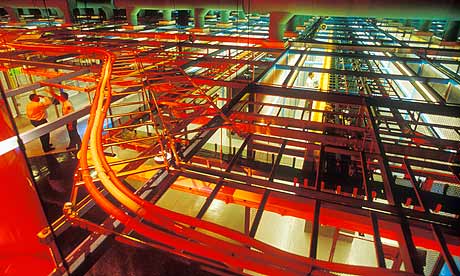
    <figcaption>Experts warn than the internet's capacity is running low. Photograph: Bob Sacha/Corbis Facebook, Google and Yahoo are switching their websites to new internet addresses in a 24-hour bid to raise awareness of the critical shortage of capacity.
    The three internet giants, which together attract more than 1bn visits a day, will transfer their sites to the next generation of internet addresses on 8 June, as experts warn than online capacity is running dangerously low.
    Vint Cerf, a vice-president at Google and the man dubbed "the godfather of the net", said the transition to new address space is "one of the most important steps to protect the internet as we know it".
    Most of the net in Europe is based on internet protocol (IP) addresses standardised in 1996, known as IPv4. But experts warn that this space could be exhausted in a matter of months, meaning that the internet will simply stop expanding. The next generation of internet addresses, IPv6, has 4bn times more space than the current network.
    Jonathan Heiliger, vice-president of technical operations at Facebook, said the 24-hour test in June was a "crucial step" in ensuring the internet remains on a level playing field for communication. Internet users whose service providers are not IPv6 compatible might not be able to reach sites that have switched from IPv4, and vice versa.
    "In the short history of the internet, the transition to IPv6 is one of the most important steps we will take together to protect the internet as we know it," Cerf said yesterday. "It's as if the internet was originally designed with a limited number of telephone numbers, and we're soon going to run out."
    In November, Cerf warned that the issue was a "serious boundary" to the growth of the medium and that it represents one of the "biggest set of changes in the history of the internet".
    Content delivery networks Akamai – which delivers a quarter of all internet traffic – and Limelight Networks will join Facebook, Google and Yahoo in the 24-hour trial. Both YouTube and the international Google homepage, Google.com, will transition to IPv6 for the test period.
    The technology giant has provided an IPv6 version of its search site since early 2008; Facebook has done so since mid-2009.
    Leslie Daigle, the chief technology officer of the Internet Society, said 2011 is a "pivotal" year in the roll-out of IPv6 and that the trial was an "important milestone".
    </figcaption></figure>
  • <figure><figcaption> </figcaption> </figure>

http://www.theinquirer.net/inquirer/news/1936808/sites-ipv6-enabled

Top sites become IPv6 enabled

At least for a day
By Nick Farrell
Thu Jan 13 2011, 09:16


TOP TRAFFIC WEBSITES Google and Yahoo are joining the major content delivery networks Akamai and Limelight Networks, and the Internet Society, to enable IPv6 on their main services for a 24-hour test flight on June 8, 2011.
IPv4 addresses are running out this year and many in the industry have realised they must move to full IPv6 adoption, or risk increased costs and slower speeds online for Internet users everywhere.
According to the Internet Society, the companies are coming together to help motivate organizations across the industry to "prepare their services for the transition" which is often a metaphor used in hospices for the terminally ill.
Leslie Daigle, the Internet Society's Chief Internet Technology officer said that the IPv6 Test Flight will enable enabling IPv6 for a 24-hour period to help industry players to work together to support the new protocol on an accelerated timeline.
"With major web companies committing to enable IPv6 on their main websites, there are strong incentives for other industry players to ensure their systems are prepared for the transition," Daigle said.
The Society thinks that 2011 is a pivotal year in IPv6 deployment and this global IPv6 trial will prove to be an important milestone.
"By providing an opportunity for the Internet industry to collaborate to test IPv6 readiness we expect to lay the groundwork for large-scale IPv6 adoption and help make it ready for prime time. The greater the scope of the test flight, the more effective it will be for all participants so we wholeheartedly welcome additional participants," Daigle said.
Rolling out the new protocol has been a major priority for Vint Cerf, co-inventor of the TCP/IP protocol stack and Google's Chief Internet Evangelist.
Cerf said that in the short history of the Internet, the transition to IPv6 is one of the most important steps the industry will take to protect the Internet as we know it.
"It's as if the Internet was originally designed with a limited number of telephone numbers, and we're soon going to run out," Cerf said.
Google has offered a separate IPv6-only version of search on ipv6.google.com since early 2008, and during the IPv6 Test Flight the company will enable IPv6 for its main websites, including www.google.com and www.youtube.com.
Adam Bechtel, VP of Yahoo's Infrastructure Group said, "participating in the IPv6 Test Flight will allow us to obtain real-life data that we can use to ensure a seamless user experience as we transition to Ipv6." After all the last thing anyone wants is a user experience with seams.
The 2nd issue come to ISPs & makers of routers.

ISPs have to be capable of issuing IPV6 addresses to their customers, and be able to route them error free, this is a big challenge, involving many nasty surprises, and there could be a long transition period before they can get things solved. To tell you the truth, I trust IDA & local ISPs to fuck up like hell in this pitfall. I suspect in the transition time the users may need to be issued with BOTH IPV4 & IPV6 addresses, as the big boys on the web begin to test IPV6. Consumers are going to be frustrated by Frequent DISCONNECTIONS & unreliable services leading to heavy economic losses.

The consumers' laptop & PCs capable of IPV6 DOES NOT SOLVE the problems, because they are behind NAT routers, and their routers firmware is the crucial point for consumers. Your home / office LAN can run either IPV4 or IPV6 or may be mixed, but that is only your LAN and concerned only when you access your file servers or print servers etc, it is something that IT men can fix within the LAN. It is your router's NAT that have to translate your LAN's (IPV4 & IPV6) addresses to public (IPV4 & IPV6) address and connect to (IPV4 & IPV6) web servers and mail servers outside, that is where the big global orchestra will begin. You can expect a huge mix and addresses get translated back & forth between IPV4 & IPV6, and even a simple PING will get extra and unnecessary complications.

Security (black-list white-list anti-virus anti-spy firewall cache proxy etc) will even add huge amount of unnecessary complications. This trouble is much more real than Y2K issue.
 
Last edited:
some of the govt backed organisation are using the whole frigging valid IP class B and C subnets for their own internal networks.
 
some of the govt backed organisation are using the whole frigging valid IP class B and C subnets for their own internal networks.


Hackers love to whack these addresses ;)

It is too late to talk about conserving IPV4 address spaces now or curse who squandered them. If we don't get IPV6 working properly ASAP we are fucked.:(:eek:
 
Back
Top