

- Joined
- Jul 20, 2009
- Messages
- 6,206
- Points
- 113
Economic growth stirred by awakening
Economic growth in Myanmar is expected to jump sharply thanks to higher investment following the political and economic developments in the country over the past several months, says Asian Development Bank.
Craig Steffensen, ADB country director for Thailand, said both the success of the National League for Democracy in Myanmar's by-election and the announcement that the official exchange rate would utilise a managed float system starting on April 1 would serve as catalysts for economic development.
The Thai economy stands to gain from tremendous opportunities in investment and transportation linkage.
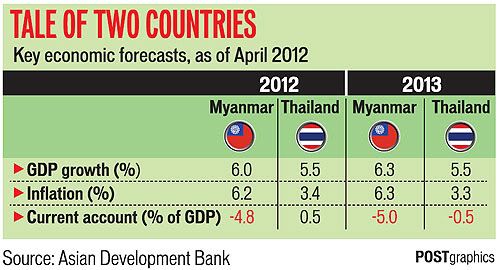
The ADB, in its latest forecasts for regional economic growth, said Myanmar is expected to post 6% growth this year and 6.3% in 2013. The bank projects 5.5% growth for Thailand this year and next.
Mr Steffensen said growth could be higher if the EU and US ease sanctions imposed during the past two decades.
Myanmar has amended some key laws to facilitate foreign direct investment. Among them are a land ownership law that allows farmers to own land and places it with banks as collateral, and a foreign direct investment code that offers corporate income tax breaks for firms.
But Mr Steffensen said problems with macroeconomic stability were reflected by high inflation and a current account deficit, immediate challenges that Myanmar must still overcome.
Myanmar announced the reference rate of the kyat was 818 to a dollar on April 1, weakening from the unofficial market rate of about 800 to a dollar in 2011.
The ADB expects the move will cause imports to widen the current account deficit to 5% of gross domestic product this year and next. Unifying the several unofficial currency markets will also expose losses in state enterprises.
Rapid economic growth could raise inflation in Myanmar to 6% over the next two years.
Mr Steffensen said over the long term, more comprehensive improvements are needed in Myanmar to lift its overall development status, particularly investment in health care and education.
Myanmar has the lowest income per capita in Asean, with ADB estimating one-fourth of its population is in poverty.
Meanwhile, in Thailand income inequality has shown signs of improvement, said ADB economist Luxmon Attapich.
But she cautioned that the gap between Thailand's richest and poorest remains wider than in many other countries in the region.
"We found the country's wealthiest 10% earned 40% of the country's income, while the poorest 10% earned just 1.7%," she said.
Thailand's Gini coefficient, a measure of income inequality, fell to 0.42 in 2010 from 0.48 in 2009. In contrast, the average for the region rose to 0.46 in 2010 from 0.39 the prior year. Under the gauge, a coefficient of zero means perfect equality while one means maximum inequality.
Economic growth in Myanmar is expected to jump sharply thanks to higher investment following the political and economic developments in the country over the past several months, says Asian Development Bank.
Craig Steffensen, ADB country director for Thailand, said both the success of the National League for Democracy in Myanmar's by-election and the announcement that the official exchange rate would utilise a managed float system starting on April 1 would serve as catalysts for economic development.
The Thai economy stands to gain from tremendous opportunities in investment and transportation linkage.
The ADB, in its latest forecasts for regional economic growth, said Myanmar is expected to post 6% growth this year and 6.3% in 2013. The bank projects 5.5% growth for Thailand this year and next.
Mr Steffensen said growth could be higher if the EU and US ease sanctions imposed during the past two decades.
Myanmar has amended some key laws to facilitate foreign direct investment. Among them are a land ownership law that allows farmers to own land and places it with banks as collateral, and a foreign direct investment code that offers corporate income tax breaks for firms.
But Mr Steffensen said problems with macroeconomic stability were reflected by high inflation and a current account deficit, immediate challenges that Myanmar must still overcome.
Myanmar announced the reference rate of the kyat was 818 to a dollar on April 1, weakening from the unofficial market rate of about 800 to a dollar in 2011.
The ADB expects the move will cause imports to widen the current account deficit to 5% of gross domestic product this year and next. Unifying the several unofficial currency markets will also expose losses in state enterprises.
Rapid economic growth could raise inflation in Myanmar to 6% over the next two years.
Mr Steffensen said over the long term, more comprehensive improvements are needed in Myanmar to lift its overall development status, particularly investment in health care and education.
Myanmar has the lowest income per capita in Asean, with ADB estimating one-fourth of its population is in poverty.
Meanwhile, in Thailand income inequality has shown signs of improvement, said ADB economist Luxmon Attapich.
But she cautioned that the gap between Thailand's richest and poorest remains wider than in many other countries in the region.
"We found the country's wealthiest 10% earned 40% of the country's income, while the poorest 10% earned just 1.7%," she said.
Thailand's Gini coefficient, a measure of income inequality, fell to 0.42 in 2010 from 0.48 in 2009. In contrast, the average for the region rose to 0.46 in 2010 from 0.39 the prior year. Under the gauge, a coefficient of zero means perfect equality while one means maximum inequality.


