

- Joined
- Aug 20, 2022
- Messages
- 27,285
- Points
- 113
Burning question: Why are most CNY new notes bound for the incinerator?
Excess notes are burnt, not long after they leave the red packet
Deon Loke
Published Fri, Feb 20, 2026 · 01:05 PMwww.businesstimes.com.sg
[SINGAPORE] For many Singaporeans, the Chinese New Year (CNY) begins with the crisp snap of a brand-new S$2 or S$10 note.
But behind this cherished tradition lies a sobering environmental reality: Excess new notes are destined for the incinerator, not long after they leave the red packet.
Why new notes are incinerated
According to a Monetary Authority of Singapore (MAS) spokesperson, about 80 million to 90 million new notes have been issued for festive gifting annually over the last three years.Once these notes are deposited back with MAS, they are processed and, where possible, reissued to replace worn-out currency.
However, most of them are deposited back into banks almost immediately, creating a mountain of excess cash that the economy does not need for daily circulation.
“If the volume of new notes issued remains high, the excess notes returned to MAS will remain elevated,” the spokesperson noted. “These excess notes will then need to be incinerated before the end of their useful life, resulting in unnecessary wastage.”
Navigate Asia in
Get the insights delivered to your inbox.MAS said that the carbon emissions from annually producing new notes are equivalent to those from powering 1,600 four-room Housing & Development Board flats for a year, where the electricity bill would amount to about S$2 million.
Currency operations remain one of the central bank’s top contributors to emissions.
It did not respond to questions raised by The Business Times on alternative disposal methods.
SEE ALSO
MAS does not currently track “once-used” new notes separately from general circulation notes once they are returned, making it impossible to say exactly how many crisp bills were burned in the previous years.
It also declined to provide specific figures on the total volume of notes incinerated in previous years.
“The number of new notes issued for festive gifting is adjusted as the take-up of fit notes increases,” said MAS.
The rise of the fit note
MAS has been pivoting the public towards fit notes, which are used currency notes that are clean and of high quality but may have minor fold lines.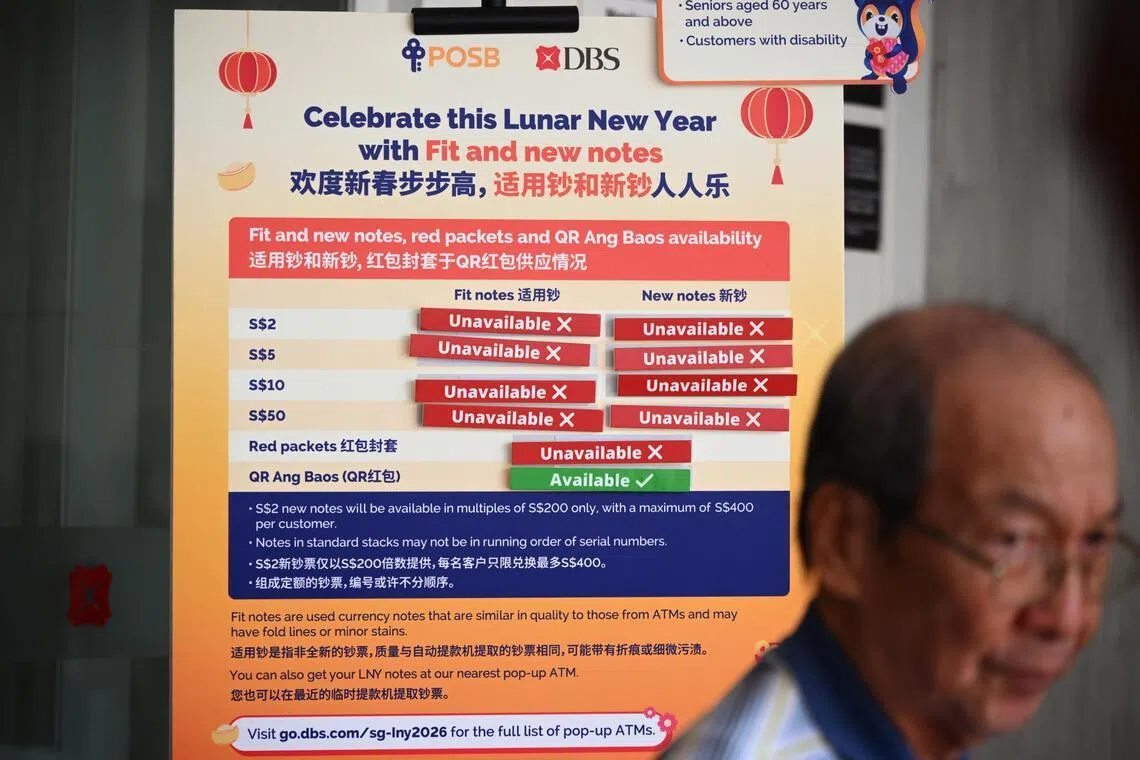
During CNY 2024, 11.7 million fit notes were exchanged. This translated to emissions savings of around 408 tonnes of carbon dioxide equivalent, from not issuing an equivalent amount of new notes to meet festive demand during CNY, stated MAS.
In 2025, 16.2 million pieces of fit notes were exchanged, representing an increase of about 38 per cent compared with CNY 2024.
As part of the fit-notes campaign, MAS has discontinued its previous issuance of “good-as-new” S$2 notes since CNY 2023, which required an additional round of machine processing, generating more carbon emissions.
“Good-as-new” notes were derived from new currency that had been issued for a single festive season and subsequently returned to MAS. These notes underwent a dual-processing cycle to harvest only those of suitable quality for reissuance.
In contrast, fit notes are standard circulating currency that has been deposited and processed through banknote machines for immediate re-circulation, a streamlined approach that generates lower carbon emissions.
Despite the success of the fit-notes campaign, the “new note” tradition remains tough to change.
A sustainability report from 2021/2022 said that MAS intends to “pave the way for a sustainable future, where MAS will no longer issue new notes for festive giving”. The central bank declined to provide a further update or prospective timeline.


