
- Joined
- Aug 20, 2022
- Messages
- 28,789
- Points
- 113
China's birth rate hits record low as population continues to shrink
www.bbc.com
16 hours ago
Kelly Ng
 GOH Chai Hin / AFP via Getty Images
China's birth rates sunk to a record low in 2025, despite the government rolling out a spate of incentives to boost it, as the country's population fell for the fourth straight year.
Government data on Monday showed that the country's birth rate fell to 5.63 per 1,000 people – a record low since the Communist Party took power in 1949 – while its death rate rose to 8.04 per 1,000 people, the highest since 1968.
Its population fell 3.39 million to reach 1.4 billion by the end of 2025, marking a quicker decline than the previous year.
Faced with an ageing population and sluggish economy, Beijing has been trying hard to encourage more young people to marry and have children.
In 2016, it scrapped its longstanding one-child policy and replaced it with a two-child limit. When that did not lead to a sustained upsurge in births, authorities announced that they would allow up to three children per couple in 2021.
More recently, China has offered parents 3,600 yuan (£375; $500) per each of their children under the age of three. Certain provinces are also dishing out their own baby bonuses, including additional payouts and extended maternity leave.
Some of these incentives have stirred controversy. For instance, a new 13% tax on contraceptives - including condoms, birth control pills and devices - has sparked concern about unwanted pregnancies and HIV rates.
China has one of the lowest fertility rates in the world, at around one birth per woman, below the replacement rate of 2.1. Other economies in the region, such as South Korea, Singapore and Taiwan, have similarly low fertility rates.
China is also one of the most expensive countries in which to raise a child, according to a 2024 report by the YuWa Population Research Institute in Beijing.
But some Chinese people have told the BBC they are hindered by other factors - including the desire for a carefree life without constantly worrying about their children.
"I have very few peers who have children, and if they do, they're obsessed about getting the best nanny or enrolling the kids in the best schools. It sounds exhausting," a Beijing resident told the BBC in 2021.
Experts at the United Nations believe China's population will continue on a downward trajectory, estimating that the nation will lose more than half of its current population by 2100.
A shrinking population has economic and social implications for the world's second-largest economy: exacerbating an already declining workforce and weak consumer sentiment.
With many young people moving away from their parents, there is also a growing number of seniors who are being left to look after themselves or rely on government payments.
But the pension pot is running dry, according to the state-run Chinese Academy of Social Sciences - and the country is running out of time to build enough funds to care for its growing elderly population.
 Getty Images
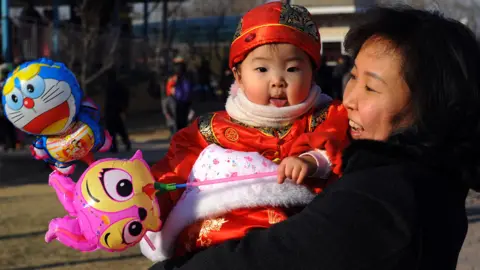
Faced with an ageing population and sluggish economy, Beijing has been trying hard to boost birth rates
www.bbc.com
16 hours ago
Kelly Ng
China's birth rates sunk to a record low in 2025, despite the government rolling out a spate of incentives to boost it, as the country's population fell for the fourth straight year.
Government data on Monday showed that the country's birth rate fell to 5.63 per 1,000 people – a record low since the Communist Party took power in 1949 – while its death rate rose to 8.04 per 1,000 people, the highest since 1968.
Its population fell 3.39 million to reach 1.4 billion by the end of 2025, marking a quicker decline than the previous year.
Faced with an ageing population and sluggish economy, Beijing has been trying hard to encourage more young people to marry and have children.
In 2016, it scrapped its longstanding one-child policy and replaced it with a two-child limit. When that did not lead to a sustained upsurge in births, authorities announced that they would allow up to three children per couple in 2021.
More recently, China has offered parents 3,600 yuan (£375; $500) per each of their children under the age of three. Certain provinces are also dishing out their own baby bonuses, including additional payouts and extended maternity leave.
Some of these incentives have stirred controversy. For instance, a new 13% tax on contraceptives - including condoms, birth control pills and devices - has sparked concern about unwanted pregnancies and HIV rates.
China has one of the lowest fertility rates in the world, at around one birth per woman, below the replacement rate of 2.1. Other economies in the region, such as South Korea, Singapore and Taiwan, have similarly low fertility rates.
China is also one of the most expensive countries in which to raise a child, according to a 2024 report by the YuWa Population Research Institute in Beijing.
But some Chinese people have told the BBC they are hindered by other factors - including the desire for a carefree life without constantly worrying about their children.
"I have very few peers who have children, and if they do, they're obsessed about getting the best nanny or enrolling the kids in the best schools. It sounds exhausting," a Beijing resident told the BBC in 2021.
Experts at the United Nations believe China's population will continue on a downward trajectory, estimating that the nation will lose more than half of its current population by 2100.
A shrinking population has economic and social implications for the world's second-largest economy: exacerbating an already declining workforce and weak consumer sentiment.
With many young people moving away from their parents, there is also a growing number of seniors who are being left to look after themselves or rely on government payments.
But the pension pot is running dry, according to the state-run Chinese Academy of Social Sciences - and the country is running out of time to build enough funds to care for its growing elderly population.
Faced with an ageing population and sluggish economy, Beijing has been trying hard to boost birth rates


