Singapore will not negotiate for safe passage through Strait of Hormuz: Vivian Balakrishnan
Foreign Affairs Minister Vivian Balakrishnan stressed that transit through such waterways is a right, not a privilege.
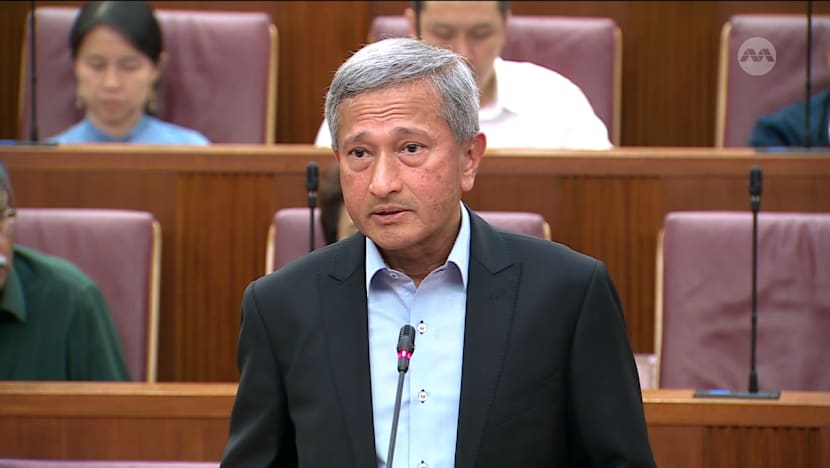
Foreign Affairs Minister Vivian Balakrishnan speaking in parliament on Apr 7, 2026.
07 Apr 2026 06:31PM (Updated: 07 Apr 2026 07:19PM)
Read a summary of this article on FAST.
FAST
SINGAPORE: Singapore will not negotiate for safe passage through the Strait of Hormuz, as doing so would undermine fundamental principles of international law, said Foreign Affairs Minister Vivian Balakrishnan on Tuesday (Apr 7).
Responding to a parliamentary question by Member of Parliament Fadli Fawzi (WP-Aljunied) on whether Singapore would engage Iran or consider paying a toll for its vessels, Dr Balakrishnan stressed that transit through such waterways is a right - not a privilege.
“There is a right of transit passage,” he said. “It is not a privilege to be granted by the bordering state, it’s not a licence to be supplicated for, it is not a toll to be paid.”
He emphasised that the Strait of Hormuz, like the Strait of Malacca and the Strait of Singapore, is a waterway used for international navigation. This right is codified in the United Nations Convention on the Law of the Sea (UNCLOS), to which Singapore is a signatory.
Dr Balakrishnan added that the principle applies even to states that have not ratified UNCLOS, stating that it is not a "get-out-of-jail-free card" for them.
Iran said previously that it has allowed several countries' ships to cross the Strait of Hormuz since its forces effectively slowed traffic through the narrow sea lane to a trickle during the war, which began in late February.
The list comprises largely Asian states, and includes China, India, Pakistan, Japan, Thailand and Malaysia.
Dr Balakrishnan characterised Singapore’s approach as being grounded in principle rather than geopolitics.
“You may be wondering why I'm taking such a legal and strict definition, and it's not because I'm particularly obsessed with law, but because the Straits of Malacca, the Straits of Singapore is, in fact, another critical choke point,” he said.
He pointed out that more maritime oil - crude and refined - flows through the Straits of Malacca and Singapore than even the Strait of Hormuz. In terms of global container trade, more flows through the region than the Strait of Hormuz, he said.
While the narrowest point in the Strait of Hormuz is 21 nautical miles, the narrowest point in the Strait of Singapore is less than two nautical miles, he added.
“Do you understand now why we have to take a categorical position that international law and UNCLOS is the constitution of the oceans?” he said.
“Freedom of navigation is a right, and not a privilege for ships and planes, and this is of profound importance to Singapore.”
He revealed that he had engaged Iran’s foreign minister prior to the current conflict and expects to do so again, but drew a clear line on negotiations over passage.
“As a matter of principle, and not because we are taking sides, I cannot engage in negotiations for safe passage of ships or negotiate on toll rates, because to do so would be implicitly eroding this legal principle,” he said.
“This is another example of Singapore upholding principle, not taking sides,” he added.
Providing an update, he said that the government has been closely monitoring the situation in the Strait of Hormuz, adding that the Maritime and Port Authority remains in close contact with shipowners and operators of Singapore-flagged vessels in the region.
Agencies are also engaging stakeholders at both international and regional levels to facilitate safe transit.
Efforts include discussions with the International Maritime Organisation (IMO) and member states on the possible establishment of a safe maritime corridor, following a recent extraordinary session of the IMO council.
Singapore is also working with regional counterparts to explore additional arrangements.
Dr Balakrishnan highlighted the humanitarian dimension, pointing to the welfare of maritime workers aboard vessels.
At the same time, he warned of a more volatile global environment and its consequences.
“The world has become more violent and more volatile, and there is a price to be paid for that,” he said.
“It's not enough to be an oasis of safety, security, cohesion, wealth and even having the military ability to protect ourselves. Because if our region is aflame and with war and missiles flying, no oasis can be safe,” he said.
He called for transparency with the public about these risks, while cautioning against alarmism.